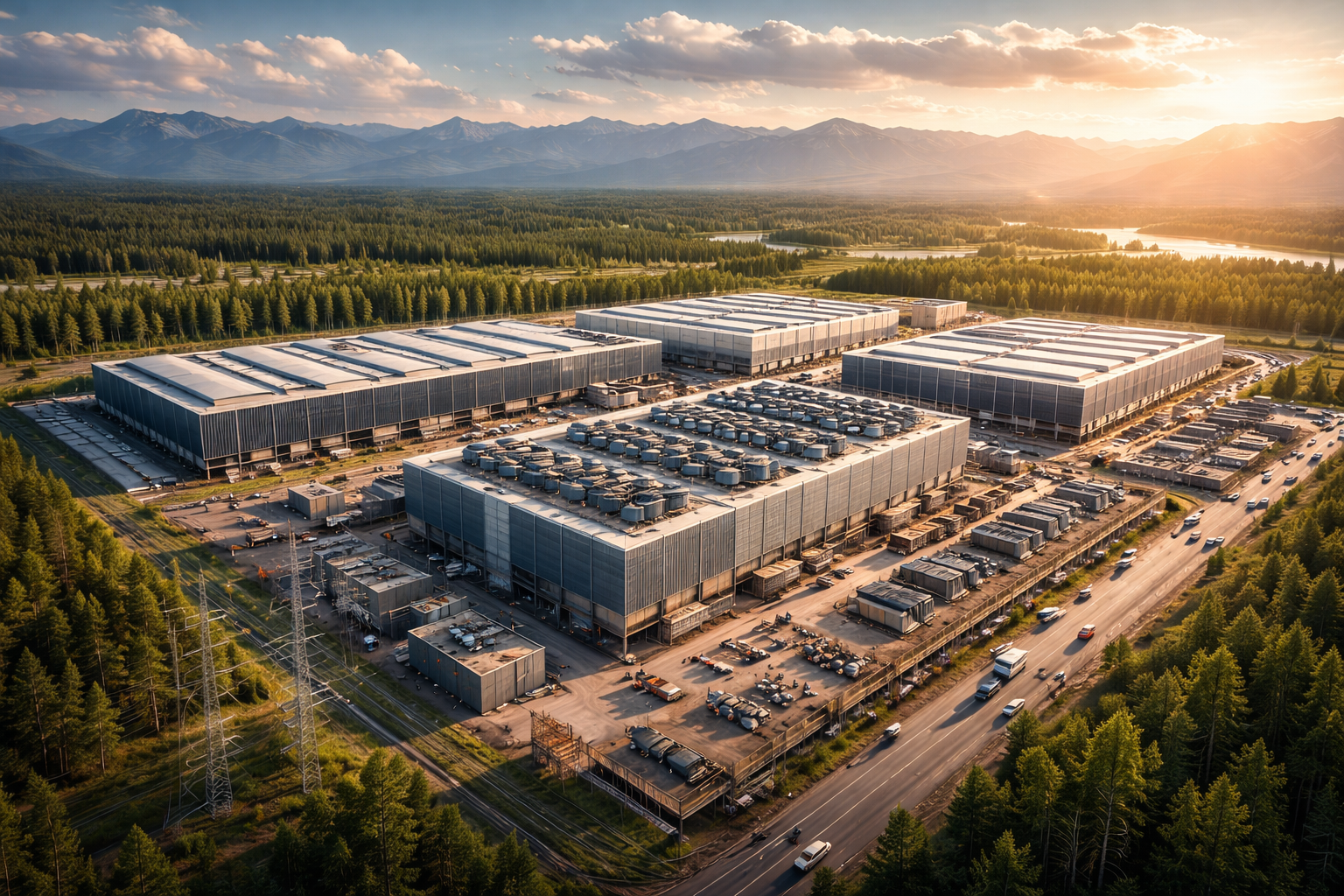
Global capital is racing to secure the digital backbone of the AI era, and a proposed $9.4 billion data center development in Alberta is rapidly becoming one of the most talked-about infrastructure stories among investors. As artificial intelligence workloads expand and cloud demand accelerates, large-scale data centers are emerging as critical assets—drawing interest not just from technology firms, but from institutional investors worldwide.
According to a Bloomberg report, European-backed developers are exploring plans for a massive €8 billion ($9.4B) data center complex in Alberta, underscoring North America’s growing role as a hub for next-generation digital infrastructure.
A Strategic Bet on North American Infrastructure
The Alberta proposal reflects a broader shift in how global investors view data centers. Once considered niche real estate, these facilities are now seen as essential infrastructure supporting AI training, cloud computing, streaming services, and enterprise software.
Bloomberg reports that the proposed project would leverage Alberta’s access to reliable energy, available land, and proximity to major North American markets. These factors are increasingly important as hyperscale data centers demand massive power capacity, stable grid access, and favorable regulatory environments.
For European investors, North America offers long-term stability, strong demand growth, and predictable legal frameworks—key considerations when committing billions in capital to long-lived infrastructure assets.
Why This Matters for Investors
The scale of this project highlights how data centers have moved to the center of capital allocation discussions. According to research from McKinsey, global data center demand is expected to grow at double-digit rates through the end of the decade, driven primarily by AI model training and cloud adoption.
AI workloads, in particular, require exponentially more computing power than traditional enterprise applications. This has created a structural demand tailwind for facilities capable of supporting high-density computing, advanced cooling systems, and energy-efficient operations.
For investors, this translates into potential opportunities across multiple asset classes—not only in direct infrastructure ownership, but also in REITs, utilities, and technology suppliers that support the data center ecosystem.
Energy, Efficiency, and the Competitive Edge
One of the most critical aspects of modern data centers is energy efficiency. Large-scale AI facilities can consume as much power as small cities, making electricity costs and sustainability key competitive differentiators.
Alberta’s energy mix and evolving investment in cleaner power sources may give it an advantage as companies seek to balance performance with environmental commitments. Bloomberg notes that developers are increasingly prioritizing regions that can offer scalable power without excessive cost volatility.
This dynamic has implications for energy providers, grid infrastructure companies, and firms specializing in cooling, power management, and efficiency technologies—all of which stand to benefit from continued data center expansion.
The Bigger Picture: Data Centers as a Core Asset Class
Institutional investors are increasingly treating data centers as a standalone asset class. Pension funds, sovereign wealth funds, and private equity firms have ramped up allocations to digital infrastructure, viewing it as a hybrid between real estate and technology growth.
Industry analysts point out that data centers often feature long-term contracts, high switching costs, and mission-critical tenants—characteristics that can provide stable cash flows even during broader market volatility.
The Alberta proposal fits squarely within this narrative, signaling that capital deployment into digital infrastructure is not slowing as 2026 begins.
Future Trends to Watch
Several trends are likely to shape investor outcomes in this space:
- AI-Driven Demand: Continued growth in generative AI and enterprise automation will push demand for high-capacity data centers.
- Infrastructure REIT Expansion: Publicly traded data center REITs may benefit as private projects validate long-term demand assumptions.
- Energy Innovation: Companies focused on power optimization, advanced cooling, and renewable integration could see rising demand.
- Geographic Diversification: Secondary markets like Alberta may gain prominence as capacity tightens in traditional tech hubs.
Investors tracking infrastructure and emerging industries should watch how quickly projects like this move from proposal to execution—a key signal of market confidence.
Key Investment Insight
The proposed $9.4B Alberta data center project reinforces a powerful investment theme: digital infrastructure is becoming as essential as roads, utilities, and telecommunications. Investors may find opportunities not only in data center operators, but across the broader ecosystem that enables AI and cloud growth—from energy providers to efficiency technology firms.
Staying Ahead of the Infrastructure Shift
As global capital continues to flow into data centers and AI-related infrastructure, developments like the Alberta proposal offer a clear view into where long-term growth is heading. Understanding these structural shifts can help investors position portfolios for the next phase of digital transformation.
Stay informed with MoneyNews.Today for daily insights on emerging industries, infrastructure investment, and the trends shaping the future of global markets.