
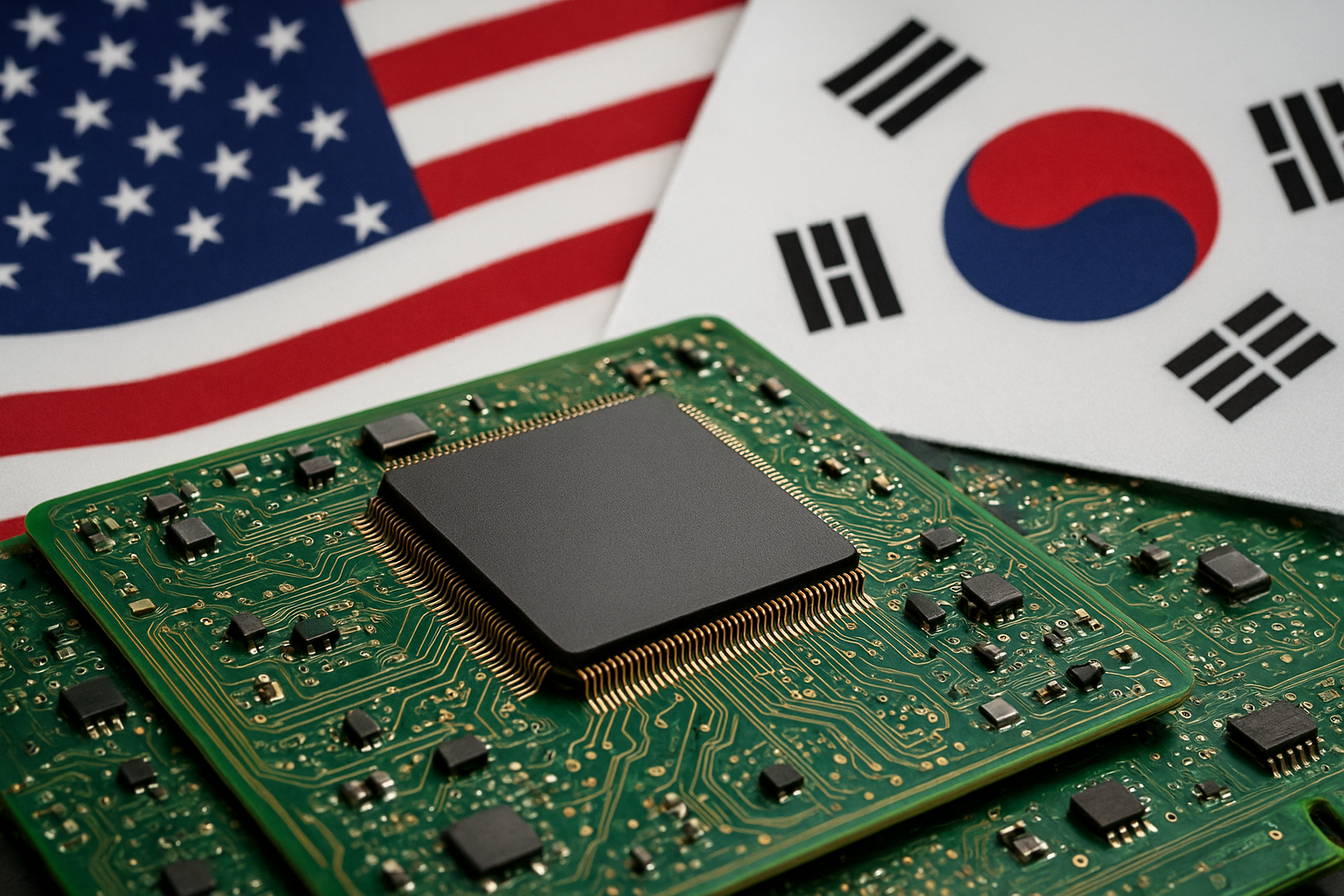
Global technology supply chains are once again in the spotlight as South Korea takes a leading role in reshaping the semiconductor and AI ecosystem. With new strategic partnerships between Korean tech giants and U.S. semiconductor firms like NVIDIA, the intersection of geopolitics, trade, and industrial strategy has rarely been clearer — or more consequential for investors.
Recent announcements show Samsung Electronics, SK Hynix, and Hyundai Motor Group entering agreements with NVIDIA to co-develop AI infrastructure and manufacturing hubs aimed at powering the next generation of data centers and smart factories. According to Korea JoongAng Daily, the deals reflect South Korea’s ambition to become a central hub for AI chip production and innovation, counterbalancing U.S.–China tensions and growing export restrictions in high-tech industries.
Strategic Shifts in the Semiconductor Arena
The global semiconductor market, valued at over $550 billion according to Statista, is undergoing a structural realignment. Washington’s export controls on advanced chips to China have pushed both U.S. and Asian allies to diversify supply chains. South Korea’s latest deals with NVIDIA position the country not just as a manufacturer but as a strategic innovation partner in the AI hardware build-out.
Samsung and SK Hynix are reportedly expanding capacity for high-bandwidth memory (HBM) chips — a key component in AI computing — while Hyundai’s involvement signals the merging of automotive and AI technology. Reuters noted that Hyundai’s move underscores how AI hardware is no longer confined to data centers but is becoming integral to autonomous and connected vehicles.
Why This Matters for Investors
Investors are navigating a complex landscape where AI growth meets geopolitical risk. On one hand, NVIDIA’s partnerships affirm sustained global demand for AI infrastructure. On the other, export restrictions, supply-chain dependencies, and industrial policy shifts introduce volatility.
For semiconductor investors, the upside remains tied to companies with deep R&D pipelines and diversified manufacturing bases. Korean chipmakers benefit from government-backed incentives and proximity to critical suppliers, making them attractive long-term plays — though sensitivity to trade restrictions remains a concern.
Meanwhile, U.S. tech leaders like NVIDIA and AMD continue to expand their global partnerships to secure production continuity. This strategy not only mitigates the risks of overdependence on China but also strengthens ties with allied economies that can meet advanced chip fabrication needs.
Future Trends to Watch
- AI Infrastructure Expansion: Expect increased capital expenditure on AI data centers, benefiting semiconductor, cooling, and power management firms.
- Automotive-AI Convergence: The integration of AI chips into EVs and autonomous driving systems could redefine industrial alliances.
- Geopolitical Balancing: Investors should monitor how U.S. export policies evolve post-2025 elections and how Asian economies navigate compliance.
- Supply Chain Localization: Korean and Taiwanese semiconductor ecosystems are likely to see continued capital inflows as companies hedge geopolitical risk.
According to McKinsey & Company, the semiconductor industry could surpass $1 trillion in value by 2030, driven largely by AI, cloud computing, and edge-device proliferation. Korea’s active role in shaping this growth trajectory highlights a broader shift from U.S.-China dependency toward a more distributed innovation model.
Key Investment Insight
Investors should focus on firms positioned along the AI hardware and infrastructure value chain, including chip designers, component suppliers, and data-center builders. Companies like Samsung Electronics, SK Hynix, and NVIDIA may offer long-term upside given their exposure to AI-driven demand — provided they maintain flexibility amid shifting export regimes.
Portfolio strategies may include:
- Selective Exposure: Favor hardware and semiconductor firms with balanced global supply chains.
- Risk Mitigation: Consider hedging exposure to export-reliant firms vulnerable to policy shocks.
- Thematic Plays: Explore ETFs tracking AI infrastructure and semiconductor innovation to capture broad sector growth.
South Korea’s expanding role in AI and chip manufacturing signals that the next phase of tech innovation will be defined not only by performance metrics but also by policy agility and supply-chain sovereignty.
Stay tuned with MoneyNews.Today for daily, investor-focused insights into how global tech and policy developments shape tomorrow’s markets.




