
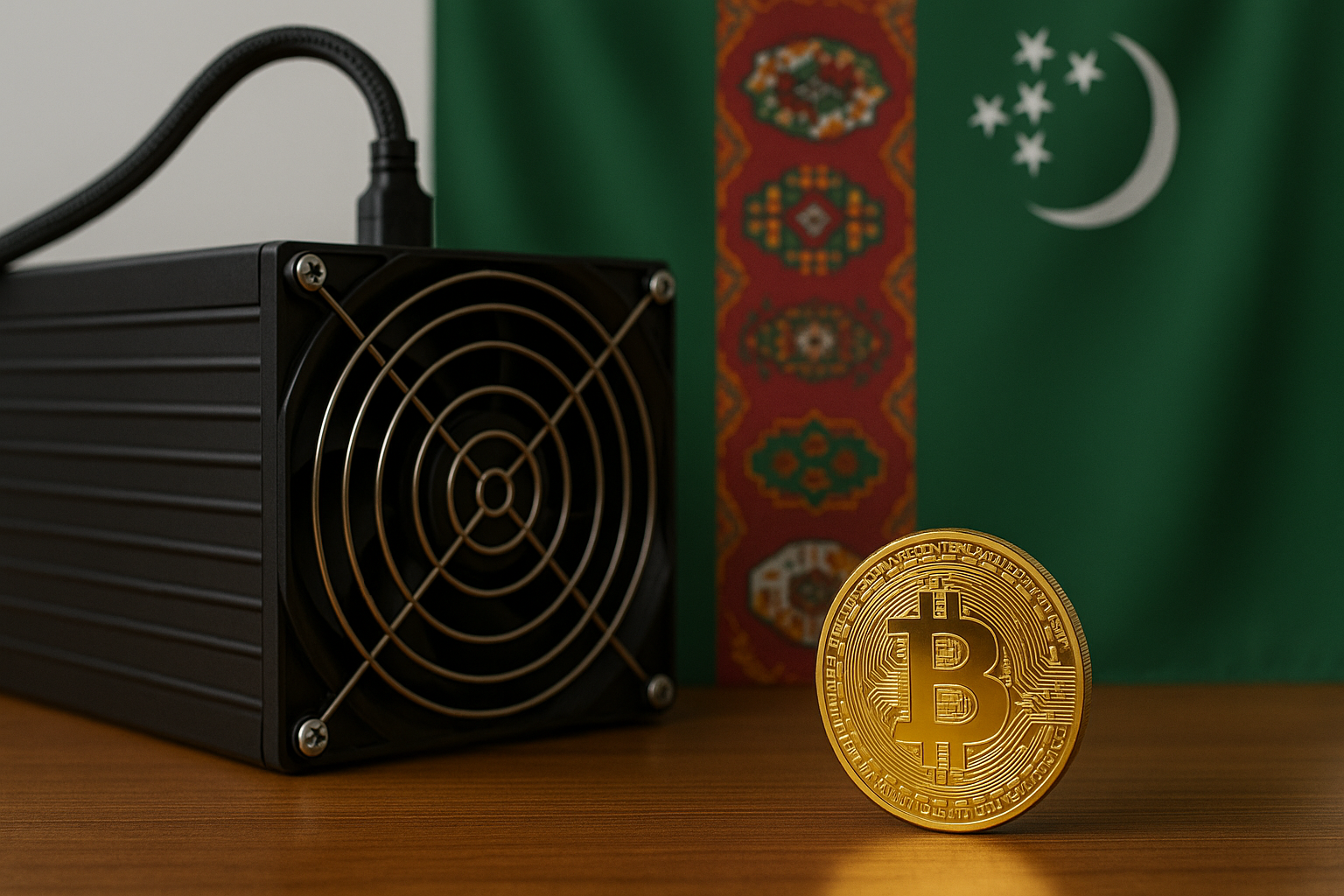
Crypto markets just received an unexpected catalyst from Central Asia. Turkmenistan — one of the world’s most closed-off and energy-rich nations — has passed a new law officially legalizing and regulating cryptocurrency mining and exchanges starting January 1, according to a Reuters report. The move instantly places Turkmenistan among a growing list of nations embracing digital assets, while potentially opening a fresh frontier for crypto-related infrastructure investment.
At a moment when global mining firms continue to grapple with electricity constraints, tightening regulations, and rising competition, Turkmenistan’s sudden policy shift introduces an entirely new jurisdiction with abundant natural resources and a state-driven push for modernization. For investors reallocating capital ahead of 2025’s crypto cycle, this development is worth more than a passing headline.
A Surprise Turn From a Historically Closed Nation
Turkmenistan has long been known for its restricted political system, limited foreign investment access, and tight control over information. That is precisely why this step is so significant. The government’s new law introduces a formal licensing regime for mining companies and crypto exchanges, providing them with regulatory clarity and legal recognition for the first time.
Reuters notes that the legislation outlines operational requirements for miners, including facility registration, energy agreements, and compliance with national oversight bodies. For exchanges, the framework may resemble other emerging-market models where operations are permitted but tightly supervised.
The timing is notable. As Kazakhstan, Russia, and Uzbekistan — Turkmenistan’s neighbors — have become major hubs for Bitcoin mining due to surplus energy and colder climates, Turkmenistan’s entry suggests regional competition in digital-asset infrastructure is heating up.
Why This Matters for Investors
1. Fresh Mining Capacity Could Relieve Global Pressure
Since China’s 2021 mining ban, global Bitcoin mining capacity has migrated to the U.S., Central Asia, and parts of the Middle East. But rising electricity costs and regulatory tightening — particularly in the United States — have constrained expansion. Turkmenistan, with its vast natural gas reserves and state-backed energy ecosystem, could provide much-needed new supply of cheap electricity.
This could reduce global hashrate bottlenecks and potentially stabilize mining economics heading into the next halving cycle.
2. Mining Equipment and Infrastructure Firms Stand to Gain
Legal clarity in a new region often leads to a surge in demand for:
- ASIC miners (from companies like Bitmain, MicroBT, and Canaan),
- Cooling and electrical systems,
- Data-center construction,
- Power distribution infrastructure.
McKinsey’s recent analysis on digital infrastructure noted that emerging markets with strong energy capacity could become the next hotspots for mining clusters — a trend Turkmenistan now supports.
3. Regional Competition Is Accelerating
Countries in Central Asia are racing to secure foreign investment in tech and energy. Kazakhstan recently introduced stricter rules but remains a major mining hub. Uzbekistan has courted miners with a tiered electricity-pricing system. Now Turkmenistan, with its authoritarian efficiency and energy surplus, appears ready to compete for crypto-related capital at scale.
If the regulatory regime proves stable, mining firms may view Turkmenistan as a strategic diversification opportunity.
4. Early-Stage Markets Can Bring Early-Stage Risks
While the opportunity is real, investors should be aware of potential risks:
- Governance opacity
- State-controlled currency systems
- Limited financial transparency
- Geopolitical unpredictability
As seen in other emerging markets, mining firms may face sudden regulatory reversals or unexpected compliance demands. Investors should track how Turkmenistan implements the law over the coming months before assuming long-term stability.
Future Trends to Watch
Energy Contracts and State Partnerships
Mining firms may be required to partner with state-owned energy enterprises. The reliability, cost structure, and transparency of these agreements will determine the sector’s viability in the country.
International Capital Reaction
If large regional miners — particularly those with operations in Kazakhstan or the U.S. — signal interest in Turkmenistan, it may validate the market’s potential. Watch for announcements from listed mining companies or major hardware suppliers.
Regulatory Alignment With Global Standards
Whether Turkmenistan’s rules align with FATF recommendations, anti-money-laundering standards, and reporting metrics will determine if foreign exchanges or institutional investors engage with the market.
Impact on Global Hashrate Distribution
A measurable rise in Turkmenistan’s share of the Bitcoin hashrate could influence global mining economics and potentially reduce geographic concentration risk.
Key Investment Insight
Turkmenistan’s crypto legalization marks the opening of a new frontier for mining expansion — one that could ease global capacity constraints and introduce fresh investment flows into mining equipment, infrastructure suppliers, and energy-linked operators. Investors seeking exposure to early-stage crypto infrastructure growth may consider monitoring publicly traded mining firms, hardware manufacturers, and energy-service providers that could benefit from new regional demand.
Stay Ahead With MoneyNews.Today
As global crypto adoption evolves one jurisdiction at a time, policy shifts like Turkmenistan’s can reshape the landscape overnight. For ongoing insights into digital-asset regulation, mining economics, and cross-border investment trends, continue following MoneyNews.Today — your trusted source for market-driven intelligence.




