The accelerating shift toward artificial intelligence is no longer just transforming software, automation, and cloud computing—it’s quietly reshaping one of the oldest investment categories in America: infrastructure. With U.S. data-center demand surging, energy grids strained by AI-driven power requirements, and the federal government pushing massive digital modernization, institutional investors are increasingly viewing AI not as a standalone sector, but as the new backbone of national infrastructure.
According to fresh insights from private equity group 3i, infrastructure investors are now “drawn to the U.S. above other markets” largely due to the strength of its AI ecosystem and the rapid integration of digital technologies into new infrastructure projects. And this shift is creating one of the most compelling long-term opportunity sets in the market today.
AI Is No Longer a “Tech Story”—It’s an Infrastructure Story
Over the past year, AI-related capital spending in the U.S. has outpaced expectations, driven by massive outlays from companies such as Microsoft, Amazon, Alphabet, and Meta, each racing to expand data-center capacity. Analysts at Goldman Sachs estimate that AI-related infrastructure investment could exceed $1 trillion globally through 2030, with the U.S. capturing the largest share.
Meanwhile, the White House’s $1.2 trillion Infrastructure Investment and Jobs Act (IIJA) continues funneling billions into broadband expansion, digital modernization, and smart-grid technologies—all areas that depend heavily on AI-powered systems for efficiency, resilience, and security.
This combination of public and private investment is creating tailwinds not just for the tech sector, but for the entire real-asset ecosystem—utilities, fiber-optic networks, construction firms, clean-energy developers, and data-center operators.
As 3i’s analysis highlights, the U.S. is now the world’s most attractive destination for infrastructure capital due to its AI acceleration, stable legal environment, and massive digital-transformation agenda.
Why Investors Are Pivoting Toward AI-Linked Infrastructure
1. Explosive Data-Center Growth
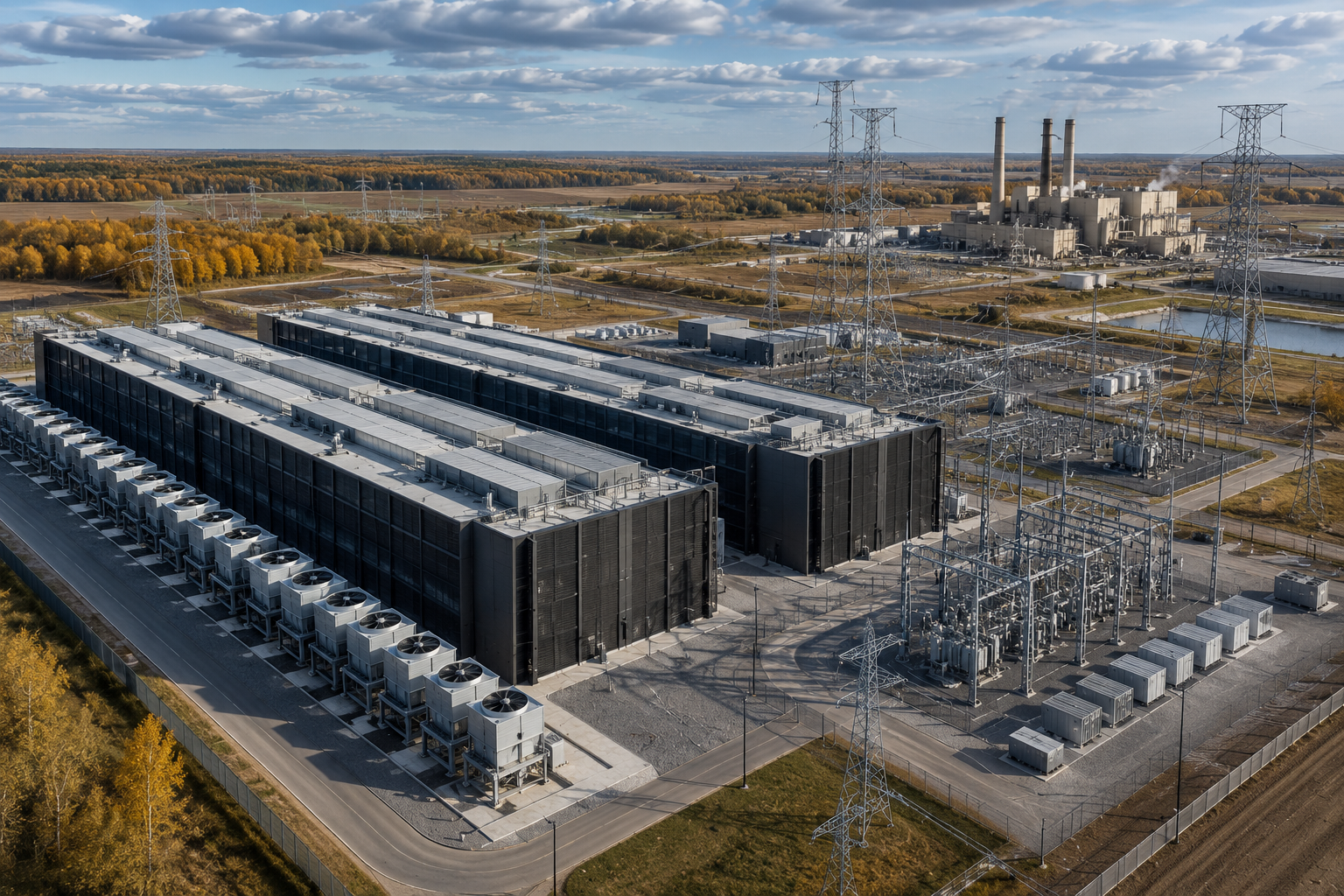
Data centers are the epicenter of AI expansion. Between GPU clusters, high-density racks, and hyperscale cloud demand, U.S. data-center power consumption is expected to double by 2030, according to McKinsey.
This alone requires:
- New transmission lines
- Grid modernization
- Massive renewable-energy generation
- Advanced cooling and efficiency systems
- Real-estate development in AI-friendly regions (Virginia, Ohio, Texas, Arizona)
Funds that traditionally focused on roads, bridges, and pipelines are now bidding aggressively on digital-infrastructure assets.
2. AI-Driven Energy Demand Is Reshaping Utilities
AI’s rapid growth is forcing utilities to rethink power distribution. States like Texas and Georgia are approving energy expansions specifically to accommodate AI workloads.
The International Energy Agency (IEA) estimates that AI and data-center electricity use could reach 4% of global demand by 2026—a number that continues to be revised upward.
That means:
- Grid operators
- Renewable-energy developers
- Storage providers
are becoming integral to the AI value chain.
3. Smart Infrastructure Needs AI at Its Core
Transportation, healthcare facilities, water systems, and manufacturing plants are increasingly adopting AI-enabled monitoring and automation. This creates new investment themes:
- AI-enhanced logistics networks
- Autonomous-vehicle infrastructure
- AI-supported hospital systems
- Predictive-analytics tools for water and waste management
These categories—once viewed as slow-moving—are attracting renewed investor interest.
Future Trends to Watch
1. The Rise of “AI-Ready Real Estate”
Real estate investment trusts (REITs) specializing in data centers, power-dense industrial spaces, and edge-computing facilities are positioned for structural tailwinds.
2. AI as a Catalyst for Utility M&A
As AI pushes energy demand higher, utilities may pursue mergers to secure grid stability and accelerate investment. Analysts at RBC have already flagged U.S. utilities as a potential outperformer in a high-demand AI environment.
3. Federal and State Incentives Will Accelerate AI Infrastructure
Expect more funding for:
- Semiconductor-manufacturing expansion
- Grid modernization
- High-performance computing research
- AI-supported public services
These incentives could reduce risk for early-stage investors.
Key Investment Insight
AI-linked infrastructure is becoming one of the most durable high-conviction investment themes of the decade. The opportunity extends far beyond Big Tech—into data-center REITs, renewable-energy developers, transmission-line builders, utilities, construction firms, digital-infrastructure providers, and even mining companies supplying the metals required for AI hardware.
Investors looking for long-term stability with high-growth upside may find that infrastructure tied to AI demand offers a rare combination: resilient cash flows, regulatory support, and exposure to one of the fastest-growing technologies in history.
For more daily insights on fast-moving AI, technology, and market trends, stay connected with MoneyNews.Today—your trusted source for sharp, actionable financial analysis.