
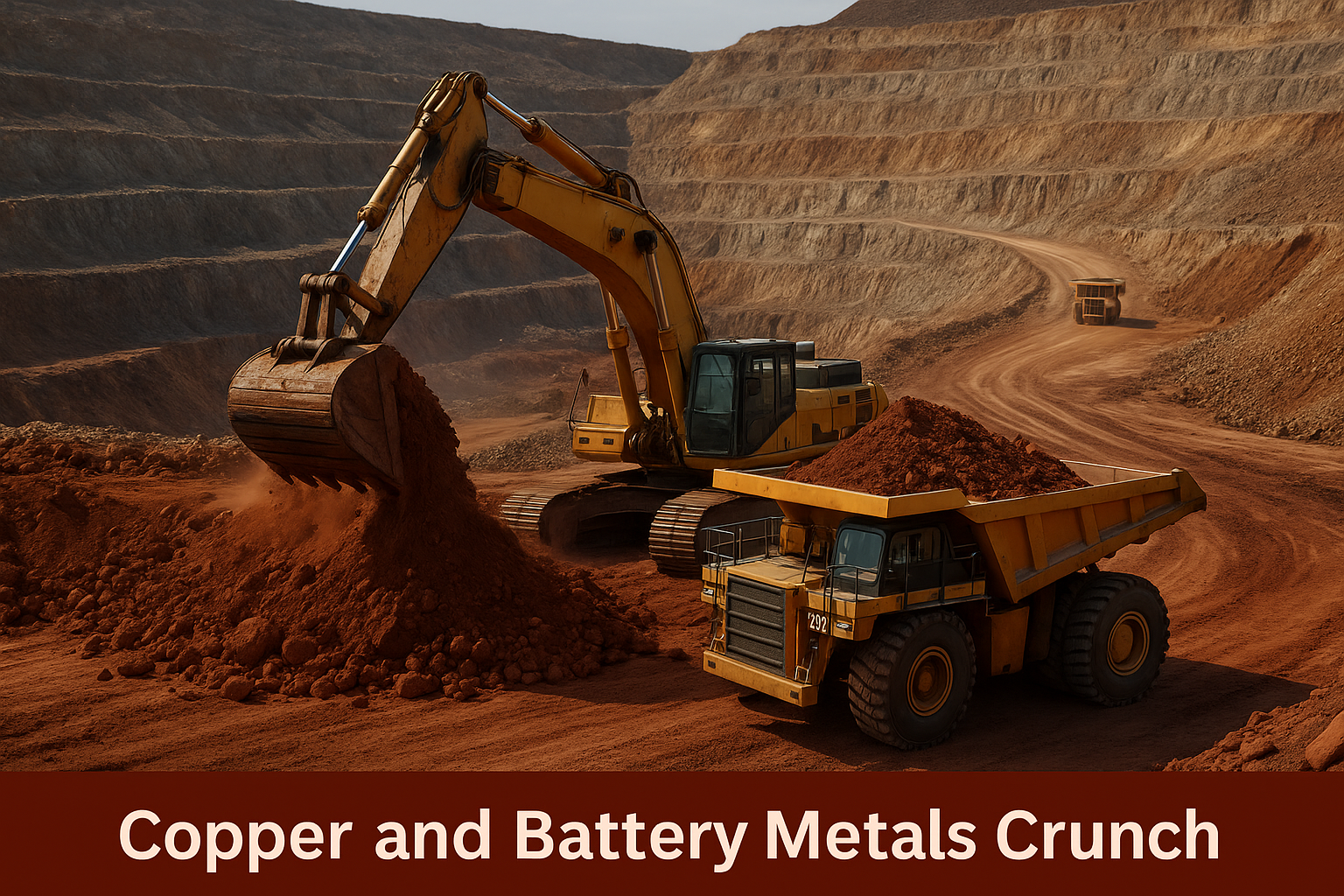
The global race for clean-energy materials is heating up, and Western miners are recalibrating strategies at a critical moment. Copper, lithium, nickel, and other battery metals — once cyclical commodities — have now become foundational inputs for AI infrastructure, EV manufacturing, grid expansion, and renewable energy. As demand surges, mining giants such as Rio Tinto are shifting capital and operational focus toward these “future-facing” minerals, according to recent reporting from Investing.com. But the problem is clear: global supply simply isn’t keeping pace.
A perfect storm of aging mines, limited new greenfield projects, and ongoing regulatory bottlenecks has created one of the tightest supply outlooks in decades. For investors, this tightening market may become one of the defining commodity stories of the 2025–2030 cycle.
A Structural Crunch in Copper and Battery Metals
Copper demand is accelerating rapidly as electrification transforms every major sector of the economy. Grid upgrades, data centers supporting AI workloads, and renewable-energy installations all require massive copper inputs. Meanwhile, lithium and nickel remain core materials for EV batteries — demand that continues to rise as automakers double down on long-term electrification targets.
Yet supply is not expanding nearly as fast. Mining analysts from Bloomberg note that the copper market could face a structural deficit through the end of the decade. McKinsey’s materials outlook estimates global copper demand could increase up to 50% by 2035, while lithium demand could nearly quadruple due to battery adoption.
Compounding the issue:
- Several of the world’s largest copper mines — especially in Chile and Peru — are producing below capacity.
- New major discoveries are rare, and permitting times in Western jurisdictions can extend for years.
- Lithium refining remains concentrated in China, even as Western countries attempt to diversify.
This supply-demand tension is pushing Western miners to rethink portfolios and accelerate shifts toward “strategic metals.”
Why Mining Majors Are Pivoting Now
Companies such as Rio Tinto, BHP, and Anglo American increasingly view critical minerals as core long-term growth engines. Rio Tinto recently emphasized future-facing metals in its own market strategy updates, echoing the sector-wide recalibration.
Analysts point to several catalysts behind this pivot:
1. AI & Data Center Energy Demand Is Exploding
AI compute infrastructure requires enormous amounts of electricity, putting pressure on utilities to scale transmission capacity. Copper is indispensable for transformers, underground lines, and grid reinforcement. Data-center clusters in the U.S. and Canada are already driving multi-year copper demand pipelines.
2. EV Manufacturing Remains a Dominant Growth Driver
Despite short-term fluctuations in EV sales, automakers continue securing long-term lithium, nickel, and graphite supply contracts. BloombergNEF forecasts EVs could represent 40% of new global car sales by 2030, requiring exponential increases in critical minerals.
3. Western Governments Are Providing a Policy Backstop
The U.S. Inflation Reduction Act and Canada’s Critical Minerals Strategy are directing billions toward domestic mining and processing. Subsidies, loan guarantees, and streamlined permitting are increasingly supporting project economics that would otherwise struggle to compete with low-cost producers in Asia.
4. Supply Security Is the New Commodity Thesis
After decades of globalization, supply chains are tightening — not expanding. Companies, utilities, and governments now place a premium on reliability, reshaping long-term contracting and investment decisions across the mining sector.
Future Trends to Watch
The Rise of Integrated Mine-to-Battery Supply Chains
Expect more partnerships between miners, automakers, and battery manufacturers as firms seek secure, long-term mineral access. These deals may include prepayments, joint ventures, or multi-year offtake agreements.
Copper Substitutes Will Become a Major Debate
With copper market deficits looming, research into aluminum substitutes, conductor innovations, and novel grid technologies may accelerate. But in the near term, copper remains irreplaceable for most use cases.
Refining Capacity Moves Westward
China’s dominance in critical-mineral refining remains overwhelming. However, Western-led projects in Canada and the U.S. are beginning to scale, offering opportunities in midstream processing — an area historically overlooked by investors.
Commodity Supercycle Narrative Could Re-Enter Markets
If supply remains tight while electrification accelerates, analysts may revive discussions about a new commodity supercycle focused not on hydrocarbons, but on clean-energy metals.
Key Investment Insight
A long-term supply-demand imbalance for copper, lithium, and battery metals is forming — and it appears structural rather than temporary. Investors may want to consider:
- Copper-focused producers with strong balance sheets and exposure to high-grade, long-life assets
- Lithium and battery-metal miners, particularly those in politically stable Western regions
- Refiners and midstream processors supported by government policies
- Diversified mining ETFs as broader hedges against inflation, supply shocks, and electrification-driven demand
As the world races to build the infrastructure of the next decade, the materials behind that transformation could deliver outsized returns for early investors aligned with the trend.
Stay with MoneyNews.Today for daily intelligence on commodities, mining, and global market drivers reshaping the investment landscape.




