
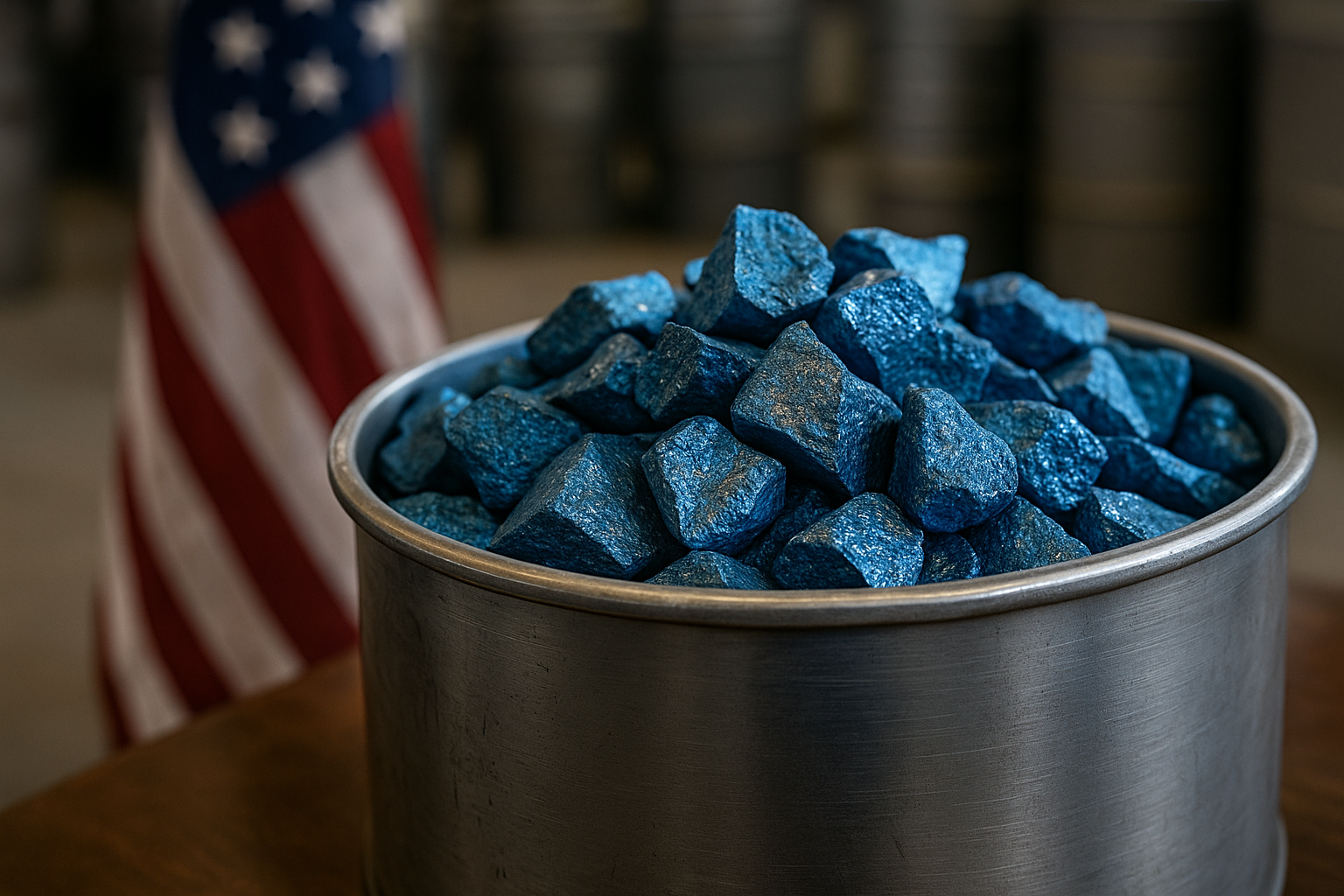
Cobalt — one of the world’s most strategically important critical minerals — is back at the center of geopolitical and supply-chain tensions. The U.S. Defense Logistics Agency (DLA) has paused its newly launched cobalt stockpiling program after prices surged nearly 50% since August 2025, according to Reuters. The abrupt intervention underscores both the fragility and the strategic importance of cobalt supply chains, which support defense systems, batteries, aerospace components, and a rapidly expanding electric-vehicle ecosystem.
For investors, the development serves as a reminder that critical minerals are no longer just a commodities story — they’re a national-security and technology story, with direct implications for industrial policy, geopolitical strategy, and long-term investment positioning.
Cobalt Market Tightens as Demand Outpaces Predictability
The DLA’s move comes at a time when global cobalt demand is accelerating across defense and commercial applications. Although cobalt prices had spent much of 2024 in a slump due to excess supply and weaker EV sales, the sudden rebound in 2025 reflects a sharp shift in fundamentals. Tighter supply forecasts from major producers in the Democratic Republic of Congo (DRC), increased strategic buying from governments, and rising demand for high-performance batteries have all contributed to the price spike.
The DLA’s halt is not due to reduced demand — rather, it is a response to volatile pricing and the risk of overpaying during a short-term rally. The agency must now reassess procurement strategy amid what looks increasingly like the early phase of another critical-minerals supercycle.
The episode also highlights the U.S. government’s challenge in securing essential materials without unintentionally exacerbating market imbalances — a tension becoming more common in critical minerals such as lithium, nickel, graphite, and rare earths.
Why This Matters for Investors
1. Strategic Minerals Are Becoming Geopolitical Catalysts
The U.S. has been accelerating efforts to reduce reliance on foreign supply chains, particularly in minerals dominated by China or mined in politically unstable regions. Cobalt sits at the intersection of these concerns: the DRC accounts for roughly 70% of global production, and China controls much of the refining process.
That means disruptions — whether from geopolitical tensions, export restrictions, or pricing spikes — can quickly ripple through defense, battery, and EV manufacturing supply chains.
For investors, this dynamic elevates the relevance of companies in:
- Cobalt mining and refining
- Battery materials processing
- Mineral recycling
- North American critical-minerals development
These industries may experience structural tailwinds as Western governments intensify resource-security initiatives.
2. Price Spikes Signal Renewed Volatility Across the Battery Metals Complex
Cobalt’s 50% surge mirrors broader volatility across energy-transition metals in 2025. Nickel and lithium markets have seen unexpected rebounds after prior oversupply. Analysts at BloombergNEF and Wood Mackenzie warn that price cycles will likely become more frequent as demand from AI data centers, EVs, grid storage, and defense systems accelerates.
Such volatility presents opportunities — and risks — particularly for mining equities and mineral-focused ETFs. Companies with diversified portfolios across cobalt, nickel, and lithium could benefit from multi-metal exposure during future supply squeezes.
3. Stockpiling Programs Will Likely Expand, Not Shrink
Though the DLA paused procurement temporarily, the underlying strategic objective — securing supply for defense and industrial needs — hasn’t changed. In fact, the pause may ultimately reinforce the urgency behind reshoring supply chains.
Investors should monitor government incentives targeting:
- New U.S.-based cobalt processing facilities
- Public-private partnerships for refining and recycling
- Long-term offtake agreements with secure Western suppliers
History shows that government-backed demand often cushions downside risk for miners and processors.
Future Trends to Watch
North American Refining Capacity
The U.S. is significantly behind China in mineral refining. Any new refinery announcements, grants, or CHIPS-style industrial policies will shape long-term investment opportunities.
Battery Chemistry Shifts
Some automakers are reducing cobalt content in batteries to cut costs and diversify supply. But defense and aerospace applications still depend on cobalt-intensive chemistries. Tracking chemistry trends will be essential for understanding long-range demand.
Recycling as a Structural Growth Engine
Recycled cobalt currently meets only a fraction of global demand, but advances in hydrometallurgical processing could change that. Investors should evaluate companies positioned to scale battery-material recycling domestically.
Resource Nationalism
As seen in Indonesia (nickel), Chile (lithium), and the DRC (cobalt), governments are exerting more control over critical mineral exports. Any policy shifts could tighten markets abruptly.
Key Investment Insight
The DLA’s procurement pause is not a sign of weakening demand — it is a wake-up call about the fragility of critical-mineral supply chains during a period of rising strategic competition. Investors should consider selective exposure to companies involved in cobalt mining, battery-metal refining, and recycling, especially those outside high-risk jurisdictions. With governments prioritizing resource security and market volatility likely to remain elevated, the sector offers both short-term trading upside and long-term structural growth potential.
For daily analysis of critical minerals, geopolitics, and market-moving trends, stay informed with MoneyNews.Today, your trusted destination for investor-focused insights.




