
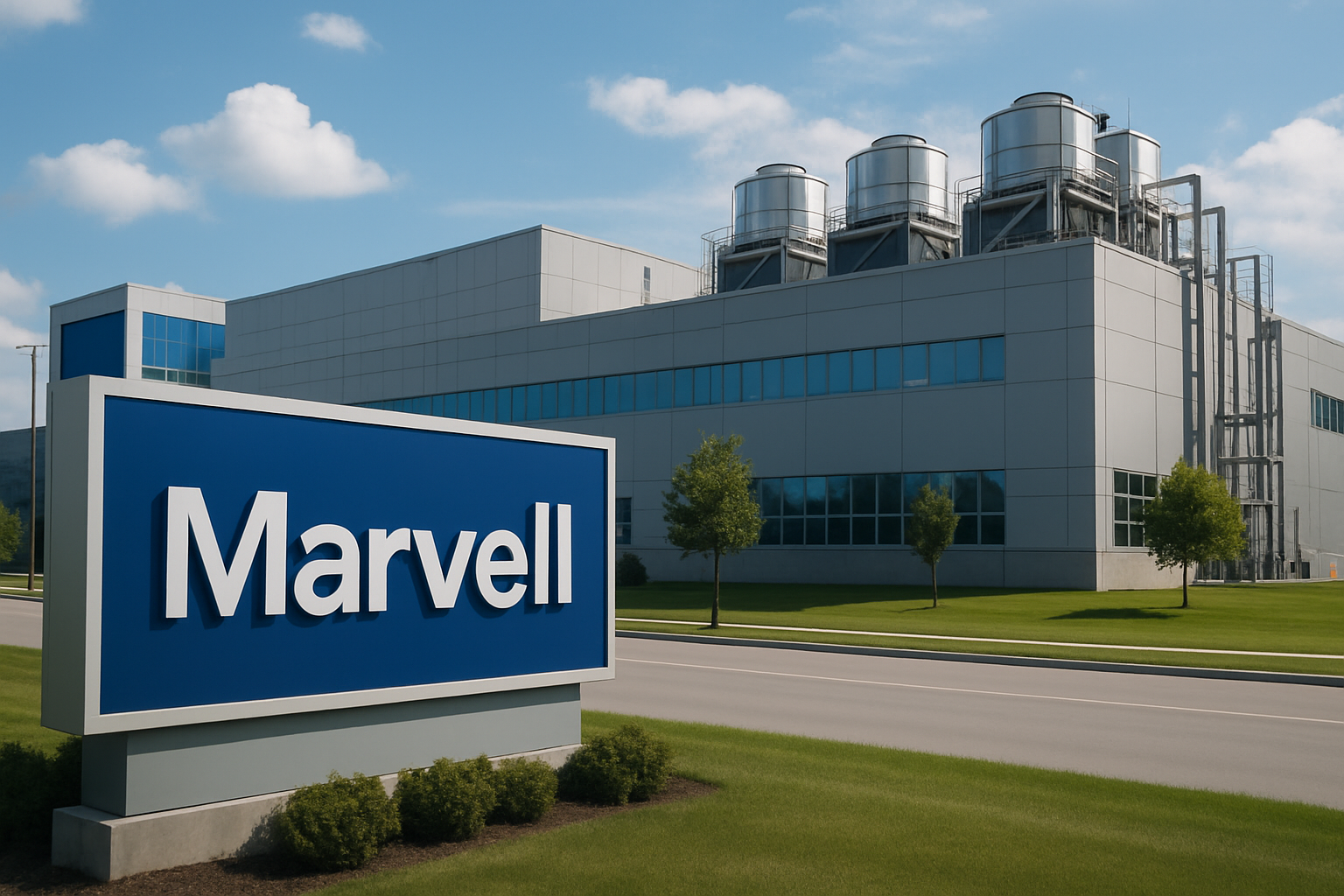
Global demand for artificial intelligence continues to accelerate, and behind every model, dataset, and inference process is a massive infrastructure layer quietly struggling to keep up. That pressure came into sharper focus this week as Marvell Technology announced a C$238 million expansion of its operations in Ontario, Canada, reinforcing the growing urgency around next-generation data, semiconductor, and AI-processing capacity across North America. The move has quickly gained traction among investors and analysts tracking the buildout of foundational AI infrastructure—one of the most critical (and capital-intensive) emerging industries of this decade.
According to reporting from ConstructConnect, the expanded Ontario facility will support increasingly complex workloads tied to cloud computing, networking semiconductors, and advanced AI systems—segments that have become some of the most resource-demanding technologies in modern markets.
North America Races to Scale AI Infrastructure
AI adoption is no longer a niche experiment—it is a full-scale technological shift touching virtually every sector. But the underlying infrastructure has struggled to keep pace. Whether it’s GPUs, advanced networking chips, fiber interconnects, data-center power systems, or low-latency storage, the physical backbone required to run AI systems is becoming a bottleneck.
Marvell’s investment highlights two major realities:
- AI infrastructure is now a long-term capital cycle, not a short-term hype cycle.
- North America is looking to localize more of its semiconductor and data-infrastructure footprint, reducing reliance on overseas supply chains.
This isn’t just an expansion—it’s a strategic positioning move, placing Ontario as a rising node in the broader North American semiconductor and AI ecosystem.
Recent reports from Reuters and Bloomberg have emphasized that 2025 has seen AI-related capex outpace traditional corporate investment categories, including consumer tech spending and general IT services. For companies like Marvell, the opportunity is clear: whoever supplies the backbone of AI deployment stands to benefit from multiyear contracts and demand visibility rarely seen in the tech cycle.
Why This Matters for Investors
A Structural, Not Cyclical, Growth Story
Unlike the typical semiconductor cycle—characterized by high volatility—AI infrastructure demand has shown signs of structural, durable growth. Cloud hyperscalers, defense systems, autonomous vehicles, biotech modeling, and robotics all require massive compute and ultra-fast interconnects, areas where Marvell specializes.
In its most recent earnings commentary, industry analysts noted that network infrastructure is becoming the next major choke point after GPUs. This creates a compelling long-term thesis for companies involved in advanced networking semiconductors, storage controllers, AI accelerators, and optical interconnects.
Canada as a Rising Strategic Hub
Ontario’s growing tech-manufacturing ecosystem is being quietly transformed by large-scale investments from global players—partly due to government incentives, and partly due to proximity to U.S. R&D centers and data-center corridors.
For investors, this opens opportunities in:
- Canadian semiconductor supply-chain companies
- Infrastructure services supporting new buildouts
- Industrial and energy firms benefiting from surging data-center power demand
It also signals that AI infrastructure exposure is no longer concentrated solely in Silicon Valley or U.S. tech hubs.
A Broadening Opportunity Across Emerging Industries
Marvell’s expansion fits seamlessly into broader trends shaping emerging industries across North America:
- Energy-intensive AI workloads are driving record demand for data-center electricity and thermal systems.
- Renewables and grid-modernization investments are rising to support new data-center clusters.
- Advanced manufacturing and automation continue expanding as governments prioritize supply-chain resilience.
Each of these verticals presents its own investable angles—but together, they paint a clear picture: the AI economy requires a massive industrial foundation that is only now entering full buildout mode.
Future Trends to Watch
1. Data-Center Power Constraints
Utilities across the U.S. and Canada are warning of multi-year strain from AI data centers. Investors should follow companies in power infrastructure, grid equipment, and renewable-energy integration.
2. Silicon Customization for AI Workloads
More companies are turning to custom semiconductor designs. Firms specializing in networking chips, ASIC development, photonics, and data-center interconnects could be major beneficiaries.
3. Onshoring & Supply-Chain Shifts
Both Canadian and U.S. industrial policy continue to prioritize domestic semiconductor capacity. This may create favorable conditions for chip manufacturers, materials suppliers, and advanced-packaging firms.
4. AI Infrastructure ETFs & Thematic Funds
Expect new investment vehicles centered around data-center infrastructure, semiconductor networking, and AI-adjacent energy solutions.
Key Investment Insight
Marvell’s Ontario expansion underscores a pivotal shift: the AI boom is now entering the infrastructure-buildout phase, where companies providing the physical backbone—not just algorithms—are positioned for durable, multi-year growth. Investors should evaluate exposure to semiconductor networking, data-center infrastructure, energy systems, and Canadian tech-industrial growth. These segments may offer a more stable and predictable trajectory than high-multiple AI software names.
For more actionable insights on fast-moving sectors shaping the future of investing, continue following daily coverage at MoneyNews.Today.




