
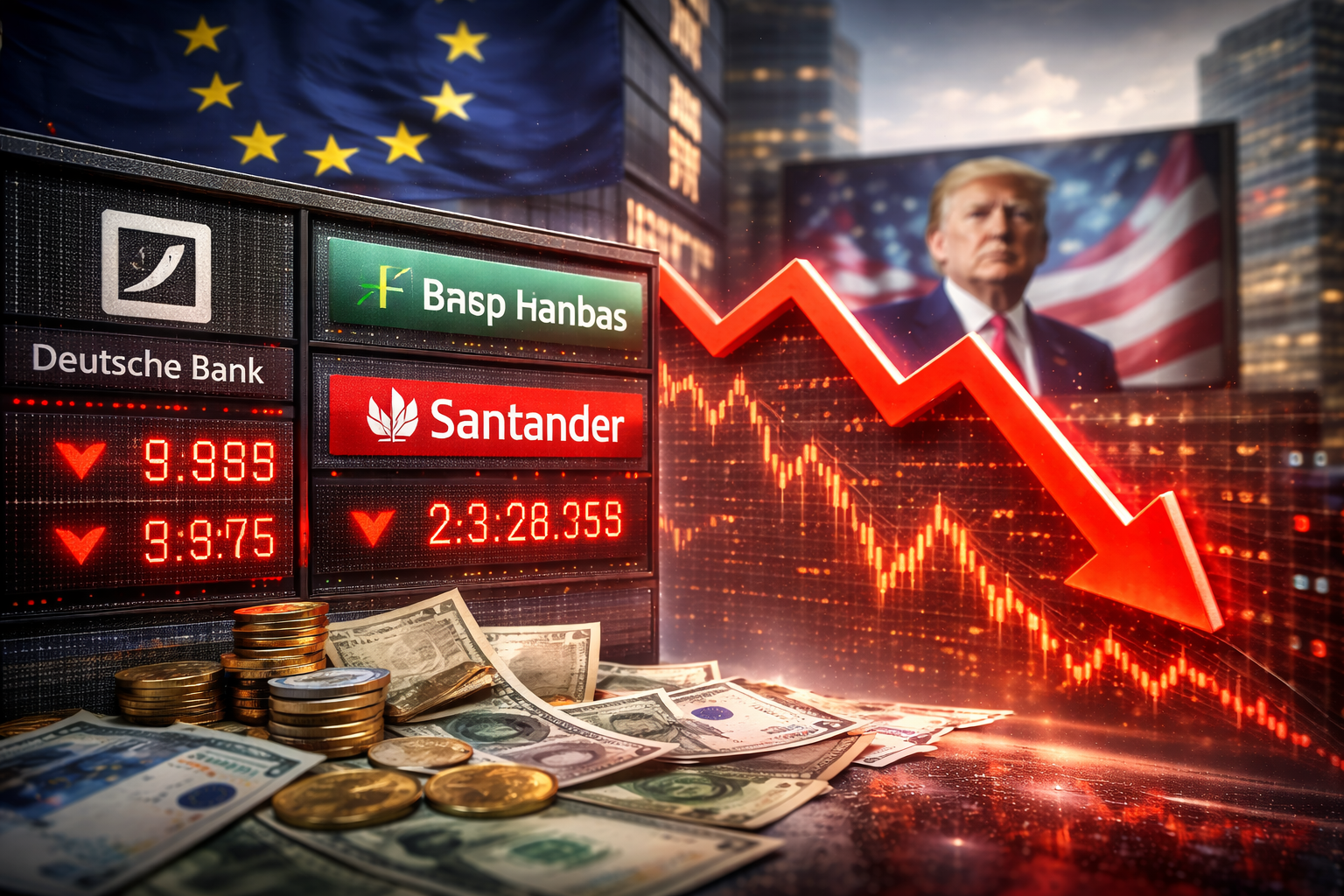
Global markets are once again being reminded that political risk rarely stays confined within national borders. European equities edged lower today as banking stocks came under pressure, weighed down by renewed policy uncertainty stemming from the United States. The pullback reflects growing investor unease over how U.S. political developments—particularly those tied to President Donald Trump’s policy agenda—could ripple through global financial systems.
While the declines were modest, the underlying message was clear: markets are reassessing risk as cross-border policy shocks collide with fragile investor confidence.
What’s Driving the Market Move
According to Reuters, Europe’s major indices slipped after financial stocks weakened, with banks leading declines across the region. Investors reacted to fresh U.S. political developments that raised concerns about regulatory stability, trade policy direction, and broader market confidence.
European banks are particularly sensitive to policy-driven volatility. Their business models are closely tied to interest rate expectations, capital flows, and global risk sentiment—factors that can shift quickly when uncertainty rises in the world’s largest economy.
At the same time, global equity performance remains uneven. While U.S. markets have shown pockets of resilience and parts of Asia have traded mixed, Europe is facing a more complex backdrop of slowing growth, tighter financial conditions, and geopolitical spillovers.
Why This Matters for Investors
Banking stocks often act as a barometer for economic confidence. When financial shares underperform, it can signal broader concerns about growth, credit conditions, or policy stability. In this case, investors are recalibrating exposure amid fears that U.S. political decisions could disrupt trade flows, regulatory cooperation, or capital markets.
Analysts cited by Bloomberg note that European banks are already navigating margin pressure as rate expectations fluctuate and loan growth softens in parts of the region. Add policy uncertainty from abroad, and risk premiums can rise quickly.
For global investors, this episode underscores how interconnected markets have become. Policy shocks in Washington can now influence sentiment in Frankfurt, Paris, and Milan within hours—affecting asset allocation decisions worldwide.
Financials Under the Microscope
The banking sector’s weakness reflects more than just political headlines. European financials face structural challenges, including:
- Interest Rate Volatility: Shifting expectations around central bank policy complicate earnings forecasts.
- Regulatory Sensitivity: Banks are highly exposed to regulatory changes and cross-border policy coordination.
- Economic Growth Concerns: Slower growth in parts of Europe limits credit demand and fee generation.
As Reuters and Financial Times have previously reported, investors tend to reduce exposure to cyclical sectors like banks during periods of elevated uncertainty, favoring defensives instead.
Broader Market Implications
Beyond financials, policy-driven volatility can influence currency markets, bond yields, and sector rotation trends. A stronger or weaker euro, driven by shifting risk sentiment, can affect exporters, while changes in bond yields directly impact equity valuations.
Strategists at major investment banks have recently highlighted that geopolitical and policy risk is becoming a more persistent feature of markets in 2026. Rather than short-lived shocks, investors may need to prepare for extended periods of uncertainty that require more active portfolio management.
What Investors Should Watch Next
Several key developments could shape near-term market direction:
- U.S. Policy Signals: Clarity—or further escalation—around trade, regulation, or fiscal measures.
- European Bank Earnings: Upcoming results may reveal how resilient balance sheets are under volatile conditions.
- Central Bank Messaging: Guidance from the European Central Bank and the Federal Reserve will influence risk appetite.
- Sector Rotation Trends: Continued outperformance of defensives could signal deeper risk aversion.
Key Investment Insight
The recent dip in European equities highlights the importance of policy risk awareness in global portfolios. With financials under pressure, investors may consider tactical hedges, selective defensive positioning, or diversification across less policy-sensitive sectors.
Rather than reacting emotionally to headlines, focusing on balance sheet strength, earnings visibility, and regional diversification can help investors navigate periods of heightened uncertainty more effectively.
As global markets adjust to shifting political and economic signals, staying informed is essential. MoneyNews.Today delivers timely, investor-focused insights to help you understand market moves, manage risk, and stay ahead in an increasingly interconnected financial world.




