
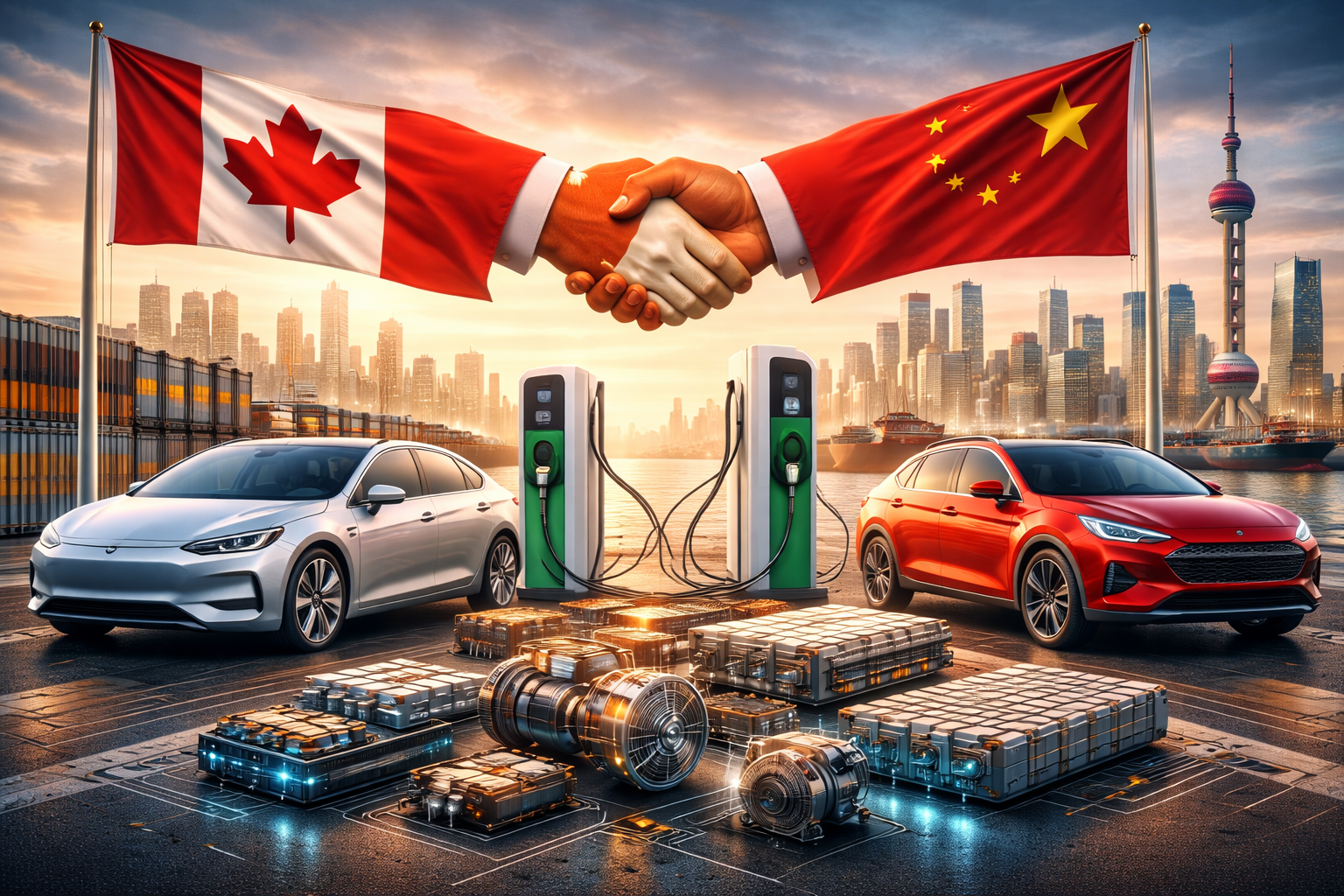
Global supply chains are shifting again—and investors are watching closely. Markets reacted swiftly after Canada announced a strategic trade reset with China that trims tariffs on electric vehicles (EVs), clean-tech components, and advanced technology goods, according to Reuters and Yahoo Finance. The move marks a notable thaw in bilateral trade relations and arrives at a moment when demand for EVs, battery materials, and climate-focused technologies is accelerating worldwide.
For investors focused on emerging industries, the agreement signals a potential inflection point for Canadian exporters positioned at the intersection of electrification, automation, and advanced manufacturing.
A Strategic Pivot With Market Implications
The Canada–China trade reset is more than a diplomatic recalibration. It directly addresses cost barriers that have constrained cross-border trade in high-growth sectors. By reducing tariffs on EVs and select technology goods, the agreement lowers friction for Canadian companies exporting components, software, and clean-energy hardware into one of the world’s largest end markets.
Reuters reports that policymakers framed the move as a pragmatic step to stabilize trade flows while supporting domestic manufacturers seeking access to global demand. China remains the largest EV market globally, accounting for more than half of worldwide EV sales, according to data from the International Energy Agency (IEA). Even incremental access improvements can translate into meaningful revenue opportunities for suppliers.
Why This Matters for Investors Now
The timing is critical. Global EV growth continues despite cyclical slowdowns in certain regions, and governments are prioritizing electrification as part of long-term climate and industrial strategies. Canada has invested heavily in battery supply chains, critical minerals, and clean-tech manufacturing, positioning itself as a key upstream and midstream supplier.
Analysts cited by Bloomberg note that tariff reductions can significantly improve margins for exporters, particularly in capital-intensive industries like EV components and advanced electronics. Lower trade costs enhance competitiveness, making Canadian firms more attractive partners for Chinese automakers and technology companies scaling production.
From an investor perspective, trade policy clarity often acts as a catalyst—unlocking delayed capital spending, accelerating order pipelines, and improving earnings visibility.
Beneficiaries Across the EV and Clean-Tech Ecosystem
While finished vehicle exports draw headlines, the real opportunity may lie deeper in the supply chain. Canadian companies supply critical inputs such as power electronics, battery materials, lightweight components, automation software, and clean-energy systems.
According to McKinsey research, EV value creation is increasingly shifting toward components, software, and energy infrastructure rather than final assembly. This dynamic favors specialized suppliers with intellectual property, engineering expertise, and scale advantages—areas where Canadian firms have built strong capabilities.
In addition, advanced technology sectors such as industrial automation, smart-grid equipment, and energy-storage systems stand to benefit as trade barriers ease and demand expands.
Trade Reset vs. Geopolitical Risk
Despite the positive signal, investors remain cautious about geopolitical risk. Canada’s move reflects a balancing act: expanding trade opportunities while managing broader strategic considerations alongside allies.
Market strategists emphasize that incremental normalization—rather than full liberalization—is often enough to unlock growth without exposing companies to excessive risk. Reuters notes that the agreement focuses on targeted tariff relief, allowing policymakers flexibility while giving businesses clearer operating conditions.
For investors, this suggests upside potential tempered by the need for selectivity and risk management.
Future Trends Investors Should Watch
Several developments will determine how impactful this trade reset becomes:
- Implementation details, including which product categories receive the greatest tariff relief
- Export volume trends for Canadian EV and clean-tech suppliers
- Capital investment announcements tied to expanded cross-border demand
- Policy alignment between trade goals and domestic industrial incentives
Progress across these areas could reinforce investor confidence and support sustained equity performance in targeted sectors.
Key Investment Insight
A more open Canada–China trade framework strengthens the growth outlook for Canadian EV supply-chain players, clean-tech manufacturers, and advanced technology exporters. Rather than focusing solely on automakers, investors may find more resilient opportunities among component suppliers, industrial technology firms, and companies enabling electrification and energy efficiency. Selective exposure to these segments could benefit as global demand and trade access expand.
As global trade dynamics reshape emerging industries, understanding where policy and capital intersect is essential. Stay informed with MoneyNews.Today, your trusted source for timely, actionable investor insights on the trends shaping tomorrow’s markets.




