
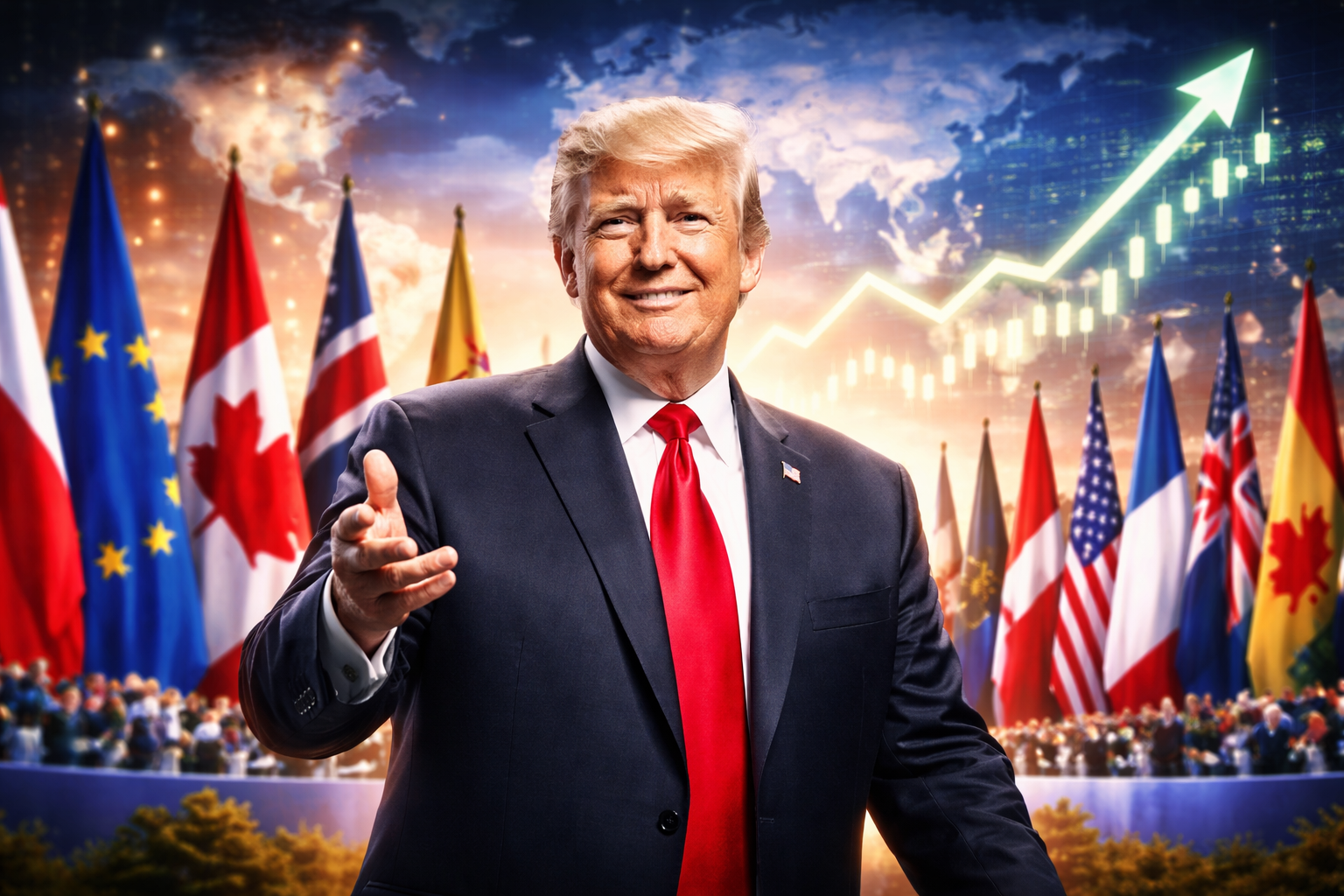
Financial markets reacted positively this week as President Trump signaled a de-escalation of trade tensions with Europe, notably easing threats of tariffs related to Greenland infrastructure and sovereignty. The announcement, delivered at the World Economic Forum in Davos, provided immediate relief to global investors and helped reduce risk premiums in equity and commodity markets. At the same time, Trump unveiled strategic initiatives, including the proposed “Board of Peace” and shifts in critical minerals policy, signaling an evolving U.S. foreign policy approach that is already influencing investor sentiment.
Markets have historically been sensitive to geopolitical uncertainty, and the Greenland tariff episode underscores the direct link between policy rhetoric and market behavior. Reuters and Bloomberg reported that U.S. equities rallied following the announcement, with cyclicals, financials, and energy stocks leading gains, while Canadian markets, particularly the TSX, saw broad-based relief in resource-linked equities.
Why This Matters for Investors
Geopolitical clarity, even if partial, has a tangible effect on investor confidence and capital allocation. The rollback of tariff threats diminishes the risk of supply-chain disruption, potential retaliatory measures, and added costs for multinational corporations, thereby supporting earnings expectations and stabilizing valuations. Analysts cited by Bloomberg noted that companies exposed to transatlantic trade, particularly in industrials, manufacturing, and energy, stand to benefit most from reduced policy uncertainty.
The Greenland episode also illustrates a broader lesson for investors: policy and political developments are often among the most immediate drivers of market sentiment. Even incremental shifts in rhetoric or the introduction of new initiatives can spark sector rotation and influence risk premiums across asset classes.
Global Initiatives and Policy Signals
Beyond the tariff rollback, the proposed “Board of Peace” initiative signals a U.S. intent to engage more actively in international diplomacy and multilateral collaboration. While details remain sparse, investors are already assessing its potential impact on global trade, defense, and energy markets. Additionally, shifts in critical minerals policy—aimed at strengthening domestic supply chains for technology and defense sectors—could create new investment opportunities in mining, energy, and infrastructure-linked equities.
Market participants are particularly attentive to how these policy signals intersect with the global energy transition. For example, support for domestic lithium, cobalt, and rare-earth production could benefit North American miners and producers supplying critical inputs for batteries, AI infrastructure, and renewable energy projects. As reported by Reuters, Canadian and U.S. resource-linked equities have shown early sensitivity to these policy developments, highlighting the importance of aligning investment strategies with geopolitical trajectories.
Future Trends to Watch
Several factors will determine whether the current market uplift is sustained:
- Follow-through on Trade and Policy Initiatives: Investors will monitor the actual implementation of the Greenland framework and other international agreements.
- Critical Minerals Development: Capital expenditure in mining and infrastructure projects tied to strategic minerals will influence both sector growth and broader market confidence.
- Geopolitical Stability: Ongoing tensions in other regions, including Asia and the Middle East, could temper risk appetite despite North Atlantic relief.
- Market Volatility Metrics: VIX and other risk indicators will reflect investor sentiment shifts as policies evolve.
Key Investment Insight
Policy rhetoric and geopolitical shifts are not abstract; they materially influence market volatility, sector rotations, and investor positioning. Relief from tariff threats can provide immediate upside for cyclicals, energy, and financial stocks, while strategic initiatives in critical minerals and international collaboration offer long-term structural opportunities. For investors, maintaining awareness of policy signals, aligning sector exposures accordingly, and integrating geopolitical risk assessment into portfolio strategy are essential steps in navigating this evolving landscape.
As the market digests these developments, investors should watch for follow-through and capitalize on opportunities where policy clarity aligns with fundamental growth trends.
Stay informed with MoneyNews.Today for daily, authoritative analysis of how politics, policy shifts, and global initiatives influence markets and investment strategies.




