
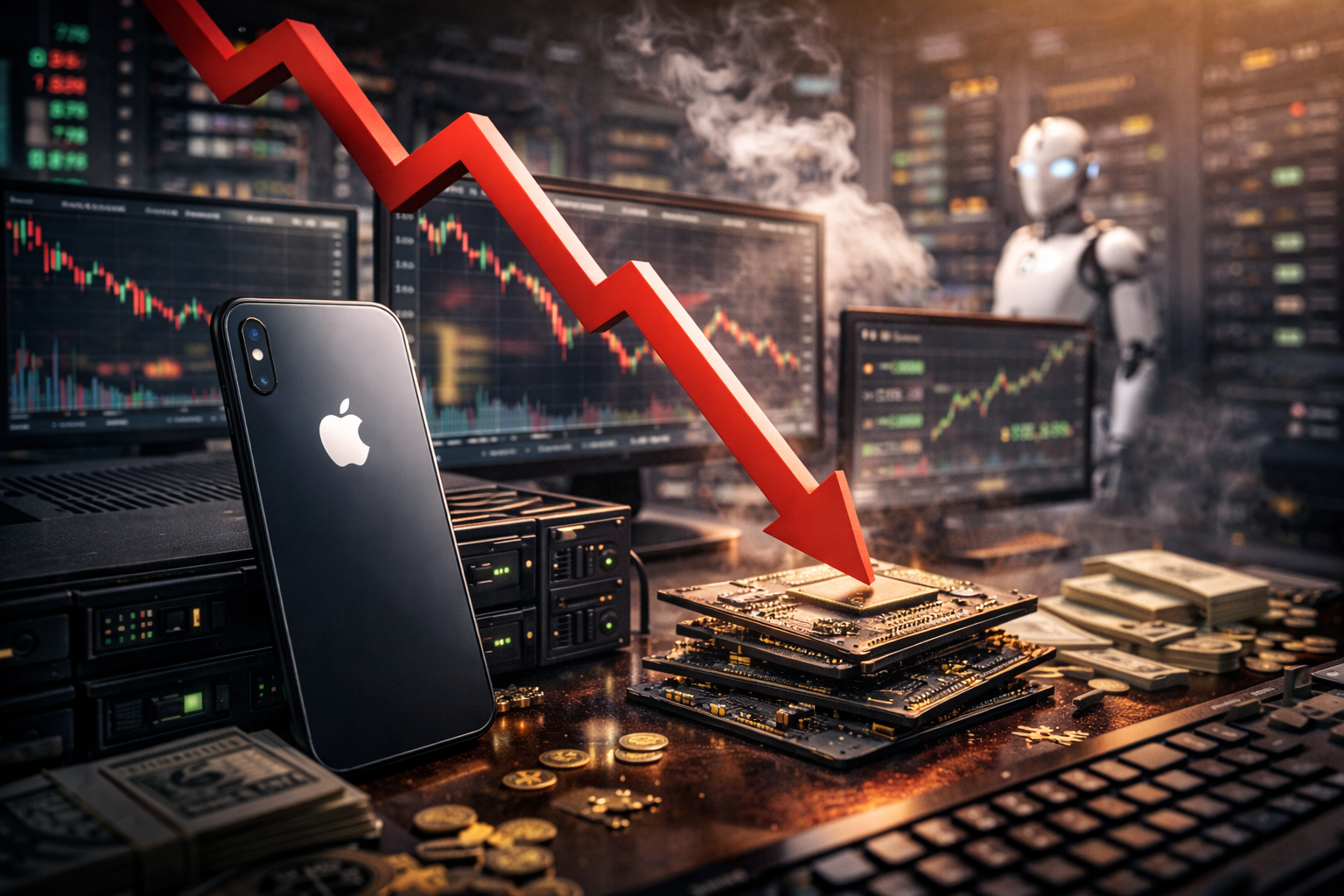
The technology sector’s AI-driven rally is facing a reality check. Apple’s recent warning that artificial intelligence deployment could pressure margins has sent ripples through U.S. tech stocks, intensifying volatility and sharpening investor focus on the true cost of scaling AI. While enthusiasm around AI remains strong, markets are increasingly demanding proof that massive investment can translate into sustainable profits.
At a time when earnings season is already revealing mixed signals across the sector, Apple’s comments have become a focal point for investors reassessing how much they are willing to pay for future AI growth.
Why Apple’s Comments Carry Outsized Weight
Apple is widely regarded as one of the most operationally disciplined companies in the world, known for its ability to protect margins even during periods of heavy investment. That is precisely why its caution has resonated so strongly with markets.
According to reporting from Bloomberg and the Economic Times, Apple flagged rising costs tied to AI infrastructure, including data-center capacity, custom silicon, and software integration. While the company reiterated its long-term commitment to AI, the acknowledgment that these investments could weigh on near-term profitability prompted investors to reevaluate assumptions not just about Apple, but about the broader tech sector.
When a company with Apple’s scale, cash flow, and pricing power signals margin pressure, it raises questions about whether smaller or less diversified tech firms can absorb similar costs without sacrificing earnings.
AI Spending vs. Profitability: A Growing Divide
The current phase of AI adoption is capital-intensive. Training large language models, expanding cloud capacity, and deploying AI across consumer and enterprise products require significant upfront spending. For many technology firms, these costs are being incurred well before monetization fully materializes.
Market analysts note that this dynamic is creating a clear divide between AI investors and AI spenders. Companies providing the infrastructure—such as semiconductor manufacturers, networking firms, and data-center operators—are seeing more direct and immediate revenue benefits. Meanwhile, companies embedding AI into products or services face longer payback periods and margin uncertainty.
Bloomberg analysis suggests that investors are no longer rewarding AI exposure indiscriminately. Instead, they are increasingly focused on cost discipline, monetization timelines, and the ability to scale AI without eroding profitability.
Mixed Earnings Add to Uneven Sentiment
Apple’s warning has landed in the middle of an earnings season already marked by dispersion. While some tech companies have delivered strong results and upbeat guidance, others have disappointed, citing cost pressures, slower enterprise spending, or uneven consumer demand.
This divergence has contributed to heightened volatility across major indices, particularly the Nasdaq. Short-term market moves have become more sensitive to earnings commentary and guidance than to long-term growth narratives alone.
For investors, the takeaway is clear: the era of blanket enthusiasm for “AI at any cost” is fading. Markets are shifting toward a more selective approach, rewarding companies that demonstrate a credible path to AI-driven returns.
What Analysts Are Watching Next
Several key factors will shape investor sentiment in the months ahead:
Monetization Strategies:
Investors are closely watching how companies plan to generate revenue from AI, whether through subscription pricing, enterprise services, or hardware upgrades.
Margin Trajectories:
Guidance around gross and operating margins is becoming just as important as revenue growth. Companies that can offset AI costs through efficiency gains or pricing power are likely to stand out.
Capex Discipline:
Large capital expenditure plans are under scrutiny. Analysts are favoring firms that balance ambition with financial discipline.
Industry research from firms such as McKinsey has highlighted that while AI can drive long-term productivity gains, the benefits are unevenly distributed and often lag initial investment. This reinforces the need for patience—and selectivity—among investors.
Why This Matters for Investors
Technology remains a cornerstone of modern portfolios, and AI continues to represent one of the most powerful structural growth themes of the decade. However, the market’s reaction to Apple’s margin warning underscores a critical shift: execution matters more than vision.
Investors are increasingly differentiating between companies that talk about AI and those that can monetize it efficiently. This environment favors firms with strong balance sheets, recurring revenue models, and proven cost control.
Key Investment Insight
While AI remains a long-term growth engine, short-term earnings and margin signals cannot be ignored. Investors may consider prioritizing companies with scalable AI monetization and clear paths to profitability, rather than those engaging in speculative or open-ended AI spending.
The AI narrative is evolving—from excitement to evaluation. As technology companies navigate the balance between innovation and profitability, informed investors will be best positioned to identify durable winners. Stay connected with MoneyNews.Today for daily, investor-focused insights on technology, earnings, and the trends shaping global markets.




