
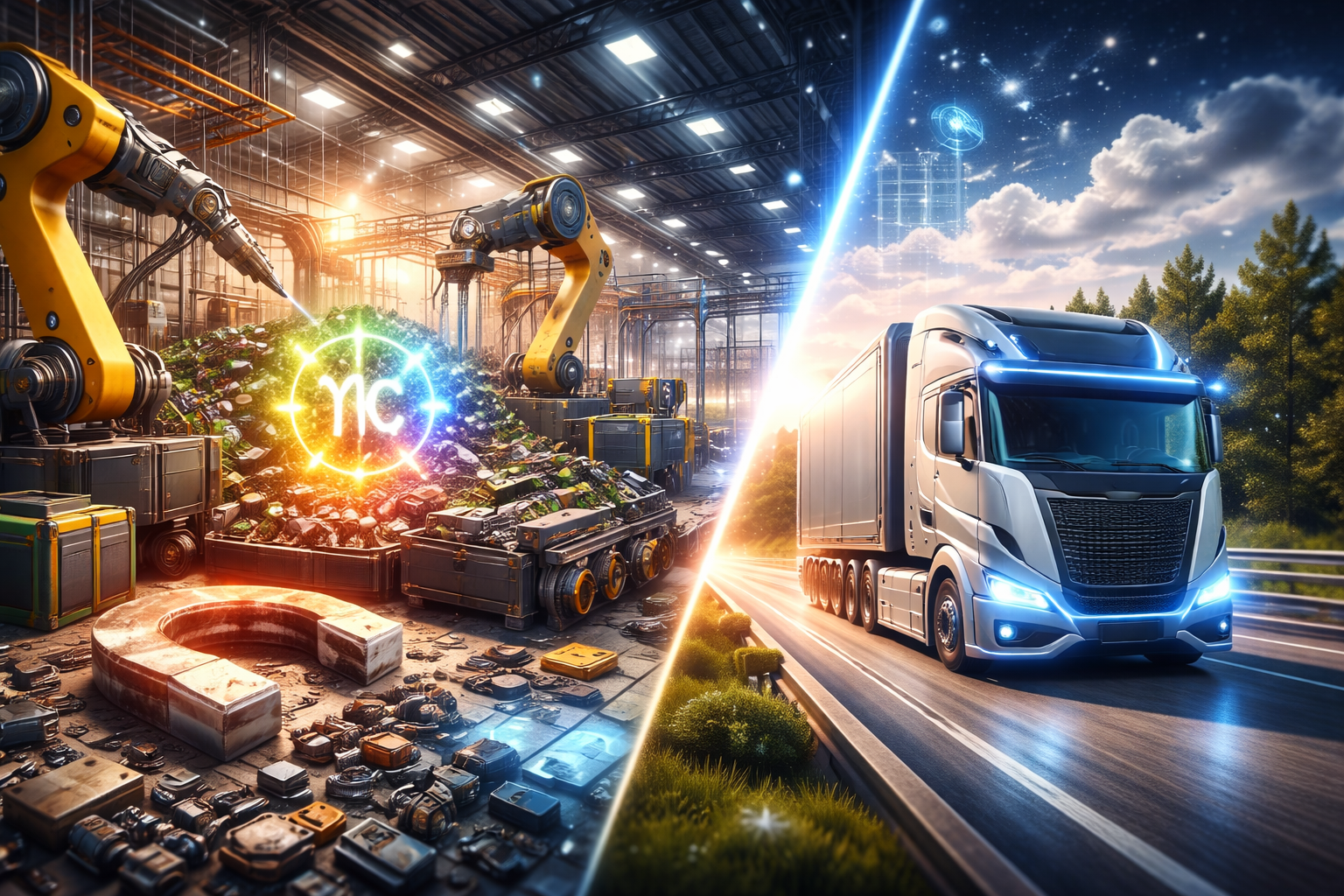
Two Canadian companies made strategically significant moves this week that underscore where capital is flowing in emerging industries: critical materials and autonomous mobility. An $82 million investment by Cyclic Materials to build a rare earth magnet recycling campus in the United States, alongside a $750 million funding round for AI-driven autonomous trucking firm Waabi, highlights how materials security and artificial intelligence are increasingly converging as priority investment themes.
For investors, these developments reflect a broader shift toward resilient supply chains, domestic production, and advanced technologies backed by both private capital and government policy.
Rare Earth Recycling Moves to the Forefront
Cyclic Materials’ announcement of a new rare earth magnet recycling campus in South Carolina marks a notable step in North America’s effort to secure critical materials essential for electric vehicles, defense systems, and AI infrastructure. According to ResearchMoneyInc, the ~$82 million project aims to recover rare earth elements from end-of-life products, reducing dependence on imported raw materials.
Rare earth magnets are a key component in EV motors, wind turbines, robotics, and data center cooling systems. Yet global supply remains highly concentrated, with China controlling a dominant share of processing capacity. This concentration has raised concerns among policymakers and manufacturers alike.
Industry analysis from Bloomberg and government agencies has repeatedly emphasized recycling as a scalable solution to mitigate supply risk while improving sustainability. By locating the facility in the U.S., Cyclic Materials also positions itself to benefit from federal incentives and growing demand from American manufacturers seeking domestically sourced inputs.
Why This Matters for Investors
The move into rare earth recycling highlights a structural investment theme: materials security is no longer just a mining story. Recycling, processing, and circular supply chains are becoming equally important parts of the value chain.
For investors, companies operating in these niches may offer exposure to long-term demand without the same geopolitical or environmental risks associated with traditional mining projects. As EV adoption accelerates and AI infrastructure expands, demand for high-performance magnets and specialty materials is expected to remain durable.
McKinsey estimates that global demand for rare earth elements used in clean energy and advanced technologies could more than double over the next decade, reinforcing the strategic importance of projects like Cyclic’s.
Waabi’s $750M Raise Signals Confidence in Autonomous AI
On the technology front, Canadian autonomous vehicle company Waabi secured $750 million in Series C funding, one of the largest AI-related raises of the year. The capital will be used to accelerate deployment of its autonomous trucking and robotaxi technology, supported by a partnership with Uber.
Waabi’s approach emphasizes AI-first development, using advanced simulation and machine learning to reduce the cost and time required to train autonomous systems. ResearchMoneyInc reports that this funding round attracted a mix of strategic and institutional investors, reflecting confidence in both the technology and its commercial potential.
Autonomous mobility remains a long-term play, but investor interest is returning as companies demonstrate clearer paths to monetization. Logistics, ride-hailing, and last-mile delivery are seen as early beneficiaries, particularly as labor shortages and cost pressures persist.
Convergence of Materials and AI
While rare earth recycling and autonomous vehicles may appear distinct, they are increasingly interconnected. AI-driven systems, robotics, and EV platforms all rely on the same critical materials Cyclic aims to supply. This convergence is drawing capital toward companies that sit at the intersection of physical infrastructure and digital intelligence.
According to industry analysts cited by Bloomberg, government-backed initiatives in the U.S. and Canada are prioritizing domestic supply chains for both advanced materials and AI technologies, creating a supportive backdrop for investment.
Future Trends to Watch
Investors should monitor three key trends emerging from these developments. First, the pace at which recycling technologies can scale to meet industrial demand will be critical. Second, partnerships between autonomous tech firms and established platforms, like Waabi’s relationship with Uber, may accelerate commercialization. Third, policy incentives tied to clean energy, defense, and domestic manufacturing could further de-risk capital deployment in these sectors.
As capital flows continue to favor strategic industries, early movers with proven technology and strong partnerships may gain a competitive edge.
Key Investment Insight
The convergence of critical materials recycling and AI-driven automation represents a compelling long-term opportunity. Investors should watch for companies positioned to serve EV, defense, and data center supply chains, where demand visibility and policy support are strongest. Exposure to these themes may provide growth potential with structural tailwinds.
For ongoing coverage of emerging industries, advanced technologies, and the investment trends shaping tomorrow’s economy, stay connected with MoneyNews.Today, your trusted source for daily investor insights.




