
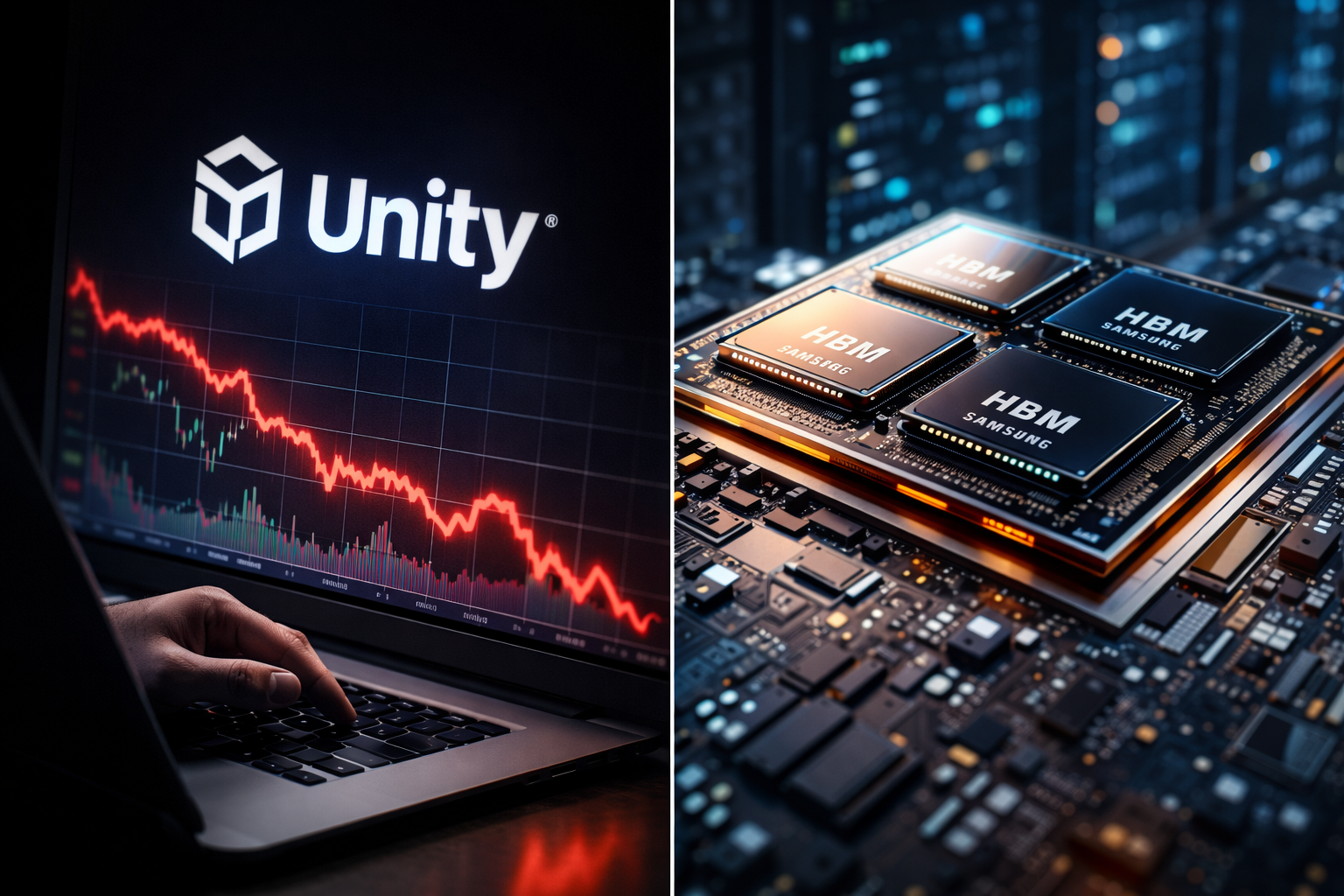
The technology sector is sending mixed signals to investors — and the divergence is becoming impossible to ignore. Shares of Unity Software tumbled after weaker-than-expected revenue guidance underscored slowing demand in creator-focused software. At the same time, supply chain improvements in advanced memory — including HBM4 shipments from Samsung Electronics — are reinforcing optimism around AI hardware infrastructure.
The message for investors: not all tech is created equal in 2026.
According to industry coverage from TS2.Tech and related semiconductor supply reports, consumer-facing software platforms are facing cyclical pressure, while AI infrastructure and chip-related ecosystems continue to demonstrate resilience.
A Sharp Reset for Creator Software
Unity’s forecast miss reflects broader softness in segments tied to gaming, app development, and digital content creation. The company cited weaker-than-anticipated monetization trends and enterprise demand moderation — a reminder that discretionary spending remains sensitive to macro conditions.
Creator tools and software platforms flourished during periods of digital acceleration and easy capital. However, as interest rates remain elevated relative to pandemic-era levels and corporate budgets tighten, growth expectations are normalizing. Investors responded swiftly, repricing shares to reflect slower near-term revenue expansion.
This dynamic mirrors trends seen across portions of the software-as-a-service (SaaS) ecosystem. While long-term digital transformation remains intact, revenue growth rates are no longer expanding at the breakneck pace of prior years. Market participants are demanding clearer profitability pathways and operating discipline.
Semiconductor Momentum Tells a Different Story
In contrast, semiconductor supply chains tied to artificial intelligence continue to show structural strength. Reports highlighting progress in high-bandwidth memory (HBM4) shipments — a critical component for advanced AI accelerators — suggest that demand for data center and AI hardware remains robust.
HBM4 memory is a key input for next-generation AI chips used in large-scale model training and inference workloads. Improved supply signals greater capacity for AI infrastructure deployment, supporting capital expenditure plans from hyperscalers and enterprise cloud providers.
This divergence reflects a broader shift: while consumer and creator software demand is softening, AI infrastructure spending remains a strategic priority for major corporations. Industry commentary from Bloomberg and McKinsey in recent months has emphasized that AI-related data center investment is expected to represent one of the fastest-growing capital expenditure categories through the end of the decade.
Why This Matters for Investors
Technology leadership is fragmenting. Over the past two years, broad tech indices often moved in tandem, lifted by AI enthusiasm. Now, performance dispersion within the sector is widening.
The tech-heavy Nasdaq Composite remains sensitive to earnings surprises in high-growth names. However, hardware and semiconductor-linked companies are increasingly decoupling from software-driven volatility.
Investors should note that infrastructure cycles often outlast application cycles. When transformative technologies such as AI emerge, capital typically flows first into the foundational layers — chips, networking, data centers — before filtering into monetized software ecosystems. Current trends suggest we are still in the infrastructure-heavy phase.
At the same time, elevated valuations in select semiconductor names mean expectations remain high. Any slowdown in enterprise AI deployment could challenge momentum-driven positioning.
Future Trends to Watch
1. AI Capex Announcements: Corporate earnings calls from hyperscalers will provide visibility into sustained infrastructure demand.
2. Memory and Chip Pricing: Monitoring HBM and advanced chip pricing trends will help gauge supply-demand balance.
3. Software Margin Discipline: Creator and SaaS companies must demonstrate operating leverage to regain investor confidence.
4. M&A Activity: Slowing software growth could trigger consolidation, especially among mid-cap platforms.
Investors should also monitor geopolitical developments influencing semiconductor supply chains. Government incentives and industrial policy continue to shape manufacturing capacity decisions, particularly in North America and Asia.
Key Investment Insight
The bifurcation within technology suggests a more selective strategy is warranted. Hardware infrastructure, semiconductors, and AI-enabling components may continue to outperform in the medium term, supported by structural capital expenditure trends.
Conversely, consumer-facing and creator-focused software companies may require evidence of stabilized demand and improved margins before regaining momentum. For diversified portfolios, balancing exposure between growth infrastructure plays and cash-generating defensive sectors may help manage volatility.
Importantly, divergence does not signal weakness across technology — it signals maturation. Investors who differentiate between cyclical softness and structural growth stand to benefit most.
Technology remains a cornerstone of global markets, but leadership is evolving. For timely, data-driven insights that cut through sector noise, stay connected with MoneyNews.Today — your trusted source for daily investor intelligence.




