
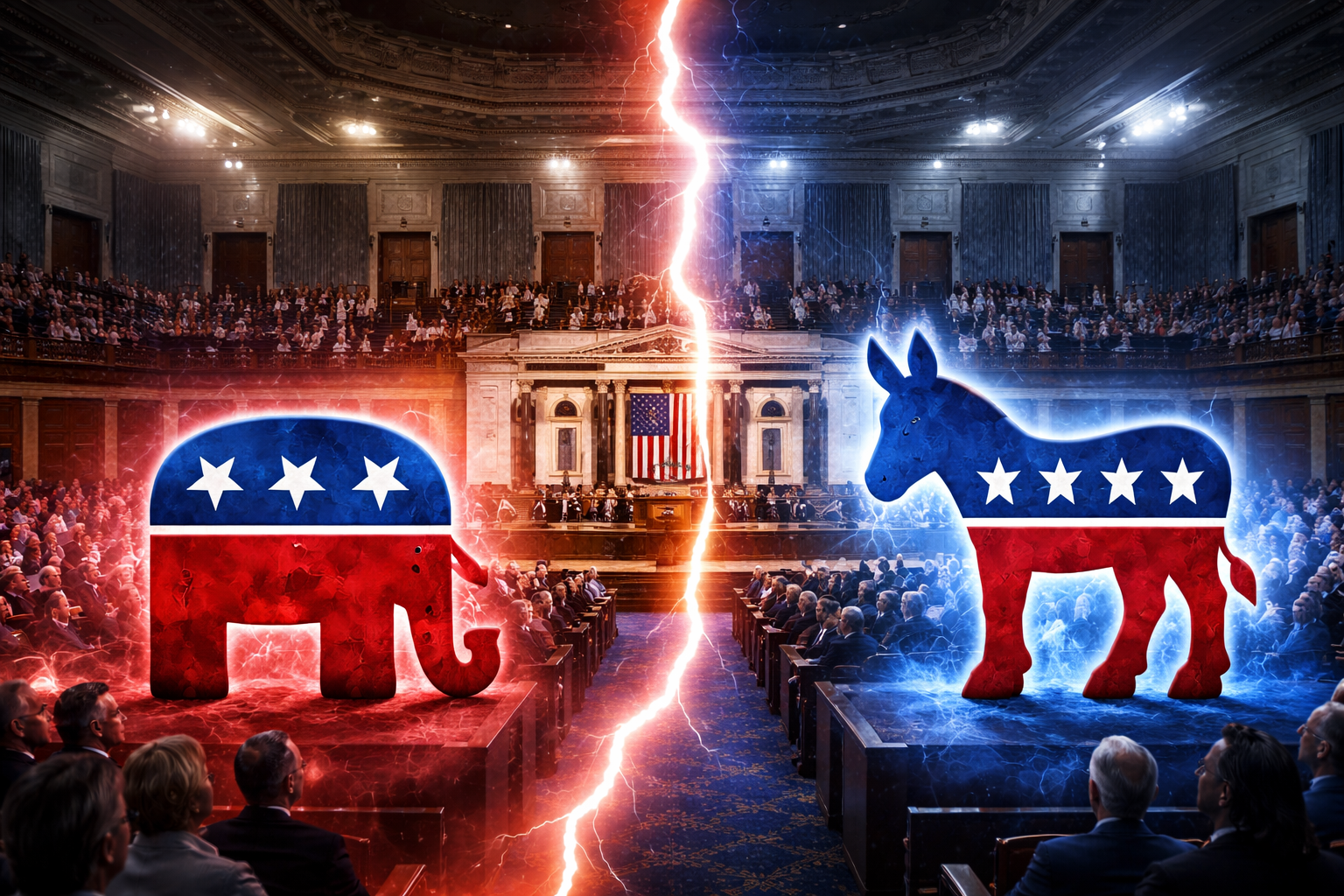
Markets may price earnings and inflation data daily, but Washington still sets the longer-term rules of the game. In the wake of President Donald Trump’s latest State of the Union address, investors are recalibrating expectations around fiscal policy, infrastructure spending, trade posture, and regulatory direction — all against a backdrop of visible partisan division.
The address, delivered before a sharply split Congress, emphasized economic growth, domestic manufacturing, border security, and national infrastructure renewal. Yet protests and notable absences among Democratic lawmakers underscored the polarized environment shaping the legislative path forward. For markets, the speech was less about rhetoric and more about probability: Which proposals can realistically pass, and what does that mean for capital allocation?
Fiscal Ambition Meets Political Gridlock
President Trump’s speech reiterated priorities around tax competitiveness, reshoring industry, and strengthening U.S. infrastructure. According to coverage from Reuters and Bloomberg, the administration signaled support for expanded domestic energy production, targeted tax incentives, and continued defense modernization.
However, the legislative math remains complicated. A divided Congress raises the likelihood of negotiated compromises rather than sweeping reforms. Historically, political gridlock has sometimes been viewed positively by markets, limiting the risk of abrupt regulatory shifts. Yet in periods of macro uncertainty, it can also delay fiscal stimulus or infrastructure packages that sectors are counting on.
For investors, this dynamic introduces both opportunity and volatility.
Why This Matters for Investors
1. Infrastructure and Industrial Policy
Infrastructure was a central theme of the address — including transportation networks, energy grids, and digital systems. While bipartisan support for infrastructure investment has existed in past cycles, disagreements over funding mechanisms and environmental provisions could slow implementation.
Companies tied to construction materials, engineering services, and grid modernization stand to benefit if legislation advances. Investors should monitor appropriations timelines and committee negotiations for signals of momentum.
2. Defense and National Security
National security rhetoric remains strong amid global geopolitical tensions. The U.S. defense budget already exceeds $800 billion annually, according to Department of Defense data, and modernization initiatives in cyber, space, and AI-driven systems are ongoing.
A polarized political environment does not necessarily impede defense funding; historically, it has enjoyed bipartisan backing. That suggests continued visibility for defense contractors, aerospace manufacturers, and cybersecurity firms — particularly those aligned with long-term Pentagon modernization programs.
3. Healthcare and Regulatory Risk
Healthcare remains one of the most politically sensitive sectors. Policy debates over drug pricing, insurance markets, and federal healthcare programs can materially impact biotech and pharmaceutical valuations.
Post–State of the Union commentary highlighted renewed partisan debate around healthcare costs. Investors should be attentive to committee hearings and proposed amendments that could alter reimbursement structures or pricing frameworks.
Trade and Corporate Planning
Trade policy remains a focal point in Washington. The administration’s emphasis on domestic manufacturing and strategic supply chains suggests a continued push toward economic nationalism.
For multinational corporations, this translates into higher compliance complexity and potentially shifting tariff structures. According to analysis from McKinsey & Company, companies navigating fragmented trade regimes increasingly prioritize regional supply chains and redundancy over pure cost efficiency.
Markets tend to respond quickly to trade headlines, particularly in sectors like semiconductors, autos, and industrial machinery. Investors should monitor executive orders, tariff announcements, and bilateral trade discussions for near-term catalysts.
Political Risk and Market Pricing
Periods of heightened political polarization often coincide with elevated volatility indexes and defensive sector rotation. Utilities, consumer staples, and healthcare frequently see inflows during legislative uncertainty, while cyclical sectors respond more directly to fiscal clarity.
At the same time, equity markets historically look beyond short-term political turbulence if corporate earnings remain resilient. The key variable for investors is whether political friction materially delays economic policy implementation.
Future Trends to Watch
1. Budget Negotiations and Debt Dynamics
Debt ceiling discussions and federal budget negotiations will likely re-emerge as flashpoints. Any disruption could impact Treasury yields and risk sentiment.
2. Executive Action vs. Congressional Legislation
If legislative pathways stall, executive orders may become a more prominent policy tool. Investors should evaluate which sectors are most exposed to regulatory adjustments that bypass Congress.
3. Election Cycle Positioning
As political narratives intensify, sector-specific messaging could shape expectations for taxation, defense allocations, and social spending programs. Markets often begin pricing election outcomes months in advance.
Key Investment Insight
In a divided political landscape, clarity is scarce — but themes emerge. Investors may consider:
- Maintaining diversified exposure across cyclical and defensive sectors
- Monitoring defense and infrastructure plays for sustained federal support
- Watching healthcare policy developments for regulatory catalysts
- Tracking Treasury yield movements as a barometer of fiscal risk
Political polarization does not automatically derail markets, but it reshapes risk distribution. Portfolio resilience, rather than aggressive positioning, may be the defining strategy during periods of legislative uncertainty.
As Washington debates the next chapter of economic policy, markets will continue to translate rhetoric into probabilities — and probabilities into price action.
Stay with MoneyNews.Today for daily investor insights that decode political developments and connect them to actionable market strategy.




