
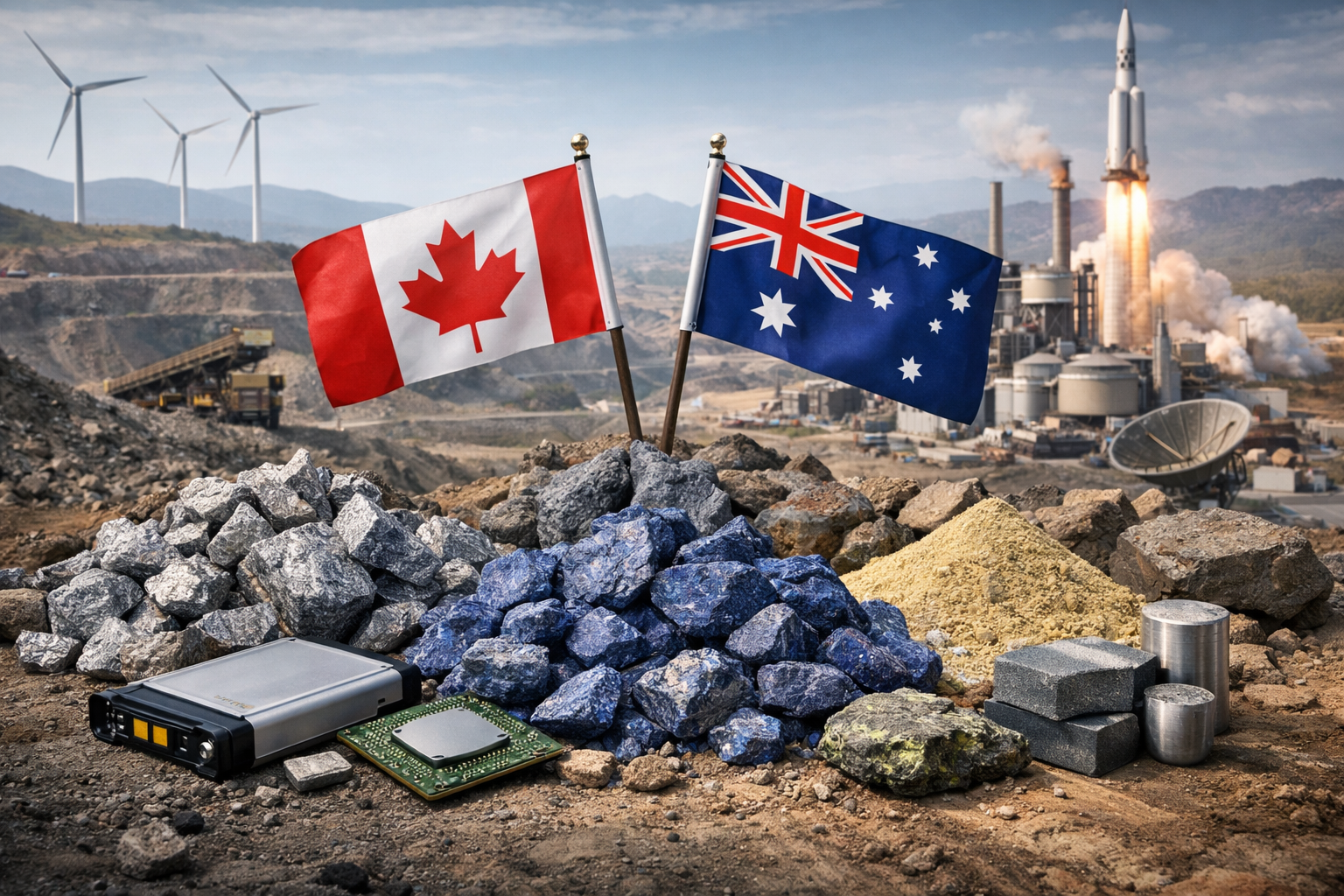
Global competition for critical minerals is intensifying, and investors are paying close attention. As the energy transition accelerates and geopolitical tensions reshape supply chains, governments are moving aggressively to secure reliable access to the materials powering modern technologies—from electric vehicles and semiconductors to advanced defense systems.
Against this backdrop, Canada and Australia have announced expanded cooperation on critical minerals development and supply chain security, strengthening a strategic partnership between two of the world’s most resource-rich economies. The move aligns with broader efforts among G7 nations to reduce reliance on China for key mineral inputs and build resilient supply networks for the industries of the future.
For investors, the growing alliance signals something even bigger: the emergence of critical minerals as one of the most important long-term investment themes of the decade.
Canada and Australia Deepen Strategic Minerals Partnership
Canada and Australia have long been global leaders in resource extraction, but the latest agreements between the two countries mark a significant escalation in cooperation around critical minerals supply chains.
According to reporting from Reuters, the expanded partnership aims to strengthen exploration, production, and processing of minerals essential for modern technology and clean energy systems. Both countries possess large reserves of strategic materials such as lithium, nickel, cobalt, rare earth elements, and uranium—minerals that are increasingly vital for electric vehicle batteries, renewable energy infrastructure, advanced electronics, and military systems.
By coordinating policies, investment frameworks, and supply chain strategies, Canada and Australia hope to build a more secure and diversified global minerals ecosystem—one that reduces the concentration of supply currently dominated by China.
The collaboration also aligns with broader initiatives among G7 and allied nations to develop “friend-shored” supply chains, where critical resources are sourced from politically stable and allied countries rather than geopolitical rivals.
For investors, the implications stretch far beyond diplomacy.
The Global Race for Critical Minerals
Demand for critical minerals has surged in recent years as industries rapidly electrify and digitize. Electric vehicles, renewable energy systems, advanced semiconductors, and defense technologies all rely heavily on materials that are difficult to substitute and often concentrated in limited geographic regions.
According to the International Energy Agency (IEA), global demand for lithium alone could increase more than 40-fold by 2040 under aggressive clean-energy scenarios. Meanwhile, the U.S. Geological Survey has repeatedly warned that supply chains for many critical minerals remain heavily dependent on a small number of countries.
China currently dominates processing and refining capacity for many of these materials, controlling significant shares of global rare earth processing and battery mineral supply chains.
That concentration has raised concerns across Western governments, particularly as geopolitical competition intensifies.
The partnership between Canada and Australia represents a strategic effort to rebalance that landscape.
Together, the two nations already account for significant portions of global mining production. Australia is the world’s largest producer of lithium and a major supplier of iron ore and nickel, while Canada holds substantial reserves of nickel, cobalt, uranium, and rare earth elements.
By combining resources, expertise, and investment capital, the alliance aims to accelerate development of new mining projects and processing facilities across both countries.
Why This Matters for Investors
For investors tracking macroeconomic trends, the strengthening of critical mineral alliances highlights a powerful intersection between geopolitics, industrial policy, and commodity markets.
Several factors are driving sustained investment momentum in the sector:
1. Government Support and Subsidies
Western governments are pouring billions of dollars into domestic mineral supply chains.
In the United States, the Inflation Reduction Act and Defense Production Act include major incentives for battery minerals and critical resources. Canada has introduced similar tax credits and funding programs aimed at expanding mining and mineral processing capacity.
These policies are designed to encourage private-sector investment while reducing reliance on foreign supply chains.
For mining companies operating in friendly jurisdictions such as Canada and Australia, that support could significantly lower project risks and accelerate development timelines.
2. Energy Transition Demand
The shift toward electrification is dramatically increasing demand for battery metals.
Electric vehicles require significantly larger quantities of minerals than traditional vehicles. Lithium, nickel, and cobalt are all essential components of EV batteries, while copper demand is rising sharply due to electrification of infrastructure and renewable energy systems.
Consulting firm McKinsey & Company estimates that demand for several key battery metals could triple or quadruple over the next decade.
This structural demand growth creates long-term tailwinds for producers and developers across the mining sector.
3. Strategic Defense and Technology Supply Chains
Critical minerals are not only important for clean energy—they are also essential for advanced defense technologies.
Rare earth elements are used in precision weapons, radar systems, and aerospace components. Semiconductor manufacturing requires high-purity materials sourced from specialized supply chains.
As governments increasingly treat these materials as strategic assets, investment flows into domestic mining and processing infrastructure are expected to grow.
Supply Chain Security Becomes a National Priority
The global push to secure mineral supply chains reflects a broader shift in how governments view economic security.
For decades, globalization encouraged companies to prioritize efficiency and cost reduction in supply chains. However, geopolitical tensions, trade disruptions, and the COVID-19 pandemic exposed vulnerabilities in highly concentrated global supply networks.
Today, many governments are prioritizing resilience and diversification instead.
Canada’s critical minerals strategy, for example, emphasizes domestic production, strategic partnerships, and downstream processing capabilities. Australia has implemented similar policies aimed at strengthening its role in the global battery supply chain.
These initiatives are increasingly supported by multinational alliances and investment partnerships.
By working together, Canada and Australia can coordinate exploration efforts, share geological expertise, and attract capital from allied nations seeking secure mineral supplies.
Future Trends to Watch
Several key developments could shape the critical minerals market in the coming years.
Expansion of Western Processing Capacity
Mining raw materials is only one part of the supply chain. Processing and refining minerals into usable materials is often the most technically complex and capital-intensive stage.
China currently dominates this segment for many critical minerals.
Expect major investments in refining facilities across North America and Australia as governments attempt to close that gap.
Rising Mergers and Acquisitions
As demand grows, larger mining companies may seek to acquire smaller exploration firms holding promising mineral deposits.
Consolidation could accelerate as companies race to secure strategic assets and scale production.
Increased Investor Attention
Institutional investors, sovereign wealth funds, and private equity firms are increasingly targeting critical minerals projects.
The sector is gradually shifting from a niche commodity market into a strategic pillar of the global economy.
Key Investment Insight
The expansion of the Canada-Australia critical minerals alliance underscores a long-term investment theme that extends well beyond commodity price cycles.
As governments prioritize supply chain security and energy transition technologies continue to scale, companies involved in lithium, nickel, rare earths, and battery materials could see sustained demand and policy support.
Investors may want to monitor:
- Mining companies developing lithium and battery metal projects
- Rare earth producers supporting defense and semiconductor industries
- Infrastructure and processing companies building refining capacity
- Exploration firms with deposits in politically stable jurisdictions
While mining investments carry inherent risks—including commodity price volatility and project development challenges—the structural demand drivers behind critical minerals appear increasingly durable.
For long-term investors seeking exposure to the intersection of geopolitics, technology, and energy transition, the sector may represent one of the most compelling opportunities of the coming decade.
Global supply chains are being rewritten in real time, and the race for critical minerals is at the center of the transformation. As strategic partnerships like the Canada-Australia alliance continue to reshape resource markets, investors will need to stay informed about emerging opportunities across the mining and energy transition landscape.
Stay ahead of the latest market-moving trends with MoneyNews.Today, your trusted source for daily investor insights and global financial news.




