
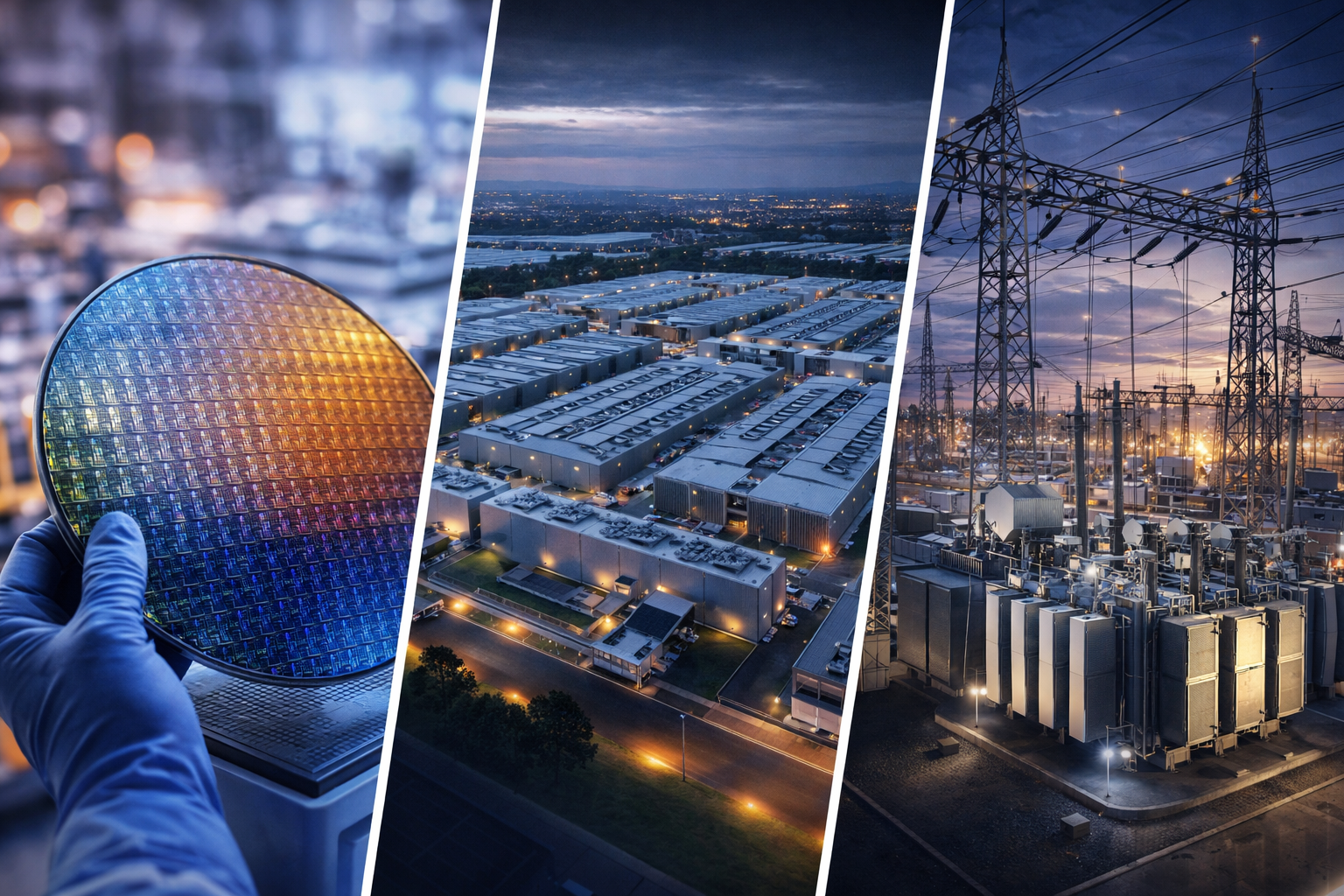
The artificial intelligence boom is entering a new phase—and it’s one that looks far less like Silicon Valley software and far more like heavy industry.
From semiconductor fabs to hyperscale data centers and even energy supply chains, tech giants are deploying capital at an unprecedented pace. According to Bloomberg (via Investing.com, April 1, 2026), this surge in AI-driven infrastructure spending is reshaping the entire technology sector, marking the beginning of what many analysts now describe as a capex supercycle.
For investors, the implications are profound. The biggest opportunities in AI may no longer be concentrated in software platforms or consumer applications—but in the physical backbone powering the AI economy.
A Historic Shift in Tech Spending
For decades, the technology sector was defined by capital efficiency. Software companies scaled rapidly with minimal physical infrastructure, generating high margins and strong free cash flow.
AI is changing that model.
Today’s leading tech companies—including Microsoft, Amazon, Alphabet, and Meta—are committing tens of billions of dollars annually to build out:
- Advanced semiconductor supply chains
- Massive data center networks
- AI training and inference infrastructure
- Energy and cooling systems
Estimates from industry analysts suggest that global AI infrastructure spending could exceed hundreds of billions annually by the end of the decade, driven by the race to develop and deploy increasingly powerful models.
Microsoft alone is projected to invest up to $146 billion in AI-related capital expenditures, underscoring the scale of this transformation.
Why This Matters for Investors
1. The Rise of a Capex Supercycle
The term “capex supercycle” is not used lightly.
Historically, such cycles have been associated with sectors like:
- Energy (oil and gas booms)
- Commodities (China-driven demand cycles)
- Telecommunications (5G infrastructure buildouts)
AI is now joining that list.
This supercycle is characterized by:
- Sustained, multi-year capital investment
- High demand for infrastructure and materials
- Structural shifts in industry economics
For investors, this signals a long-duration opportunity, rather than a short-term trend.
2. Margins Are Under Pressure—But Growth Is Expanding
One of the most important implications of this spending surge is its impact on profitability.
AI infrastructure requires:
- High upfront capital investment
- Ongoing operational costs (energy, maintenance)
- Continuous upgrades and scaling
This means:
- Short-term margins may compress
- Free cash flow could become more volatile
- Earnings visibility may decline
However, these investments are also laying the foundation for:
- New revenue streams
- Long-term competitive advantages
- Market leadership in AI-driven industries
As Bloomberg reporting highlights, companies are effectively trading near-term profitability for long-term dominance.
3. The AI Value Chain Is Expanding
The biggest shift for investors is the broadening of the AI investment landscape.
Previously, AI exposure was concentrated in:
- Software companies
- Cloud providers
- Semiconductor leaders
Now, the value chain includes:
- Chip manufacturers (GPUs, AI accelerators)
- Data center operators
- Energy providers and utilities
- Cooling and infrastructure companies
- Construction and industrial firms
This creates a more diverse set of opportunities—many of which are still underappreciated by the market.
The Semiconductor Backbone
At the heart of the AI infrastructure boom lies the semiconductor industry.
AI workloads require specialized chips capable of handling:
- Parallel processing
- High-speed data transfer
- Energy-efficient computation
Companies producing GPUs and AI accelerators are seeing:
- Explosive demand
- Supply constraints
- Pricing power
According to industry data and analyst commentary from firms like McKinsey & Company, semiconductor demand linked to AI could drive one of the most significant growth cycles in the sector’s history.
However, this also introduces risks:
- Supply chain bottlenecks
- Geopolitical tensions (particularly U.S.-China relations)
- High capital requirements for fabrication
Energy: The Hidden Driver of AI
One of the most overlooked aspects of AI infrastructure is energy.
Data centers are among the most energy-intensive facilities in the world, and AI workloads significantly increase power consumption.
As a result:
- Tech companies are securing direct energy partnerships
- Utilities are seeing rising demand forecasts
- Renewable energy projects are gaining strategic importance
Recent developments—including Microsoft’s reported discussions with energy companies—highlight how critical power supply has become.
According to the International Energy Agency (IEA), global electricity demand from data centers could rise sharply over the next decade, driven largely by AI.
For investors, this reinforces a key theme:
AI is not just a tech story—it is an energy story.
Future Trends to Watch
1. Vertical Integration by Tech Giants
Expect major tech firms to increasingly control their infrastructure stack, including:
- Chip design
- Data center operations
- Energy sourcing
This could create significant barriers to entry for smaller competitors.
2. Regional Competition for AI Infrastructure
Countries and regions are competing to attract AI investment by offering:
- Favorable regulations
- Access to energy
- Infrastructure support
The U.S. and Canada are emerging as key hubs, but global competition is intensifying.
3. New Leaders Beyond Big Tech
While mega-cap companies dominate headlines, smaller firms in:
- Industrial automation
- Cooling technologies
- Power management
could become critical enablers of the AI ecosystem.
4. Sustainability and ESG Considerations
The environmental impact of AI infrastructure is becoming a major concern.
Investors should monitor:
- Energy efficiency initiatives
- Renewable energy adoption
- Regulatory developments related to emissions
Companies that align with sustainability goals may gain a competitive edge.
Credible Signals Behind the Trend
- Bloomberg / Investing.com (April 1, 2026): Highlights the surge in AI infrastructure spending and its impact on tech economics
- McKinsey & Company: Identifies AI as a key driver of next-generation infrastructure investment
- International Energy Agency (IEA): Projects rising electricity demand from data centers
- Corporate disclosures: Reveal massive capex commitments from leading tech firms
These sources collectively confirm that the current investment cycle is not speculative—it is grounded in real capital deployment and structural demand.
Key Investment Insight
The AI boom is entering a phase where infrastructure—not applications—will determine the winners.
Investors should consider shifting focus toward:
- Semiconductor companies benefiting from AI chip demand
- Energy and utility providers supporting data center growth
- Industrial and infrastructure firms building AI ecosystems
- Selective tech companies with strong capital discipline and execution capabilities
The most compelling opportunities may lie in picks-and-shovels plays—the companies enabling AI rather than those simply using it.
Strategic Perspective
The surge in AI infrastructure spending marks a turning point for the technology sector.
What was once a capital-light industry is becoming increasingly asset-intensive, driven by the need to build the physical foundation of the AI economy.
This transition brings both opportunity and risk:
- Opportunity in the form of new growth markets and expanded value chains
- Risk in the form of higher costs, execution challenges, and evolving competitive dynamics
For investors, the key is to recognize that the AI narrative is evolving. The next phase will not be defined solely by innovation—but by who can build, scale, and sustain the infrastructure behind it.
Understanding this shift early could be the difference between capturing the next wave of returns—or missing it entirely.
Stay ahead of the evolving AI landscape with MoneyNews.Today—your trusted source for daily, data-driven investor insights.




