
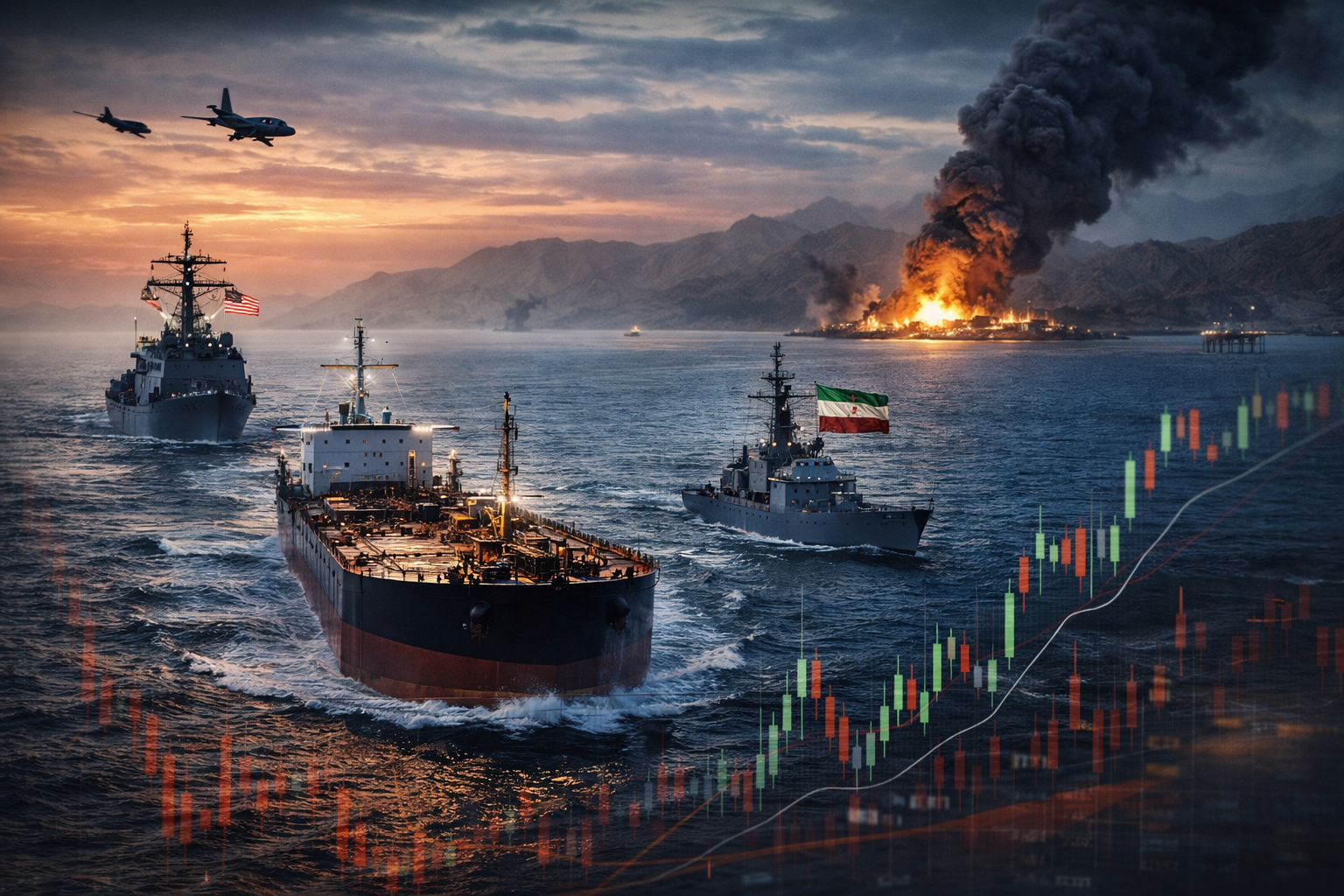
Global markets are once again being driven not by earnings or economic data—but by geopolitics. A rapidly escalating standoff between the United States and Iran has placed one of the world’s most critical energy chokepoints—the Strait of Hormuz—at the center of a high-stakes confrontation.
According to Reuters (April 7, 2026), the U.S. has issued a firm deadline for Iran to reopen the strait following disruptions, warning of potential military consequences if compliance is not met. Iran, however, has rejected ceasefire proposals, raising the risk of prolonged conflict and triggering alarm across global financial markets.
For investors, this is not just another geopolitical headline—it is currently the single most important macro driver, with the potential to influence oil prices, inflation trajectories, and global market stability in real time.
A Critical Flashpoint for Global Energy Markets
The Strait of Hormuz is not just a regional concern—it is a global economic lifeline.
Roughly one-fifth of the world’s oil supply passes through this narrow waterway. Any disruption, even temporary, can have immediate and far-reaching consequences:
- Sharp spikes in oil prices
- Supply chain disruptions
- Increased shipping and insurance costs
- Heightened volatility across financial markets
The current situation has already triggered a surge in crude prices, with markets pricing in the risk of a prolonged disruption.
Historically, similar geopolitical events have led to rapid re-pricing of risk across asset classes, and early signs suggest that this time is no different.
Why This Matters for Investors
This crisis is unfolding at a time when markets are already navigating a complex macro environment. The implications are both immediate and structural.
1. Oil Prices as the Transmission Mechanism
Oil is the primary channel through which geopolitical tensions impact financial markets.
When supply is threatened:
- Prices rise quickly due to fear-driven buying
- Inflation expectations increase
- Central banks face renewed policy challenges
The current spike above $100—and toward $114—has already begun influencing investor sentiment.
For equity markets, higher oil prices act as a headwind, particularly for sectors sensitive to input costs and consumer demand.
2. Inflation Risk Is Back in Focus
Just as markets were beginning to anticipate stabilization in inflation, rising energy prices are complicating the outlook.
Higher oil prices feed directly into:
- Transportation costs
- Manufacturing expenses
- Consumer prices
This raises the possibility that central banks, including the U.S. Federal Reserve, may need to maintain tighter monetary policy for longer, delaying potential rate cuts.
For investors, this creates a challenging dynamic where both growth and valuations come under pressure.
3. Market Volatility Is Being Repriced
Periods of geopolitical tension are typically associated with higher volatility.
In the current environment, this is manifesting as:
- Increased fluctuations in equity markets
- Sharp movements in commodity prices
- Rising demand for safe-haven assets
Investors are shifting toward risk management strategies, prioritizing capital preservation over aggressive growth positioning.
Sector-Level Impact: Winners and Losers
The geopolitical shock is not affecting all sectors equally.
📈 Beneficiaries
Energy Stocks:
Higher oil prices directly boost revenues and margins for energy producers.
Defense Companies:
Rising geopolitical tensions often lead to increased defense spending.
Commodities and Mining:
Broader commodity markets benefit from inflationary pressures and supply concerns.
📉 Under Pressure
Technology and Growth Stocks:
Higher rates and risk aversion weigh on high-valuation sectors.
Consumer Discretionary:
Rising fuel and living costs reduce consumer spending power.
Transportation and Airlines:
Fuel costs represent a major expense, impacting profitability.
What the Data and Experts Are Saying
According to Reuters (April 7, 2026), the U.S. deadline represents a significant escalation in tensions, increasing the likelihood of further market disruptions.
Additional perspectives from leading institutions reinforce the risks:
- Bloomberg analysts highlight the Strait of Hormuz as one of the most sensitive points in global energy infrastructure
- The International Energy Agency (IEA) has repeatedly warned that supply disruptions in the region can lead to rapid and sustained price increases
- Market strategists note that geopolitical shocks often trigger short-term equity sell-offs followed by sector rotation
Investopedia’s latest market analysis confirms that investors are currently in a “wait-and-see” mode, closely monitoring developments before making major allocation decisions.
Risks Investors Should Watch
⚠️ Military Escalation
Any direct conflict could lead to a sharp and sustained spike in oil prices, amplifying market volatility.
⚠️ Prolonged Supply Disruption
Extended closure or instability in the Strait of Hormuz would have significant economic consequences.
⚠️ Policy Uncertainty
Central banks may face difficult decisions if inflation rises again due to energy costs.
⚠️ Market Overreaction
Markets can overprice risk in the short term, creating both challenges and opportunities.
Future Trends to Watch
🛢️ Energy Market Dynamics
Oil prices will remain highly sensitive to developments in the region.
🌍 Geopolitical Realignment
Shifting alliances and strategic priorities could reshape global trade and investment flows.
🔄 Sector Rotation
Investors may continue moving toward defensive and commodity-linked sectors.
📊 Increased Market Sensitivity
Markets are likely to react more quickly—and more sharply—to geopolitical news.
Key Investment Insight
This crisis underscores a critical reality: markets are currently event-driven, not fundamentals-driven.
For investors, this means:
- Monitoring geopolitical developments as closely as economic data
- Using commodities as a hedge against uncertainty
- Staying diversified across sectors and asset classes
- Being prepared for rapid changes in market conditions
Understanding the macro landscape is essential for navigating today’s environment.
Investment Outlook: Geopolitics Takes Center Stage
The escalating tensions between the United States and Iran represent a defining moment for global markets. As the situation around the Strait of Hormuz continues to evolve, investors are being forced to reassess risk in real time.
While uncertainty remains high, it also creates opportunities for those who can interpret market signals effectively. The key is to remain disciplined, avoid overreaction, and focus on long-term positioning within a rapidly changing landscape.
In the near term, caution is warranted. But as history has shown, periods of geopolitical stress often pave the way for strategic investment opportunities once clarity emerges.
Stay ahead of the markets with MoneyNews.Today, your trusted source for daily investor insights, breaking trends, and actionable financial analysis.




