
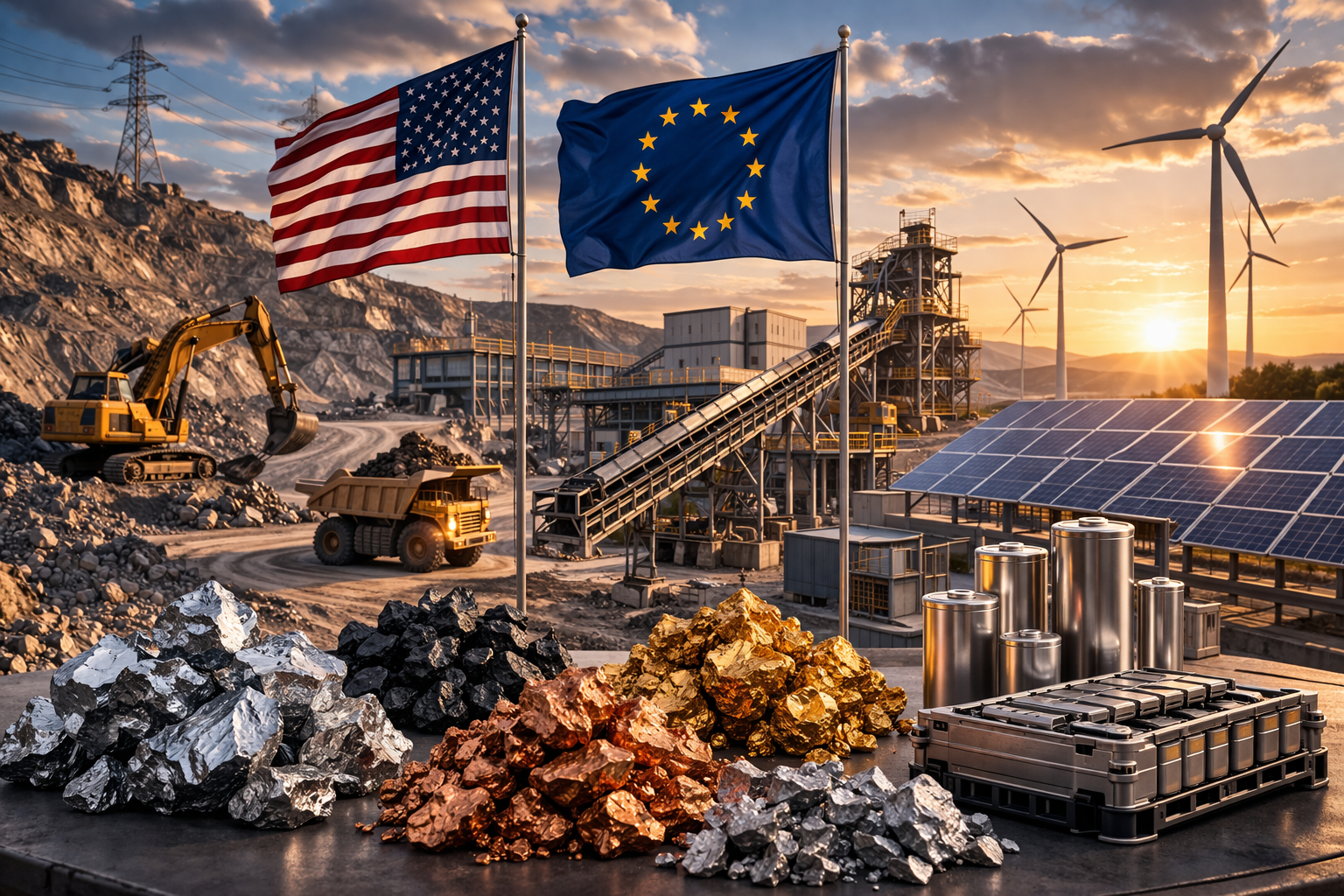
The global race for resources is entering a new phase—and this time, it’s not about oil.
Instead, it’s about critical minerals: the essential building blocks powering electric vehicles, renewable energy systems, semiconductors, and advanced defense technologies. According to Bloomberg (April 10, 2026), the United States and the European Union are on the verge of a landmark agreement to coordinate supply chains for these materials—aimed squarely at reducing dependence on China.
For investors, this is more than a geopolitical headline. It signals a long-term structural shift in global commodity markets, one that could reshape mining economics, supply chains, and capital flows for years to come.
A Strategic Pivot Away From China
China currently dominates the global supply chain for critical minerals, particularly rare earth elements, lithium processing, and key battery materials. According to data from the International Energy Agency (IEA) and U.S. Geological Survey (USGS):
- China controls a significant share of rare earth production and refining
- It leads in processing capacity for lithium, cobalt, and graphite
- It plays a central role in downstream manufacturing, including batteries and electronics
This concentration has long been viewed as a strategic vulnerability by Western governments.
The proposed U.S.–EU agreement aims to change that by:
- Coordinating sourcing and processing strategies
- Supporting domestic and allied mining projects
- Introducing mechanisms such as price guarantees and subsidies
- Encouraging private sector investment into non-China supply chains
In essence, this is about building a parallel, Western-aligned supply ecosystem for critical minerals.
Why This Matters for Investors
The implications of this agreement stretch far beyond politics—they directly affect commodity markets, mining equities, and industrial supply chains.
1. A Structural Demand Shift
As governments actively support alternative supply chains, demand for non-China sourced minerals is expected to rise significantly.
2. Pricing Power and Stability
Potential incentives like price guarantees could reduce volatility and provide more predictable revenue streams for mining companies.
3. Capital Reallocation
Institutional capital is likely to flow toward projects aligned with Western supply chains, particularly in regions like:
- North America
- Australia
- Select parts of Africa and Latin America
4. Strategic Premiums
Companies operating in politically aligned jurisdictions may begin to command valuation premiums due to reduced geopolitical risk.
According to Bloomberg Intelligence, supply chain diversification is becoming a central investment theme, particularly in sectors tied to energy transition and national security.
The Commodities at the Center of the Deal
Not all minerals are created equal. The agreement is expected to focus on materials that are both economically critical and geopolitically sensitive.
Rare Earth Elements
Used in wind turbines, electric motors, and defense systems, rare earths are among the most strategically important materials.
Lithium
A key component in EV batteries, lithium demand is projected to grow exponentially over the next decade.
Cobalt and Nickel
Critical for battery chemistry, these metals are essential for energy storage technologies.
Graphite
Used in battery anodes, graphite is another area where China has significant control.
According to the IEA’s Critical Minerals Outlook, demand for these materials could increase by several multiples by 2030 under energy transition scenarios.
Supply Constraints and Opportunity
While demand is surging, supply remains constrained—a dynamic that creates both risk and opportunity.
Long Project Timelines
Mining projects often take 5–10 years to move from discovery to production, limiting the speed at which supply can respond.
Environmental and Regulatory Hurdles
Stricter environmental standards in Western countries can slow project approvals but also create higher barriers to entry.
Capital Intensity
Developing mining and processing infrastructure requires significant upfront investment, making government support a critical factor.
This is where the U.S.–EU deal could be transformative. By providing policy support and financial incentives, it may accelerate project development timelines and unlock new supply.
The Competitive Landscape Is Shifting
As Western nations push to diversify supply chains, competition in the mining sector is intensifying.
Existing Producers
Established mining companies with operations in stable jurisdictions are well-positioned to benefit from increased demand and policy support.
Emerging Players
Junior mining companies and early-stage projects could see significant upside as they become acquisition targets or receive funding.
Processing and Refining
Beyond mining, there is a growing focus on processing capacity, an area where China has historically dominated.
According to McKinsey’s energy transition research, the value chain for critical minerals is expanding, with opportunities across extraction, refining, and recycling.
Future Trends to Watch
The critical minerals story is still unfolding, and several key trends will shape its trajectory:
Policy-Driven Markets
Government intervention will play a larger role in commodity pricing and supply chain decisions.
Vertical Integration
Companies may seek to control more of the value chain—from mining to processing to end-use manufacturing.
Recycling and Circular Economy
As demand grows, recycling of critical minerals will become increasingly important.
Technological Innovation
Advancements in battery technology and material science could shift demand patterns over time.
Geopolitical Tensions
Resource competition is likely to remain a source of geopolitical friction, influencing market dynamics.
Risks Investors Should Consider
While the opportunity is significant, it is not without risks.
Execution Risk
Mining projects are complex and often face delays, cost overruns, and operational challenges.
Policy Uncertainty
Government support can change with political cycles, affecting long-term project viability.
Commodity Price Volatility
Despite structural demand, prices can be highly volatile in the short term.
Technological Disruption
New technologies could reduce reliance on certain minerals, altering demand dynamics.
Investors should approach the sector with a balanced perspective—recognizing both the upside potential and the inherent risks.
Key Investment Insight
The emerging U.S.–EU critical minerals deal represents a strategic realignment of global supply chains, with far-reaching implications for the mining sector.
For investors, this creates a clear thematic opportunity:
- Focus on Western-aligned mining companies with exposure to critical minerals
- Monitor developments in government policy and incentives
- Look for opportunities in processing and refining infrastructure
- Consider the broader ecosystem, including equipment suppliers and recyclers
This is not just a commodity cycle—it is a multi-decade structural shift driven by energy transition, technological innovation, and geopolitical strategy.
A New Era for Commodities Investing
The global economy is being reshaped by forces that extend far beyond traditional market cycles. The race for critical minerals is one of the most important—and underappreciated—investment themes of this decade.
As the U.S. and EU move closer to formalizing this agreement, the implications for markets will continue to evolve, creating both risks and opportunities for investors.
Stay with MoneyNews.Today for daily, investor-focused insights that help you navigate the trends shaping the future of global markets.




