
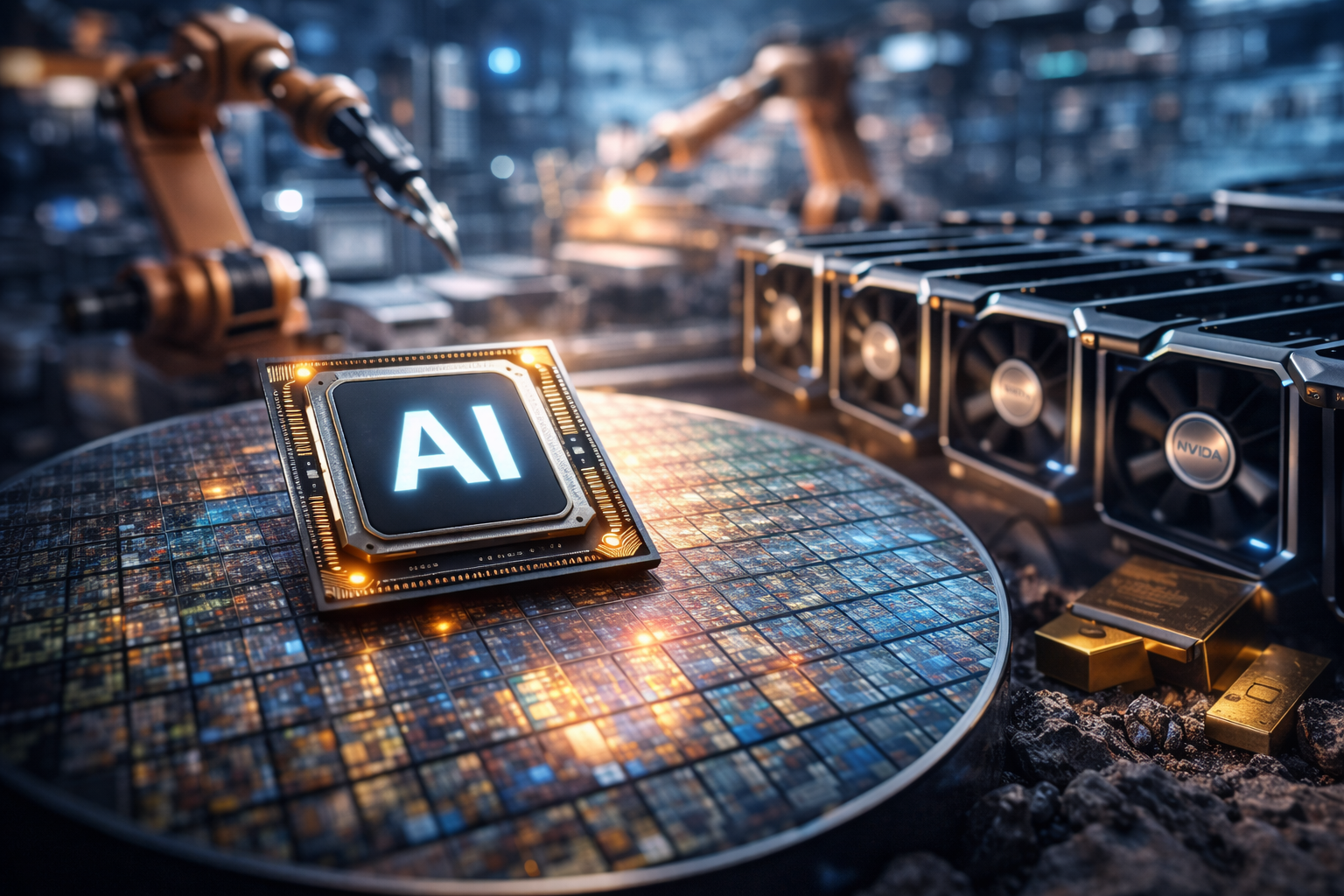
Artificial intelligence is no longer just a software revolution—it is rapidly becoming the most powerful demand engine in global hardware markets.
That reality was reinforced once again as Taiwan Semiconductor Manufacturing Company (TSMC) reported a 35% surge in revenue, driven by explosive global demand for AI chips. The performance highlights the continued strength of semiconductor demand even as broader macroeconomic uncertainty persists across global markets.
For investors, this is a critical signal: the AI trade is not slowing down—but it is becoming more concentrated, more capital-intensive, and increasingly sensitive to supply chain dynamics.
AI Demand Is Reshaping the Semiconductor Cycle
TSMC sits at the center of the global semiconductor ecosystem, manufacturing chips for leading technology companies that power everything from cloud computing to generative AI models.
The latest revenue surge underscores a key market reality: AI is now the dominant driver of semiconductor demand.
This growth is being fueled by several interconnected trends:
- Rapid expansion of hyperscale data centers
- Accelerated adoption of generative AI models
- Increasing demand for high-performance GPUs and accelerators
- Enterprise-wide AI integration across industries
According to Reuters industry analysis and Bloomberg Intelligence reports, AI-related chip demand is now outpacing traditional semiconductor segments such as consumer electronics and mobile devices.
This marks a structural shift in the industry’s growth engine.
Why This Matters for Investors
TSMC’s results are not just a company-specific story—they reflect a broader transformation in global technology markets.
1. Semiconductors Are the Core of the AI Economy
Every AI application—from large language models to autonomous systems—relies on advanced chips. This places semiconductor manufacturers at the center of value creation in the AI supply chain.
2. Visibility Into Global AI Spending
TSMC’s performance serves as a real-time indicator of global AI infrastructure investment. When chip demand rises at this scale, it signals that AI capital expenditure is accelerating across major tech firms.
3. Supply Chain Bottlenecks Remain a Key Risk
Despite strong demand, the semiconductor industry remains constrained by:
- Limited advanced fabrication capacity
- High capital expenditure requirements
- Complex production timelines
This creates a mismatch between demand and supply, which can amplify pricing power for leading manufacturers like TSMC.
The 35% Surge: What’s Driving It
The magnitude of TSMC’s revenue growth reflects a convergence of demand drivers across multiple sectors.
Hyperscale Cloud Expansion
Major cloud providers are investing heavily in AI infrastructure, building new data centers to support training and deployment of large-scale models.
AI Model Scaling
As AI models become more complex, they require exponentially more computing power, driving demand for advanced chips built on cutting-edge process nodes.
Enterprise AI Adoption
Corporations across finance, healthcare, manufacturing, and retail are integrating AI into operations, further expanding semiconductor demand.
Government and Strategic Investment
National initiatives in the U.S., Europe, and Asia are supporting domestic semiconductor capacity and AI infrastructure development.
According to McKinsey’s global technology outlook, AI-related infrastructure spending is expected to remain one of the fastest-growing segments in global capital investment over the coming years.
The Semiconductor Industry’s New Growth Phase
TSMC’s results highlight a broader shift in the semiconductor industry from cyclical recovery to structural growth driven by AI.
However, this new phase comes with important nuances.
Strong Demand, Limited Supply
Advanced chip production is highly concentrated and capital-intensive, meaning supply cannot quickly respond to demand spikes.
Rising Capital Expenditure
Leading semiconductor firms are increasing investment in fabrication plants and R&D, raising long-term fixed costs.
Technological Competition Intensifies
The race for smaller, more efficient chip architectures is accelerating, with competition among global foundries intensifying.
Geopolitical Importance
Semiconductors have become a strategic asset, with governments treating chip production as a matter of national security.
According to Bloomberg semiconductor research, this combination of factors is creating a long-term structural uptrend—but also increasing volatility in earnings expectations.
Valuation Risk: The Other Side of the AI Trade
While growth remains strong, investors are increasingly focused on valuation sensitivity.
Semiconductor stocks have already experienced significant re-rating due to AI optimism. As a result:
Expectations Are Elevated
Markets are pricing in sustained double-digit growth across the AI chip ecosystem.
Any Slowdown Could Trigger Volatility
Even modest signs of demand normalization could lead to sharp corrections in high-growth tech stocks.
Cyclical Risks Still Exist
Despite structural growth, semiconductors remain cyclical, meaning periods of oversupply or demand stabilization are still possible.
This creates a delicate balance for investors: strong long-term growth potential, but heightened short-term sensitivity.
Future Trends to Watch
The next phase of the semiconductor and AI cycle will likely be shaped by several key developments:
Continued AI Infrastructure Expansion
Cloud providers are expected to maintain aggressive investment in AI hardware and data center capacity.
Shift Toward Custom Silicon
Companies are increasingly designing proprietary chips optimized for specific AI workloads, changing demand patterns across the industry.
Advanced Manufacturing Breakthroughs
Next-generation process technologies will determine competitive positioning among leading chipmakers.
Supply Chain Diversification
Geopolitical tensions are pushing countries to diversify semiconductor production outside traditional hubs.
Efficiency vs Scale Trade-Off
As energy consumption and costs rise, efficiency in chip design will become as important as raw performance.
Key Investment Insight
TSMC’s 35% revenue surge confirms a central truth of the current market cycle: semiconductors are the core profit engine of the AI revolution.
However, this is no longer an early-stage growth story. It is a maturing structural trend with rising complexity and valuation risk.
For investors, this means:
- Maintaining exposure to high-quality semiconductor leaders with strong pricing power
- Monitoring AI infrastructure spending trends as a leading indicator
- Being cautious about overextended valuations in high-growth tech segments
- Considering adjacent opportunities such as equipment suppliers and materials providers
The AI semiconductor cycle remains powerful—but it is entering a phase where execution and expectations matter as much as growth.
Stay Ahead of the Curve
As AI continues to reshape global markets, developments like TSMC’s earnings will remain central to understanding where capital is flowing next.
Stay with MoneyNews.Today for daily, investor-focused insights that help you navigate the trends shaping technology, markets, and the global economy.




