
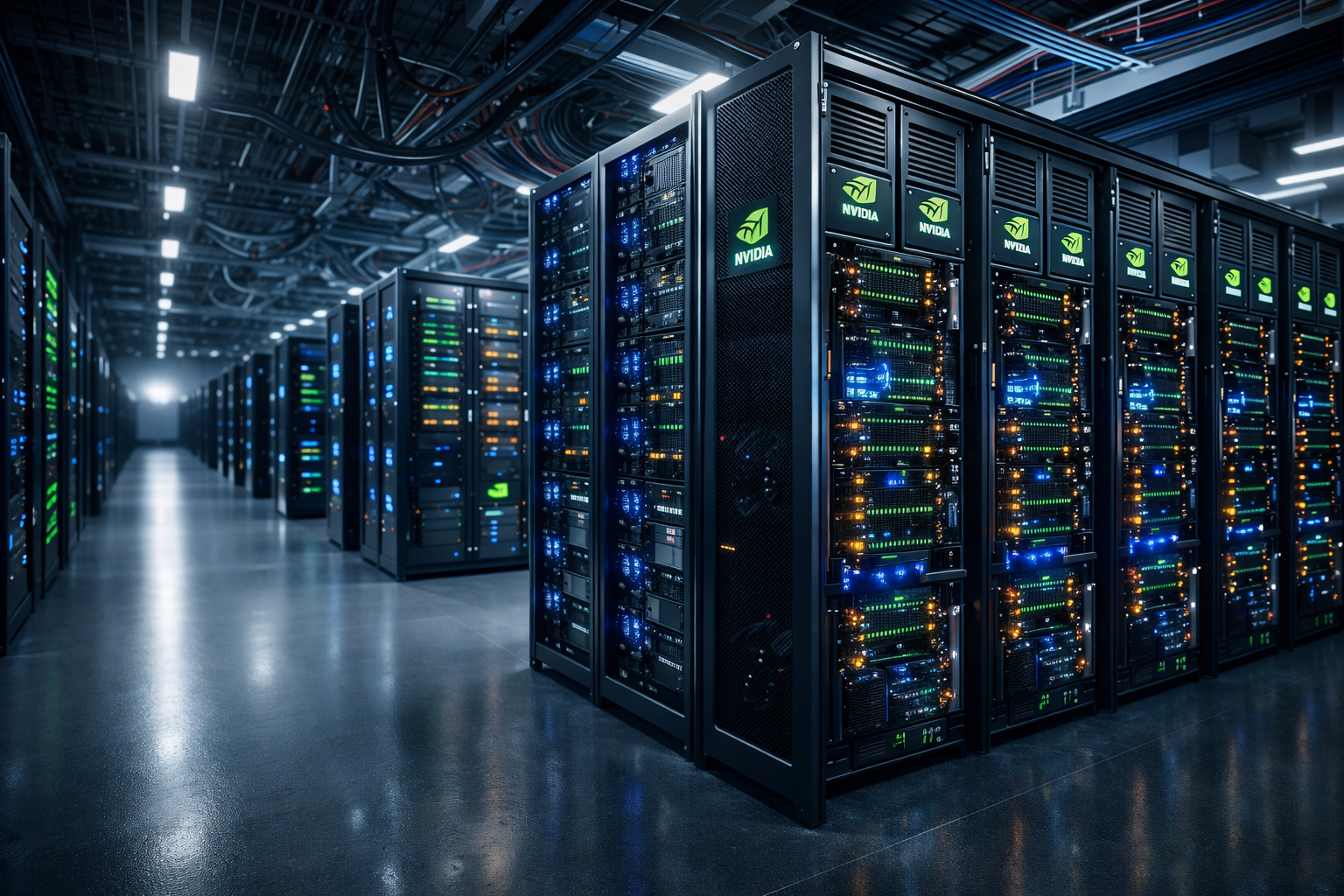
The market’s obsession with artificial intelligence is entering a decisive new phase—and this time, it’s not about flashy demos or speculative narratives. It’s about infrastructure, capital intensity, and real revenue generation. As investors head into a critical earnings window featuring Tesla and Intel, attention is shifting rapidly toward the backbone powering AI: data centers, advanced semiconductors, and enterprise deployment at scale.
Across Wall Street and Bay Street, one message is becoming increasingly clear—AI is no longer a concept trade. It is an industrial buildout, and capital is flowing accordingly.
The Shift From Hype to Hardware
Over the past two years, AI has driven some of the strongest equity market gains, particularly in mega-cap technology names. But the narrative is evolving. Instead of focusing solely on applications like chatbots or automation tools, investors are now zeroing in on the infrastructure layer required to sustain AI growth.
This includes:
- Hyperscale data centers
- High-performance GPUs and specialized AI chips
- Power generation and cooling systems
- Enterprise-grade cloud infrastructure
According to research and commentary from RBC Global Asset Management, the AI economy is transitioning into a “compute-intensive phase,” where long-term value creation will be driven by those enabling the technology—not just those deploying it.
Recent reporting from Reuters reinforces this trend, highlighting that global tech firms are significantly increasing capital expenditures tied to AI infrastructure. Meanwhile, market intelligence platforms such as Bitget point to surging demand for computing power as enterprise adoption accelerates.
Data Centers: The New Oil Fields of the Digital Economy
If AI is the engine, data centers are the fuel supply.
Demand for data center capacity is exploding, driven by the sheer computational requirements of training and running large-scale AI models. Unlike traditional cloud workloads, AI systems require massive parallel processing power, significantly increasing energy consumption and hardware needs.
Major cloud providers and infrastructure players are now racing to expand their footprints. This includes not only building new facilities but also upgrading existing ones to support AI-specific workloads, such as high-density GPU clusters.
The implications for investors are substantial:
- Data center REITs and infrastructure providers are seeing renewed growth trajectories
- Energy companies are benefiting from rising electricity demand tied to AI workloads
- Cooling and thermal management technologies are emerging as critical enablers
This shift mirrors historical industrial cycles—where infrastructure buildouts often generate more durable and predictable returns than end-user applications.
Semiconductors Take Center Stage
At the heart of the AI infrastructure boom lies the semiconductor industry. Advanced chips are the foundation of modern AI systems, and demand is outpacing supply in several key segments.
Companies like Intel are repositioning themselves to capture this opportunity, investing heavily in next-generation chip manufacturing and AI-focused architectures. Meanwhile, competitors across the sector are scaling production of GPUs and specialized accelerators designed specifically for AI workloads.
This surge in demand is not cyclical—it is structural.
Analysts note that AI-driven chip demand could represent one of the largest secular growth drivers for semiconductors in decades, rivaling the rise of smartphones and cloud computing.
However, the stakes are high. Semiconductor manufacturing is capital-intensive, geopolitically sensitive, and highly competitive. Execution will be critical, particularly as governments in the U.S. and Canada push for domestic chip production and supply chain resilience.
Big Tech Earnings: A Defining Moment
The upcoming earnings reports from major technology players are expected to provide crucial insight into the sustainability of the AI trade.
For Tesla, investors will be watching for updates on its AI-driven initiatives, including autonomous driving and data processing capabilities. Tesla’s positioning as both an automotive and AI company makes it a unique bellwether for how AI is being integrated into real-world applications.
Meanwhile, Intel will be under scrutiny for its progress in scaling AI chip production and competing in an increasingly crowded market.
Beyond individual companies, these earnings will offer broader signals:
- Are capital expenditures on AI continuing to rise?
- Are companies seeing measurable returns on AI investments?
- How quickly is enterprise adoption translating into revenue?
The answers to these questions will likely determine whether the AI rally continues—or enters a more volatile phase.
Why This Matters for Investors
The transition from AI hype to infrastructure has several important implications:
1. Capital Is Moving Down the Stack
Early gains were concentrated in software and platform companies. Now, investment is shifting toward hardware, infrastructure, and enablers—areas that often have longer investment cycles but more stable revenue streams.
2. Margins vs. Scale
Infrastructure businesses typically operate with different margin profiles compared to software companies. However, they benefit from scale, long-term contracts, and recurring demand, making them attractive in uncertain macro environments.
3. New Winners Are Emerging
The next phase of AI growth may not be led solely by the same mega-cap names. Instead, mid-cap infrastructure providers, semiconductor firms, and specialized technology companies could outperform as the ecosystem expands.
4. Energy Becomes a Critical Variable
AI’s energy consumption is rapidly becoming a key constraint—and opportunity. Companies involved in power generation, grid infrastructure, and energy efficiency are increasingly tied to the AI growth story.
Future Trends to Watch
As the AI infrastructure boom accelerates, several trends are likely to shape the market:
AI-Native Data Centers
New facilities designed specifically for AI workloads will become the standard, incorporating advanced cooling systems and optimized hardware configurations.
Vertical Integration
Tech giants may increasingly control more of their infrastructure stack—from chips to data centers—to improve efficiency and reduce dependency on third parties.
Government Involvement
Public policy will play a growing role, particularly in areas like semiconductor manufacturing, energy supply, and data sovereignty.
Enterprise AI Adoption
Beyond Big Tech, traditional industries are beginning to integrate AI into operations, driving incremental demand for infrastructure and compute power.
Key Investment Insight
The AI trade is no longer about identifying the most exciting applications—it’s about understanding where capital is being deployed at scale.
Investors should consider focusing on:
- Semiconductor companies benefiting from AI chip demand
- Cloud and data center providers expanding infrastructure capacity
- Energy and utility firms supporting increased power consumption
- Industrial and engineering companies involved in building AI ecosystems
At the same time, caution is warranted. Valuations in certain segments remain elevated, and execution risks—particularly in capital-intensive industries—should not be overlooked.
The most compelling opportunities may lie in companies with proven delivery capabilities, strong balance sheets, and clear exposure to AI infrastructure growth.
AI is no longer just a technological revolution—it is becoming an economic and industrial transformation. For investors, the opportunity is shifting from speculation to strategy, from narratives to numbers.
Stay ahead of these market-defining trends with MoneyNews.Today, your trusted source for daily investor insights and actionable financial intelligence.




