
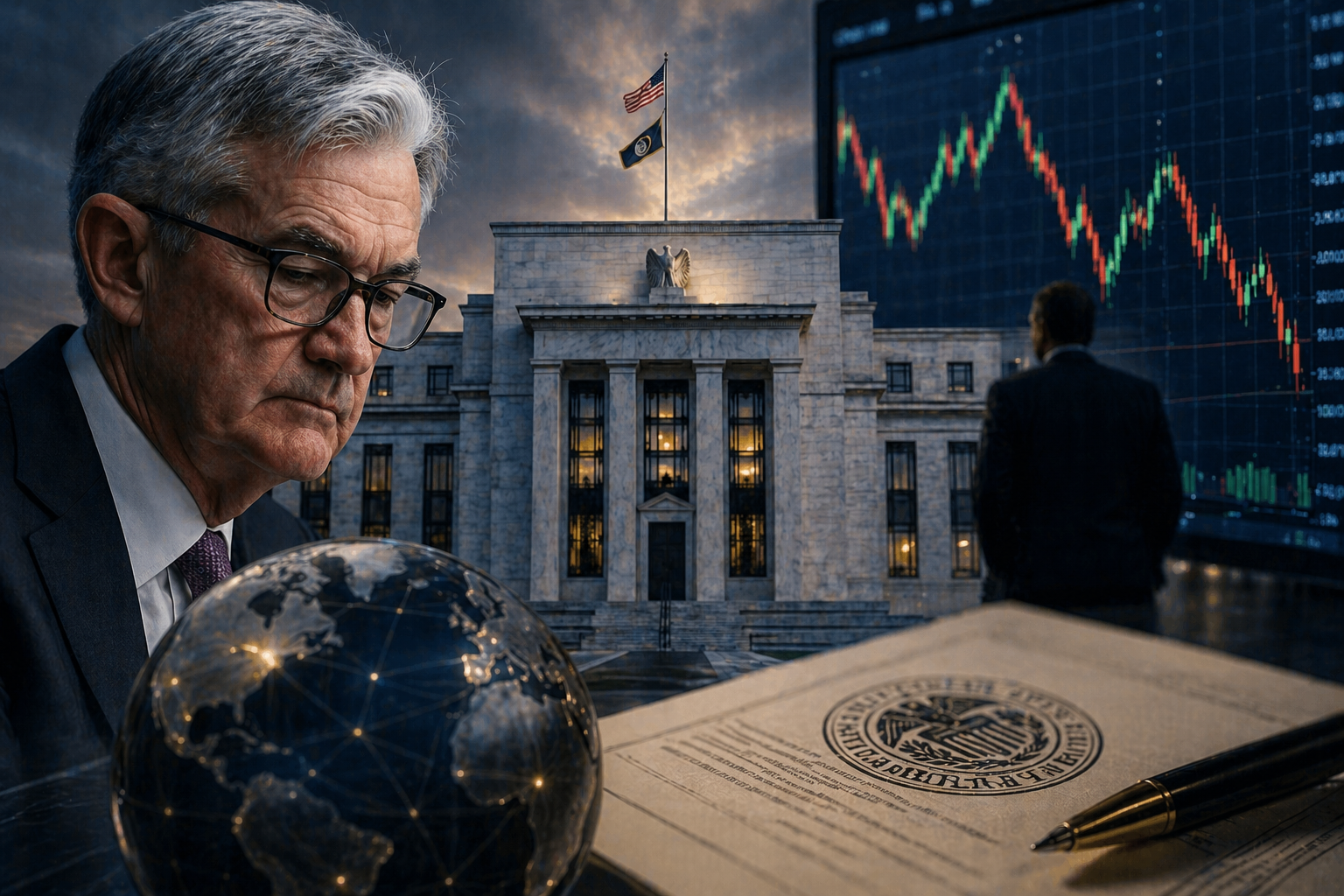
Markets are accustomed to parsing every word from the Federal Reserve—but today, investors are reading between the lines more than ever. The latest policy meeting isn’t just about interest rates; it may mark the closing chapter of Jerome Powell’s tenure at the helm of the Federal Reserve.
With expectations that the Fed will hold rates steady, the real focus has shifted toward something far more consequential: what comes next—and who will shape it.
According to Reuters (April 29, 2026), the combination of a policy decision and an impending leadership transition is injecting a new layer of uncertainty into global markets. For investors, this is not just a routine central bank update—it’s a potential policy regime shift that could redefine the trajectory of interest rates, liquidity, and risk assets.
A Turning Point for Monetary Policy
For the past several years, Powell’s leadership has been defined by navigating extraordinary economic conditions—from pandemic-era stimulus to aggressive rate hikes aimed at controlling inflation.
Now, as inflation shows signs of moderating and growth remains uneven, the Federal Reserve finds itself at a crossroads.
The key issue is no longer just whether rates go up or down. It’s about:
- The framework guiding future decisions
- The tolerance for inflation versus growth risks
- The communication style of future leadership
Leadership transitions at central banks are rare—but when they occur, they often coincide with meaningful shifts in policy direction.
Why This Matters for Investors
Policy Continuity Is No Longer Guaranteed
Under Powell, markets became familiar with a relatively transparent and data-driven approach to monetary policy. Forward guidance, press conferences, and clear signaling helped reduce uncertainty—even during volatile periods.
A leadership change introduces a critical unknown:
- Will the next chair maintain the same approach?
- Could the Fed adopt a more hawkish or dovish stance?
- How will communication with markets evolve?
For investors, these questions directly impact expectations for:
- Interest rates
- Equity valuations
- Bond yields
- Currency movements
Markets Are Highly Sensitive to Tone
Even if today’s rate decision meets expectations, the tone of the Fed’s statement and press conference could move markets significantly.
Investors are watching for signals on:
- Timing of potential rate cuts
- Inflation outlook
- Economic growth expectations
Subtle shifts in language—particularly during a leadership transition—can trigger:
- Equity market rallies or sell-offs
- Bond yield volatility
- Currency fluctuations
In today’s environment, communication is policy.
A Regime Shift Could Reshape Asset Allocation
A change in leadership raises the possibility of a broader policy reset.
This could include:
- A different inflation target approach
- Adjustments to balance sheet policy
- New priorities in financial stability
Such changes would have far-reaching implications for asset allocation strategies.
For example:
- A more dovish Fed could support equities and growth stocks
- A more hawkish stance could favor defensive sectors and fixed income
The Market Context: Why Timing Matters
The significance of today’s meeting is amplified by the broader market environment.
Inflation Remains a Key Variable
While inflation has cooled from its peak, it remains above long-term targets.
The Fed must balance:
- The risk of easing too soon
- The risk of tightening too much
This delicate balance becomes even more complex during a leadership transition.
Economic Growth Is Uneven
Recent data suggests a mixed economic picture:
- Strong consumer spending in some sectors
- Weakness in manufacturing and housing
- Persistent global uncertainties
This makes future policy decisions less predictable—and more dependent on leadership judgment.
Markets Are Already on Edge
As highlighted in recent Reuters and Bloomberg coverage, markets are entering this decision with elevated uncertainty.
Volatility indicators have been rising, and investors are positioning cautiously ahead of both:
- The Fed decision
- Ongoing earnings reports
This creates a setup where even minor surprises can lead to outsized reactions.
Future Trends to Watch
The Next Fed Chair and Policy Direction
One of the most important developments to monitor is the selection of the next Federal Reserve chair.
Key considerations include:
- Their stance on inflation versus growth
- Their approach to communication
- Their views on financial stability and regulation
Markets will quickly attempt to price in these factors.
Evolution of Forward Guidance
Under Powell, forward guidance became a central tool for managing market expectations.
A new leader may:
- Continue this approach
- Modify it
- Or adopt a more opaque communication style
Each scenario carries different implications for market stability.
Global Implications
The Federal Reserve’s influence extends far beyond the United States.
Changes in U.S. monetary policy affect:
- Global capital flows
- Emerging market currencies
- Commodity prices
A leadership transition could therefore have ripple effects across international markets.
Key Investment Insight
This is not just a rate decision—it’s a moment of strategic reassessment for investors.
The key takeaway is clear: policy uncertainty is rising, and positioning must reflect that reality.
Actionable strategies include:
- Staying diversified across asset classes to manage uncertainty
- Monitoring Fed communication closely, particularly tone and guidance
- Adjusting exposure to interest rate-sensitive sectors such as technology and real estate
- Considering defensive positioning in case of increased volatility
- Watching bond markets for early signals of shifting expectations
In an environment where policy direction is less certain, flexibility becomes a critical advantage.
The Bigger Picture
Central bank leadership transitions are rare—but they often mark the beginning of new market cycles.
What makes this moment particularly significant is the combination of:
- A potential leadership change
- A shifting inflation environment
- Evolving economic conditions
Together, these factors create the conditions for a policy regime shift that could influence markets for years to come.
For investors, the challenge is not just reacting to today’s decision—but anticipating how the broader policy landscape may evolve.
This requires a deeper understanding of:
- Monetary policy dynamics
- Market sensitivity to central bank actions
- The interplay between macroeconomics and asset prices
In times like these, informed decision-making is more important than ever.
Stay ahead of shifting policy and market dynamics with MoneyNews.Today—your trusted source for daily investor insights, macro analysis, and actionable financial intelligence.




