
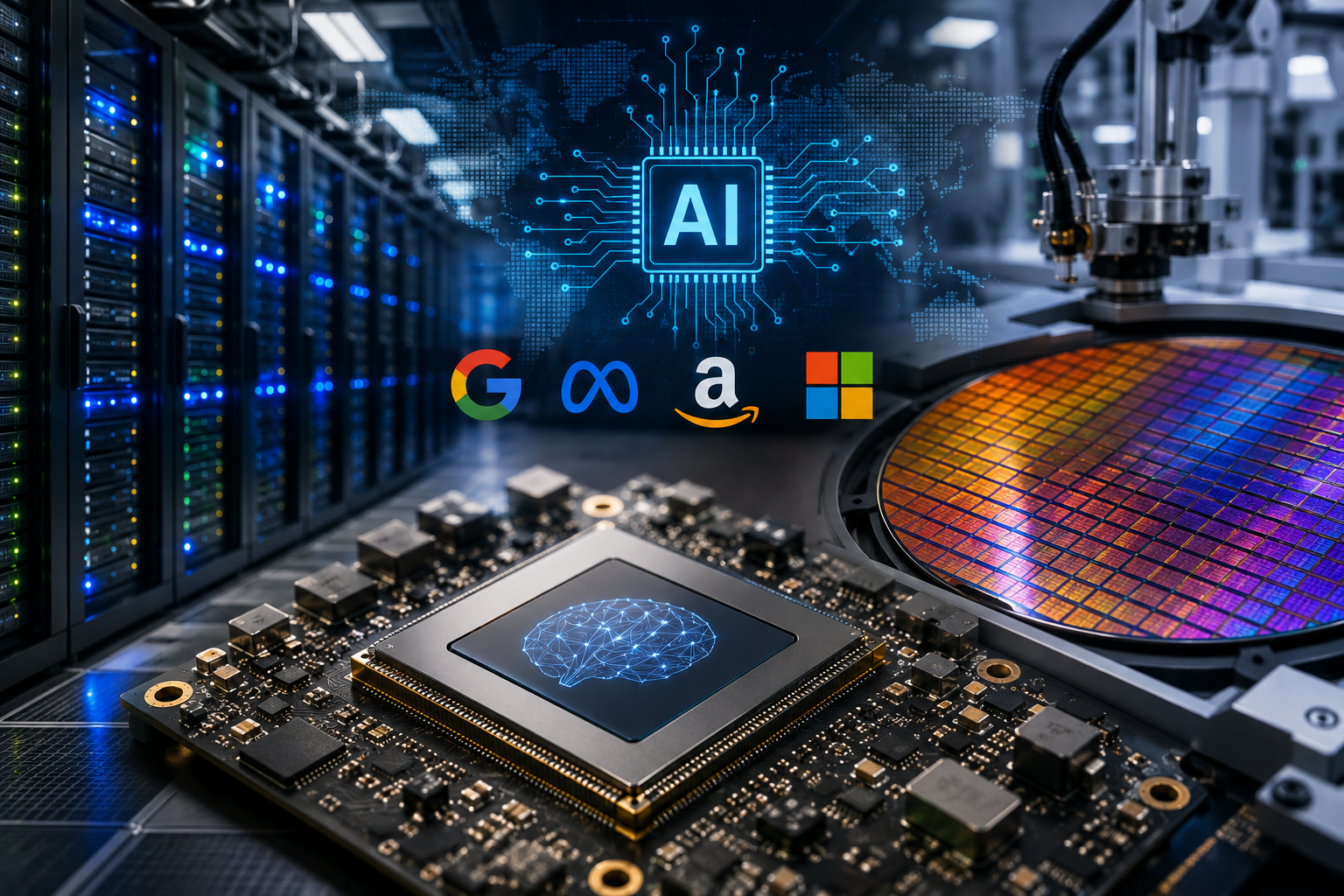
The artificial intelligence boom that fueled one of the biggest rallies in semiconductor history may be entering a new phase — and investors are beginning to look beyond Nvidia.
For nearly two years, Nvidia has dominated headlines as the undisputed backbone of generative AI infrastructure. Its GPUs became the gold standard powering large language models, enterprise AI applications, and cloud computing expansion across the globe. But now, some of the world’s largest technology companies are aggressively developing their own custom AI chips in an effort to reduce costs, improve efficiency, and lessen dependence on Nvidia’s increasingly expensive hardware ecosystem.
That shift is quickly becoming one of Wall Street’s most closely watched investment themes.
According to analyst commentary from Goldman Sachs and industry reporting from Tom’s Hardware and The Motley Fool, custom AI ASICs — application-specific integrated circuits designed specifically for AI workloads — could rival traditional GPU demand by 2027. The trend is being driven by hyperscalers including Google, Meta, Amazon, and Microsoft, all of which are scaling AI infrastructure spending at an unprecedented pace across 2026.
For investors, the implications extend far beyond a single stock.
The AI Infrastructure Race Is Expanding
The first phase of the AI boom largely centered around compute scarcity. Companies scrambled to secure Nvidia GPUs as demand for AI model training exploded following the rapid rise of generative AI applications like ChatGPT.
Now, the second phase appears to be focused on optimization and ownership.
Major cloud providers are increasingly building custom silicon tailored to their own AI ecosystems. Google continues advancing its Tensor Processing Units (TPUs), Amazon is scaling its Trainium and Inferentia chips through AWS, while Meta and Microsoft are reportedly increasing investments in internally optimized AI accelerator programs.
The reason is straightforward: AI infrastructure costs are becoming enormous.
Training and operating advanced AI models requires massive amounts of compute power, electricity, networking capacity, and cooling infrastructure. By developing custom chips, hyperscalers can reduce operational costs, improve performance efficiency, and control more of the AI supply chain internally.
This trend mirrors previous technology cycles where cloud giants eventually moved toward vertical integration after relying heavily on third-party providers during early growth phases.
For Wall Street, that creates a broader investment landscape beyond the obvious AI leaders.
Why Nvidia Still Matters — But Faces a New Dynamic
None of this suggests Nvidia’s dominance is disappearing anytime soon.
The company still maintains a significant lead in software integration, developer adoption, CUDA ecosystem advantages, and AI training performance. Nvidia’s networking technologies, including InfiniBand and advanced AI cluster architecture, also remain critical to large-scale AI deployment.
However, the market is increasingly realizing that AI demand growth may no longer translate into a winner-take-all scenario.
Instead, the AI infrastructure market is evolving into a diversified ecosystem involving:
- Custom chip designers
- Semiconductor foundries
- Advanced packaging firms
- Networking equipment providers
- Power and cooling infrastructure companies
- Data center REITs
- Memory and storage suppliers
That diversification is exactly why investors are starting to rotate capital toward what many analysts call “second-wave AI beneficiaries.”
Broadcom, AMD, and TSMC Are Emerging as Key Beneficiaries
Among the companies drawing increased investor attention is Broadcom.
Broadcom has emerged as one of the biggest beneficiaries of custom AI chip demand because it helps hyperscalers design and scale specialized ASIC architectures. The company’s AI-related revenue has surged as cloud providers seek alternatives and complements to Nvidia’s GPU ecosystem.
AMD is also positioning itself aggressively in the AI accelerator market. Its MI300 series chips have gained traction with enterprise customers and cloud providers looking for competitive alternatives in high-performance AI computing.
Meanwhile, Taiwan Semiconductor Manufacturing Company (TSMC) may be one of the most strategically important players in the entire AI supply chain.
Regardless of which company designs the winning AI chips, many of them ultimately rely on TSMC’s advanced manufacturing capabilities. As demand for cutting-edge 3nm and 2nm semiconductor production increases, TSMC stands to benefit from virtually every major AI infrastructure expansion cycle.
Analysts increasingly view TSMC as a “picks-and-shovels” investment tied to the broader AI economy rather than the success of any single AI platform.
Data Centers and AI Networking Are Quietly Becoming Massive Winners
The custom AI chip boom is also creating significant demand in adjacent infrastructure sectors.
AI workloads require extraordinary data center capacity, including advanced cooling systems, high-speed networking, energy infrastructure, and specialized server configurations.
Companies tied to optical networking, AI interconnects, and high-bandwidth memory are becoming critical components of next-generation AI clusters.
This is one reason investors are increasingly monitoring firms involved in:
- AI networking hardware
- Data center construction
- Power management systems
- Semiconductor packaging
- Liquid cooling technologies
- Energy infrastructure
Several analysts have warned that electricity demand from AI data centers could become one of the defining infrastructure stories of the decade.
According to estimates from multiple industry groups and utility operators, AI-driven power demand in the United States could rise substantially over the next several years as hyperscalers continue building larger compute clusters.
That trend may ultimately benefit utilities, nuclear energy projects, grid modernization firms, and industrial infrastructure providers alongside traditional semiconductor names.
Geopolitics and Supply Chains Are Becoming Central Risks
Another reason custom AI chips are attracting investor attention is geopolitical risk.
The United States continues tightening restrictions on advanced semiconductor exports to China, while Washington simultaneously pushes to expand domestic semiconductor manufacturing through the CHIPS Act and related industrial policies.
As AI increasingly becomes a strategic national priority, governments are treating semiconductor supply chains as critical economic and security infrastructure.
That has accelerated investment into domestic chip manufacturing, advanced packaging facilities, and semiconductor research initiatives across North America.
For investors, this introduces both opportunity and risk.
Companies aligned with U.S. industrial policy priorities may benefit from long-term government support and capital incentives. At the same time, supply chain disruptions, export controls, and geopolitical tensions could create volatility across the semiconductor sector.
The AI race is no longer just a corporate competition — it is becoming a geopolitical competition.
What Investors Should Watch Next
The next 12 to 24 months could determine how the AI infrastructure market evolves for the remainder of the decade.
Several trends are likely to shape investor sentiment moving forward:
1. Expansion of Custom Silicon
More hyperscalers are expected to increase investments in internally designed AI chips, particularly for inference workloads where cost efficiency matters most.
2. AI Capital Expenditure Growth
Cloud providers continue signaling aggressive AI infrastructure spending despite concerns about broader economic slowing and higher interest rates.
3. Semiconductor Manufacturing Constraints
Advanced chip packaging and fabrication capacity may become bottlenecks as AI demand accelerates globally.
4. AI Energy Consumption
Power availability and grid capacity could emerge as major limiting factors for future AI expansion.
5. AI Regulation and National Security
Governments are likely to increase oversight of advanced AI hardware exports and domestic semiconductor production.
Key Investment Insight
The biggest opportunity in AI may no longer be confined to Nvidia alone.
While Nvidia remains a dominant force in AI computing, Wall Street is increasingly shifting toward a broader thesis centered on the entire AI infrastructure ecosystem. Companies involved in custom chip design, semiconductor manufacturing, networking, data center infrastructure, cooling systems, and energy supply chains may represent the next phase of AI-driven investment growth.
For long-term investors, the emerging custom AI chip race signals that the AI economy is maturing from a single-company momentum story into a multi-sector industrial transformation.
That transition could create opportunities well beyond the companies currently dominating AI headlines.
Stay ahead of the latest market-moving trends, emerging investment opportunities, and deep financial analysis with MoneyNews.Today, your trusted source for daily investor insights.




