
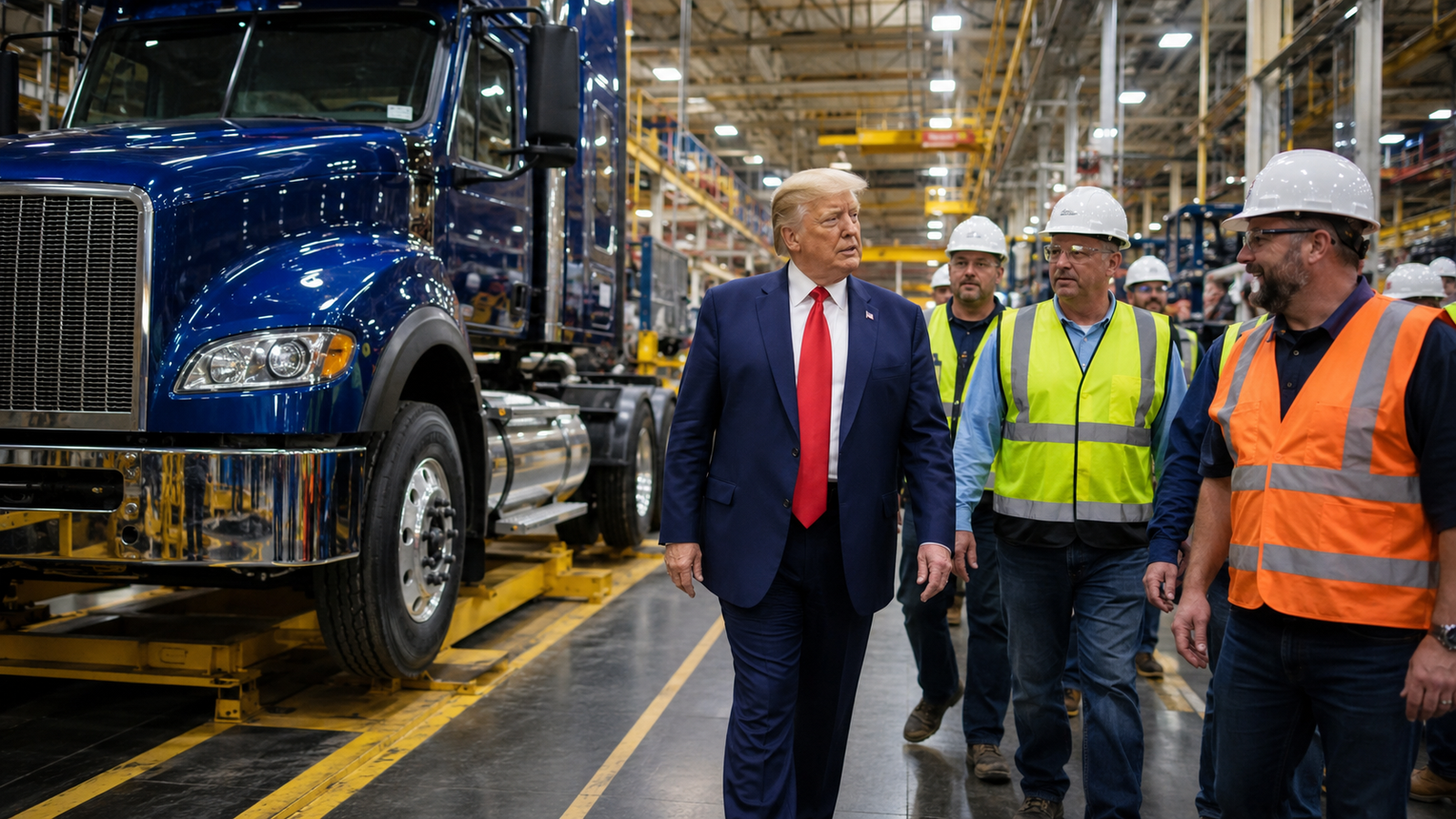
President Donald Trump’s visit to a Mack Trucks facility in Macungie, Pennsylvania, puts one of Wall Street’s most politically sensitive investment themes back in the spotlight: U.S. manufacturing. For investors, the stop is not just a campaign-style appearance in a battleground state. It is a signal that industrial jobs, domestic production, tariffs, transportation, and supply-chain policy are likely to remain central market-moving issues heading into the 2026 midterm elections.
The timing matters. Investors are already watching inflation pressures, labor costs, interest-rate expectations, and policy uncertainty. A presidential visit to a major heavy-duty truck manufacturing plant adds another layer to the market debate: whether Washington will continue to support domestic industrial capacity through tariffs, procurement policy, infrastructure spending, tax incentives, or targeted reshoring measures.
For traders and long-term investors, that could create both opportunity and volatility across industrial stocks, truck makers, steel and aluminum producers, construction suppliers, transportation equipment manufacturers, and companies exposed to U.S. labor costs.
Why This Visit Matters for Investors
Trump’s appearance at Mack Trucks in Macungie is designed to refocus public attention on the U.S. economy and industrial employment. According to Associated Press reporting, the visit takes place in Pennsylvania’s 7th Congressional District, a politically competitive region that could matter for control of the House in the November midterms.
That political context is important for markets because policy risk tends to rise during election cycles. Investors often see more aggressive messaging around trade, manufacturing, energy, taxes, wages, and federal spending as politicians try to appeal to key voter groups. Pennsylvania is especially important because it sits at the intersection of manufacturing, energy, logistics, steel, transportation, and organized labor.
For investors, the Mack Trucks visit should be read as a reminder that U.S. industrial policy is no longer a niche issue. It is now a central part of the broader economic conversation. The companies most exposed include heavy equipment makers, truck manufacturers, rail and logistics firms, steel and aluminum suppliers, infrastructure contractors, and automation providers serving domestic factories.
Mack Trucks as a Symbol of American Industry
Mack Trucks’ Lehigh Valley Operations facility is a powerful backdrop because it directly represents the kind of industrial base politicians often highlight when discussing American manufacturing strength. Mack Trucks says every Mack truck built for the North American market begins at the company’s cab and vehicle assembly plant in Macungie, Pennsylvania. Volvo Group materials also describe the Lehigh Valley operation as a state-of-the-art facility that manufactures Mack’s Class 8 product line.
That makes the facility relevant far beyond local politics. Class 8 trucks are tied to freight, construction, infrastructure, distribution, and the broader health of the goods economy. When investors evaluate truck demand, they are also looking at capital spending by fleets, construction activity, logistics volumes, replacement cycles, fuel efficiency standards, and financing conditions.
A visit to this type of facility sends a clear policy signal: manufacturing and transportation equipment are likely to remain part of the administration’s economic messaging. That could influence sentiment toward companies connected to domestic production, especially if the White House pairs speeches with policy proposals or procurement commitments.
Manufacturing Data Is Improving, But Investors Remain Cautious
The political message comes as recent manufacturing data shows signs of improvement. ISM and S&P Global purchasing managers’ data are closely watched by economists, investors, and corporate executives because they offer a timely view of factory activity, new orders, employment, inventories, and price pressures.
Recent PMI readings have pointed to a firmer manufacturing backdrop, with S&P Global data showing U.S. manufacturing expansion in May and ISM-related data suggesting improved factory momentum. A PMI reading above 50 generally indicates expansion, while a reading below 50 signals contraction.
At the same time, investors should avoid assuming that better manufacturing data automatically translates into stronger profits for every industrial company. Manufacturing firms still face elevated wage costs, financing costs, tariff-related input uncertainty, and supply-chain adjustments. Some companies benefit from reshoring and domestic demand, while others are squeezed by higher costs for steel, aluminum, machinery, and components.
The key is margin sensitivity. Companies that can pass higher costs to customers may outperform. Companies locked into fixed-price contracts or competing in price-sensitive markets could struggle.
Tariffs Remain a Market-Moving Variable
One of the most important investor angles is tariff policy. Trump has repeatedly used tariffs as a central tool of industrial policy, including prior moves to increase tariffs on steel and aluminum imports. Associated Press reporting from 2025 noted that Trump announced plans to double tariffs on foreign steel to 50%, arguing that the policy would protect domestic producers.
For investors, tariffs can create winners and losers. Domestic steel and aluminum producers may benefit from higher import barriers and improved pricing power. However, manufacturers that use steel and aluminum as inputs may face higher costs. That includes automakers, truck makers, construction suppliers, packaging companies, machinery firms, appliance makers, and infrastructure contractors.
This is why the Mack Trucks visit is not just a bullish signal for industrials. It is more complex. A pro-manufacturing agenda may support domestic factory investment, but if tariffs raise input costs too aggressively, margins could come under pressure for companies further down the supply chain.
Investors should watch whether the administration emphasizes protection for producers, relief for manufacturers that rely on imported inputs, or a combination of both. The details will matter.
Key Stocks and Industries to Watch
The most obvious market focus is the industrial sector. Investors should monitor truck and heavy-equipment manufacturers, engine and powertrain suppliers, steel and aluminum producers, logistics companies, and construction materials firms.
Potentially relevant areas include heavy-duty trucking, rail equipment, commercial vehicle components, automation, industrial software, U.S. steel production, aluminum, infrastructure contractors, and manufacturing-focused real estate. Exchange-traded funds tied to industrials, materials, transportation, and infrastructure may also see increased attention if political messaging turns into policy momentum.
Investors should also watch labor-sensitive manufacturers. Domestic production can be a strong long-term theme, but it often comes with higher labor costs than offshore manufacturing. Companies with automation, robotics, lean manufacturing systems, and pricing power may be better positioned than those dependent on low-margin assembly work.
What Could Move Markets Next
The first thing investors should watch is whether Trump’s Pennsylvania manufacturing message becomes a broader policy package. Campaign-style speeches can influence sentiment, but markets usually respond more strongly to concrete action: tariff changes, federal procurement rules, tax credits, infrastructure grants, energy policy, or reshoring incentives.
Second, investors should monitor inflation data. If industrial policy increases domestic investment while also raising input costs, the Federal Reserve may face a more complicated inflation picture. That could affect interest-rate expectations and valuation multiples across cyclical stocks.
Third, watch corporate earnings commentary. Industrial CEOs will likely be asked whether tariffs, supply-chain localization, labor availability, and demand from infrastructure projects are helping or hurting margins. Management guidance may offer a clearer signal than political headlines.
Key Investment Insight
Trump’s Mack Trucks visit reinforces a major theme for 2026: manufacturing policy is becoming market policy. Investors should not view the event only through a political lens. It has direct implications for industrial demand, material costs, transportation equipment, labor markets, and sector rotation.
The opportunity is in companies that benefit from domestic production, infrastructure spending, and fleet modernization while maintaining pricing power. The risk is in firms exposed to higher input costs, tariff uncertainty, or wage pressure without the ability to protect margins.
A practical investor approach is to track industrial ETFs, steel and aluminum prices, truck order trends, manufacturing PMI data, and earnings guidance from transportation and machinery companies. If policy support grows while factory activity continues to improve, select industrial names could benefit. If tariffs and costs rise faster than demand, the trade could become much more selective.
As the 2026 midterms approach, investors should expect more policy-driven volatility across manufacturing, transportation, infrastructure, and materials. Stay updated with MoneyNews.Today for daily market insight, political risk analysis, and investor-focused coverage of the stories moving stocks.




