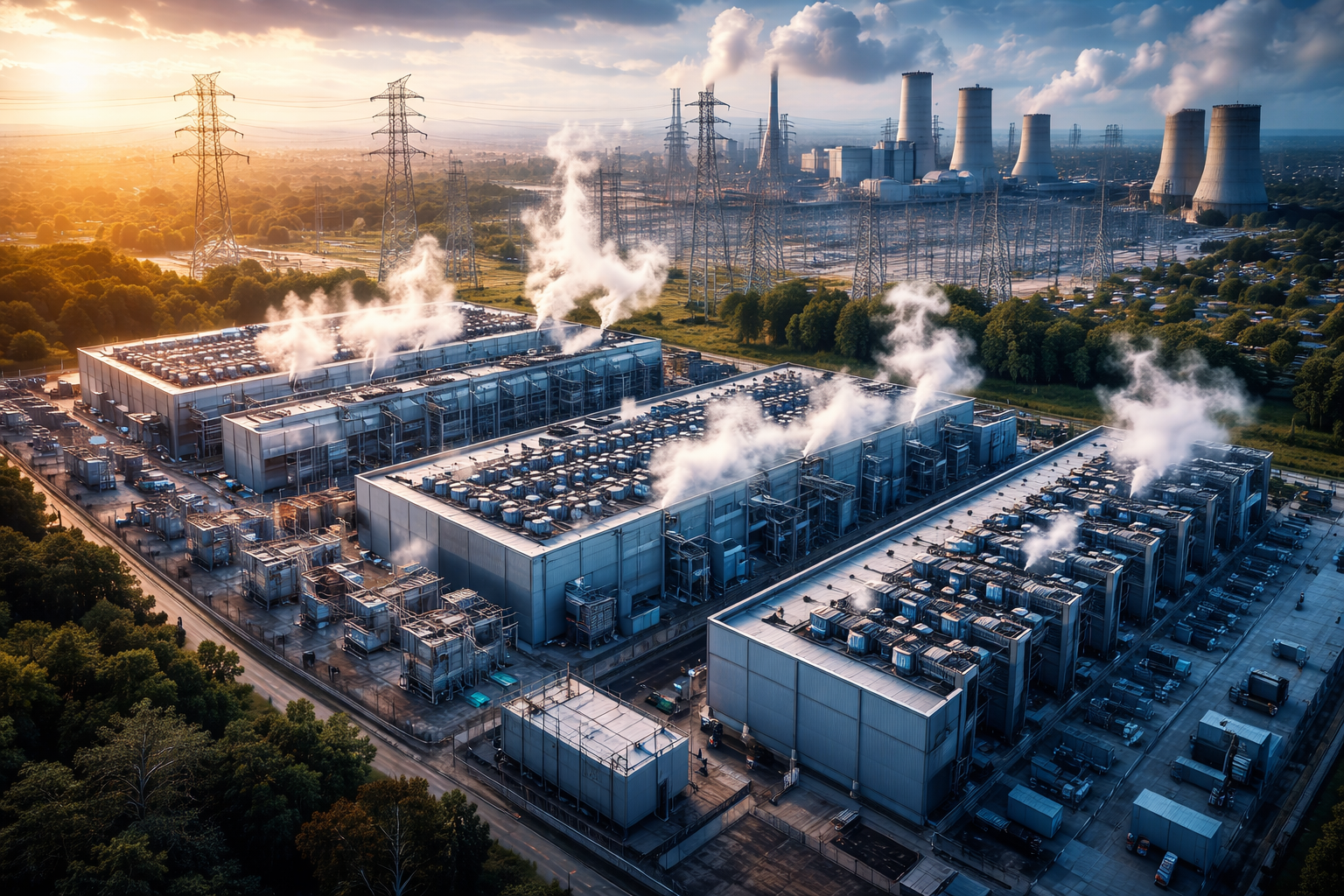
The artificial intelligence boom is no longer just a story about chips, algorithms, and software—it’s rapidly becoming a story about power grids, physical infrastructure, and energy supply constraints. As AI adoption accelerates across industries, a new reality is emerging: the biggest bottleneck to growth isn’t innovation—it’s infrastructure.
From Wall Street to Silicon Valley, investors are increasingly shifting their focus beyond AI software leaders to the less glamorous—but critically important—backbone of the AI economy: electricity, data centers, and industrial capacity. According to Reuters market commentary (April 7, 2026), the surge in AI demand is now pushing existing infrastructure to its limits, creating both risks and massive opportunities for investors.
The AI Boom Is Hitting a Physical Wall
AI models are becoming exponentially more complex and resource-intensive. Training and deploying large-scale AI systems requires enormous computing power, which in turn demands vast amounts of electricity and specialized data center infrastructure.
What’s changed in 2026 is the scale and speed of demand.
Major technology firms are racing to build AI capabilities into everything—from search engines and enterprise software to autonomous systems and robotics. But behind the scenes, this race is straining the very systems that support it:
- Electricity demand from AI data centers is surging
- Grid capacity is struggling to keep up
- Data center construction timelines are extending
- Power availability is becoming a limiting factor in deployment
Industry analysts have begun warning that access to power—not chips—could soon become the primary constraint on AI expansion.
A growing number of reports from firms like McKinsey and Goldman Sachs have already highlighted that global data center electricity consumption could double or even triple within the next decade, driven largely by AI workloads.
Why This Matters for Investors
For years, the AI trade has been dominated by semiconductor companies and software platforms. But the narrative is evolving quickly—and investors who fail to adjust may miss the next phase of growth.
1. AI Is Becoming an Energy Trade
AI is now deeply tied to energy markets. Every new data center requires a stable and scalable power supply, and many regions are already facing constraints.
Utilities and power producers are seeing renewed investor interest as demand forecasts rise. In particular:
- Electric utilities with access to scalable generation capacity
- Renewable energy providers supplying clean power to hyperscalers
- Nuclear energy players, which are gaining attention as a stable, long-term solution
This shift is transforming AI into what many analysts are calling an “energy supercycle”—where electricity demand becomes a key driver of market performance.
2. Data Centers Are the New Oil Fields
Data centers are emerging as one of the most critical assets in the global economy. Much like oil fields in the past, they are the infrastructure that powers the digital world.
However, building them is becoming increasingly difficult:
- Land availability is tightening in key regions
- Power connections can take years to secure
- Construction costs are rising due to demand for specialized equipment
According to industry data cited in recent Reuters commentary, data center vacancy rates in major U.S. markets are near historic lows, signaling a supply-demand imbalance.
For investors, this creates opportunities in:
- Data center REITs
- Infrastructure developers
- Cooling and efficiency technology providers
3. Industrial Companies Are Quiet Winners
While AI headlines are dominated by tech giants, many of the biggest beneficiaries may be industrial firms that supply the physical components of the AI ecosystem.
These include companies involved in:
- Electrical equipment and transformers
- Cooling systems for high-performance computing
- Grid infrastructure and transmission
- Construction and engineering services
As demand for AI infrastructure scales, these companies are seeing order backlogs grow and pricing power increase—a trend that is gaining attention among institutional investors.
The Bottleneck Problem: A Double-Edged Sword
Infrastructure constraints present both risks and opportunities.
The Risk Side
- Delayed AI deployment could slow revenue growth for tech companies
- Rising energy costs could compress margins
- Regulatory pressure on energy usage could increase
If infrastructure fails to keep pace, the AI boom could face temporary slowdowns—something markets are beginning to price in.
The Opportunity Side
At the same time, these bottlenecks are creating massive investment opportunities:
- Companies that solve power constraints could see outsized growth
- Regions with excess energy capacity could attract significant capital
- New technologies (like advanced cooling and energy storage) could become critical enablers
In other words, the constraints themselves are fueling the next wave of innovation and investment.
What the Data and Experts Are Saying
Recent commentary from Reuters (April 7, 2026) highlights that infrastructure limitations are now one of the most discussed topics among institutional investors.
Meanwhile:
- McKinsey estimates that AI-related infrastructure investment could reach trillions of dollars globally over the next decade
- Goldman Sachs has pointed to power demand as a key variable in AI valuation models
- U.S. government agencies are increasingly focused on grid modernization and energy security, recognizing AI as a strategic priority
This alignment between private capital and public policy suggests that infrastructure investment will remain a long-term structural trend, not a short-term cycle.
Future Trends to Watch
⚡ Grid Modernization
Governments and utilities are expected to accelerate investments in grid upgrades, transmission capacity, and energy storage.
🌱 Clean Energy Integration
Tech companies are under pressure to meet sustainability goals, driving demand for renewable energy solutions tied to AI infrastructure.
🏗️ Faster Data Center Deployment
Innovations in modular construction and edge computing could help reduce build times and alleviate bottlenecks.
🔌 Energy Efficiency Breakthroughs
New chip designs and cooling technologies may significantly reduce power consumption per AI workload—an area attracting heavy R&D investment.
Key Investment Insight
AI is no longer just a technology trend—it’s a full-scale infrastructure revolution.
The biggest opportunities are shifting toward:
- Utilities and power producers
- Data center operators and REITs
- Industrial and infrastructure suppliers
- Energy innovation and efficiency technologies
Investors who broaden their focus beyond traditional tech names and position themselves in these supporting sectors may be better aligned with the next phase of AI-driven growth.
Strategic Takeaway for Investors
The AI revolution is entering a new phase—one defined not by algorithms, but by physical limits and real-world constraints. As demand surges, infrastructure is becoming the critical battleground that will determine how fast—and how far—AI can scale.
For investors, this shift represents a rare opportunity to get ahead of a multi-sector transformation that spans technology, energy, and industrial markets.
Those who recognize that AI is as much about power and infrastructure as it is about software will be better positioned to capture the long-term upside.
Stay ahead of the markets with MoneyNews.Today, your trusted source for daily investor insights, breaking trends, and actionable financial analysis.