The artificial intelligence boom is triggering a new arms race inside the global semiconductor industry—and it’s not just about GPUs anymore. The real bottleneck powering the next generation of AI infrastructure may lie in high-bandwidth memory (HBM), a specialized chip technology rapidly becoming one of the most critical components in modern AI systems.
As hyperscalers such as cloud providers race to expand data-center capacity for AI workloads, demand for HBM—used alongside advanced GPUs to process massive datasets—has surged to unprecedented levels. Major chipmakers are now reporting that supply for next-generation memory products is effectively sold out years in advance, signaling a powerful shift in the semiconductor landscape.
For investors, the implications are significant. While much attention has focused on the companies designing AI models and GPUs, the companies manufacturing memory chips and related infrastructure components may be positioned for one of the most powerful growth cycles in semiconductor history.
The Hidden Engine Behind the AI Boom
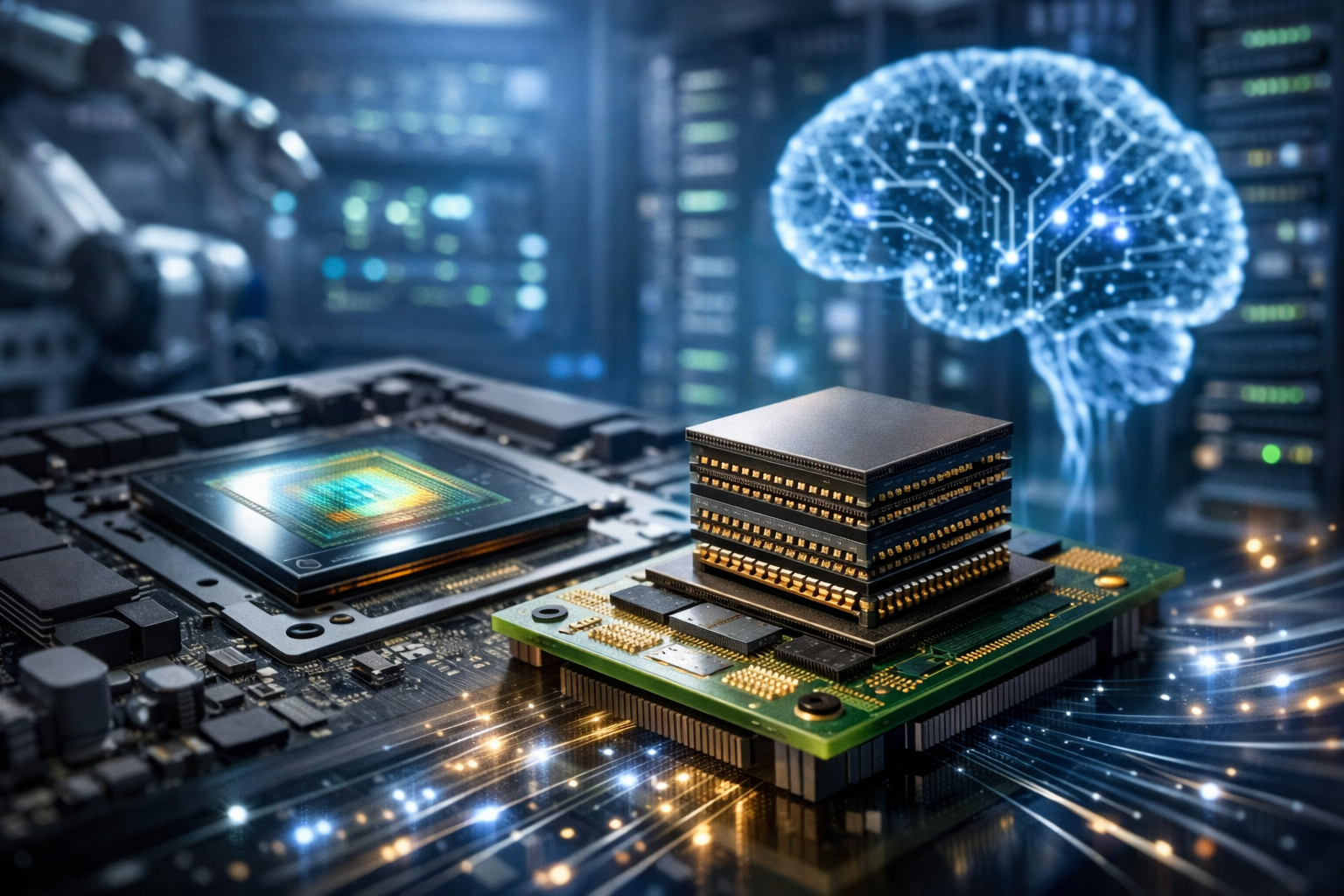
High-bandwidth memory is a specialized form of DRAM designed to deliver extremely fast data transfer rates while consuming less power. Unlike traditional memory chips used in personal computers or smartphones, HBM is stacked vertically in multiple layers, allowing it to move massive volumes of data between processors and memory units with minimal latency.
This capability is crucial for artificial intelligence workloads.
Training and running large AI models—such as those powering generative AI platforms, enterprise analytics tools, and autonomous systems—requires enormous computational throughput. GPUs can perform the necessary calculations, but without sufficient memory bandwidth, their performance becomes severely constrained.
HBM solves this problem by dramatically increasing the rate at which data can flow into and out of the processor.
According to industry reports and coverage from Reuters, the surge in AI computing demand has caused a dramatic spike in HBM orders across the semiconductor supply chain. Leading memory manufacturer Micron Technology has already indicated that supply for its next-generation HBM products is fully booked through upcoming production cycles, reflecting surging demand from AI chip manufacturers and hyperscale data-center operators.
Hyperscalers Are Driving the Demand Surge
The biggest driver behind the HBM boom is the aggressive expansion of AI infrastructure by the world’s largest technology companies.
Cloud computing giants—including major hyperscale data-center operators—are pouring billions of dollars into new AI infrastructure designed to train and deploy increasingly powerful machine learning models. These facilities require specialized hardware clusters composed of thousands of GPUs connected with high-performance networking and memory systems.
Every one of those GPUs depends heavily on high-bandwidth memory.
As a result, demand for HBM has risen sharply alongside the explosive growth of AI data centers.
Industry analysts cited by financial news outlets including Bloomberg and Reuters estimate that global demand for HBM could multiply several times over the next few years. Some projections suggest the AI memory market could exceed $100 billion by 2028, representing one of the fastest-growing segments of the semiconductor industry.
This rapid growth is reshaping supply chains across the technology sector, as manufacturers race to expand production capacity for advanced memory chips.
Semiconductor Supply Chains Are Being Reshaped
The rise of AI computing is transforming the semiconductor industry in ways that extend far beyond GPU manufacturers.
HBM production requires advanced packaging techniques, cutting-edge fabrication processes, and specialized manufacturing capabilities. These factors create high barriers to entry and limit the number of companies capable of producing HBM at scale.
That scarcity is now becoming a strategic advantage.
Several major semiconductor firms—including memory manufacturers and advanced chip packaging providers—are seeing surging demand from companies building AI hardware platforms. Suppliers of semiconductor materials, wafer fabrication equipment, and chip interconnect technologies are also benefiting from the rapid expansion of AI infrastructure.
Analysts at multiple investment banks have noted that the AI supply chain extends far beyond software developers or AI model creators. Instead, it encompasses a broad ecosystem of companies involved in semiconductor manufacturing, packaging, networking hardware, and data-center infrastructure.
As AI workloads grow more complex and compute-intensive, the need for high-performance memory solutions will only increase.
Why This Matters for Investors
For investors, the current AI infrastructure cycle presents a unique opportunity to capture growth across multiple layers of the technology ecosystem.
While high-profile AI companies and software platforms often dominate headlines, the underlying infrastructure supporting those technologies is where some of the most durable long-term investment opportunities may exist.
Semiconductor companies producing memory chips, networking components, and advanced packaging technologies are positioned at the center of this trend.
The reason is simple: AI computing requires enormous hardware investment.
Training advanced AI models involves processing vast datasets across massive clusters of GPUs and specialized processors. Without sufficient memory bandwidth, those processors cannot operate efficiently. This creates structural demand for high-bandwidth memory and related technologies.
As a result, companies supplying these components could experience sustained revenue growth as hyperscalers continue expanding AI infrastructure.
Financial analysts increasingly view the semiconductor supply chain as one of the strongest beneficiaries of the global AI boom.
Future Trends to Watch
Several key developments could shape the future of the AI memory market over the next several years.
1. Explosive AI Data Center Growth
Major technology firms are dramatically increasing capital expenditures to build AI-focused data centers. These facilities require enormous quantities of GPUs, networking hardware, and high-bandwidth memory, making them a central driver of demand across the semiconductor ecosystem.
2. Advanced Chip Packaging Innovation
Producing HBM chips requires highly specialized packaging techniques that stack multiple memory layers together. Companies developing advanced semiconductor packaging technologies are likely to benefit as demand for AI hardware accelerates.
3. Supply Constraints and Pricing Power
Because HBM manufacturing capacity remains limited, suppliers may gain strong pricing power as demand continues to exceed supply. This could boost profit margins for semiconductor companies operating in this niche market.
4. Strategic Government Support
Governments in the United States and allied countries are investing heavily in domestic semiconductor manufacturing through programs such as the U.S. CHIPS and Science Act. These initiatives aim to strengthen supply chains for critical technologies, including AI hardware components like advanced memory chips.
Key Investment Insight
The AI boom is often framed as a software revolution, but the reality is that hardware infrastructure remains the foundation of artificial intelligence.
Companies supplying the building blocks of AI systems—particularly memory chips, advanced semiconductor packaging, and high-speed networking components—may be positioned to capture significant value during this infrastructure expansion cycle.
As hyperscalers and enterprise technology providers continue scaling AI deployments, demand for high-bandwidth memory is likely to remain strong for years to come.
For investors looking to capitalize on the AI megatrend, the semiconductor supply chain may offer one of the most compelling long-term opportunities in global markets.
The rapid evolution of artificial intelligence continues to reshape industries, supply chains, and investment strategies worldwide. Stay informed with MoneyNews.Today for daily insights into the trends, technologies, and market developments shaping the future of investing.