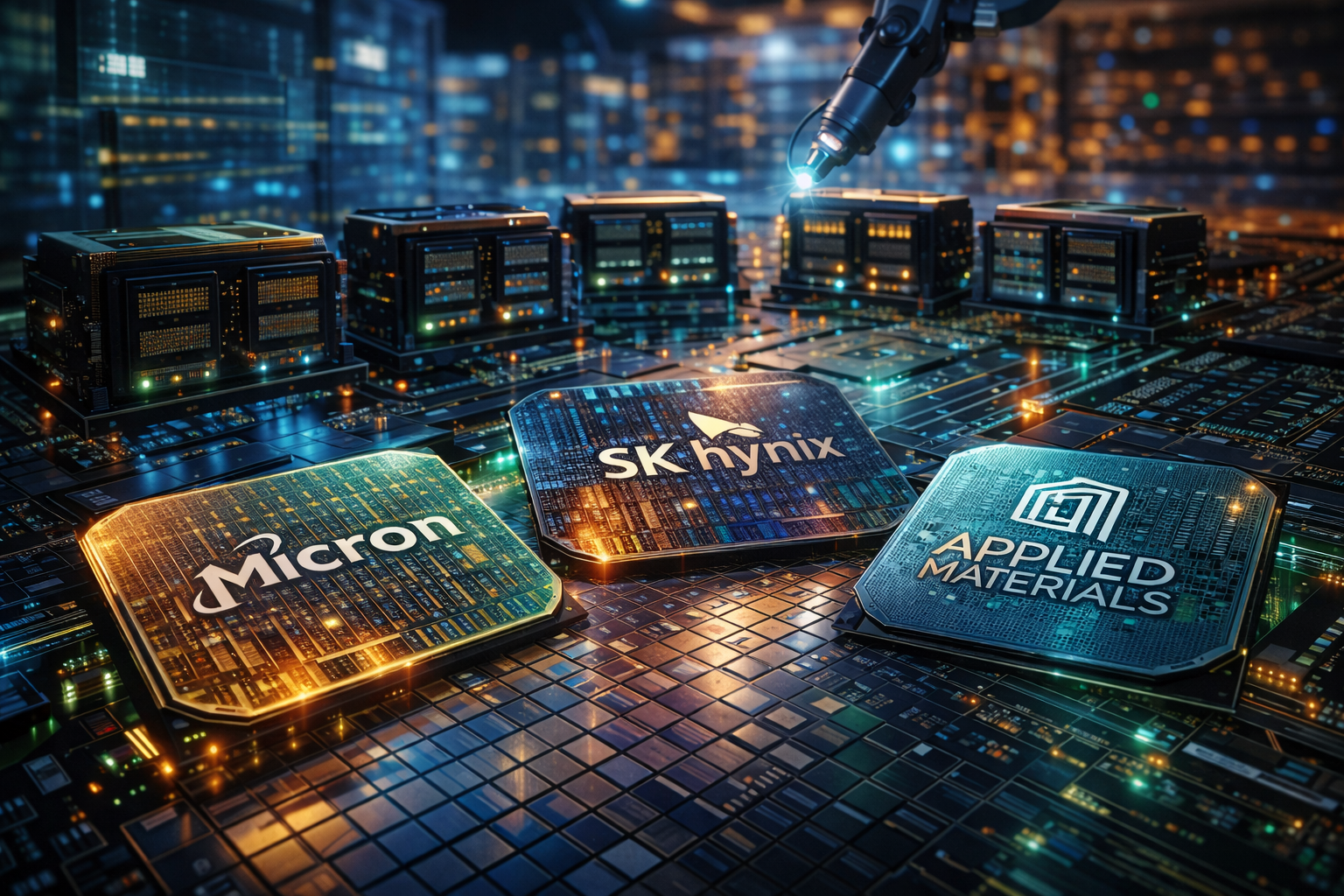
Artificial intelligence is pushing the semiconductor industry into a new era of innovation—and memory technology is quickly becoming one of the most critical battlegrounds.
In a move that highlights the growing importance of advanced chip infrastructure, Applied Materials has announced a strategic collaboration with memory giants Micron Technology and SK Hynix to develop next-generation AI memory technologies. The initiative will take place at Applied Materials’ new semiconductor research and development hub and aims to accelerate the development of high-bandwidth memory (HBM) and advanced chip packaging systems designed specifically for AI workloads.
The announcement, first reported by Reuters, underscores the escalating demand for specialized memory chips capable of supporting the enormous computing power required by modern artificial intelligence systems.
For investors watching the semiconductor industry, the partnership signals a major shift: memory technology is becoming one of the most critical components in the global AI infrastructure race.
The AI Boom Is Driving a New Memory Arms Race
The explosive growth of artificial intelligence has dramatically increased demand for advanced semiconductor technologies.
Training large-scale AI models requires enormous computing power, typically delivered through clusters of high-performance graphics processing units (GPUs). However, GPUs alone are not enough. AI workloads also require extremely fast memory systems capable of moving massive volumes of data between processors.
That is where high-bandwidth memory comes in.
HBM is a specialized type of memory designed to deliver extremely high data transfer speeds while maintaining energy efficiency. It is widely used in advanced AI systems because it allows GPUs to access data much faster than traditional memory architectures.
As AI models become larger and more complex, the demand for HBM has surged dramatically.
Industry analysts estimate that demand for high-bandwidth memory could grow several times over the next decade, driven largely by AI training workloads.
This surge has created supply constraints across the semiconductor industry, prompting companies to accelerate research and development efforts.
The new collaboration between Applied Materials, Micron, and SK Hynix is designed to address precisely that challenge.
Why This Partnership Matters for the Semiconductor Industry
Each company involved in the partnership plays a critical role in the global semiconductor ecosystem.
Applied Materials is one of the world’s leading suppliers of semiconductor manufacturing equipment. Its technologies are used by chipmakers to produce advanced semiconductor devices across a wide range of applications.
Micron and SK Hynix, meanwhile, are among the world’s largest manufacturers of memory chips.
By working together at Applied Materials’ semiconductor R&D hub, the companies aim to accelerate the development of new memory architectures capable of supporting the rapidly evolving demands of artificial intelligence.
One key focus of the collaboration is advanced chip packaging technologies, which allow multiple semiconductor components to be integrated more efficiently within a single system.
Advanced packaging techniques are becoming increasingly important as chipmakers push the limits of traditional semiconductor scaling.
Rather than relying solely on smaller transistor sizes, companies are increasingly combining multiple chips within highly integrated systems to improve performance.
This approach is particularly important for AI computing, where large amounts of data must move quickly between processors and memory.
High-Bandwidth Memory Is Becoming the Backbone of AI Computing
The rapid rise of high-bandwidth memory has become one of the defining trends in the semiconductor industry.
HBM technology uses vertically stacked memory chips connected through ultra-fast pathways, allowing data to be transferred at dramatically higher speeds than traditional memory systems.
This capability is essential for AI applications.
Large language models and other advanced AI systems must process enormous datasets during training. Without high-speed memory systems, GPUs would be forced to wait for data transfers, significantly reducing performance.
As a result, HBM has become a critical component in modern AI hardware.
Industry leaders such as Nvidia rely heavily on high-bandwidth memory in their latest AI chips, which power data centers used for training large-scale machine learning models.
The growing importance of HBM has created a new competitive landscape among memory manufacturers.
Companies that can produce the fastest and most efficient memory systems stand to capture significant market share as AI adoption continues to expand.
The Role of Semiconductor Equipment Companies
While much of the attention in the AI boom has focused on chip designers and software developers, semiconductor equipment companies are also emerging as major beneficiaries.
Applied Materials is a prime example.
As one of the largest suppliers of semiconductor manufacturing tools, the company provides the equipment used by chipmakers to fabricate advanced semiconductor devices.
When demand for advanced chips rises, semiconductor manufacturers must expand production capacity. That expansion requires new fabrication equipment, which in turn drives growth for companies like Applied Materials.
According to industry analysts cited by Bloomberg and Reuters, the semiconductor equipment sector could see strong demand over the coming years as AI-driven chip production accelerates.
This dynamic creates opportunities not only for chip designers but also for the companies that supply the tools used to manufacture those chips.
Why AI Memory Shortages Are a Growing Concern
One of the biggest challenges facing the semiconductor industry today is the limited supply of advanced memory technologies.
The rapid growth of AI applications has created a surge in demand for HBM that manufacturers have struggled to meet.
Building new semiconductor production capacity is both expensive and time-consuming. New fabrication facilities can cost tens of billions of dollars and take several years to construct.
Because of this, supply constraints in advanced memory technologies may persist in the near term.
These shortages have already begun influencing market dynamics.
Companies developing AI hardware are competing for limited supplies of high-performance memory components, driving increased investment in research, manufacturing capacity, and new technologies.
The collaboration between Applied Materials, Micron, and SK Hynix reflects the industry’s effort to accelerate innovation and expand production capabilities.
Why Investors Are Watching the AI Semiconductor Ecosystem
The semiconductor industry has historically moved in cycles, but the AI revolution may be creating a new phase of sustained growth.
Artificial intelligence is rapidly becoming integrated into industries ranging from healthcare and finance to manufacturing and logistics.
This expansion requires enormous computing resources, which in turn drives demand for advanced chips, memory systems, and semiconductor manufacturing equipment.
For investors, this means the AI semiconductor ecosystem is becoming one of the most important sectors to watch.
Companies involved in AI chip development, memory manufacturing, and semiconductor equipment production could benefit from years of increasing demand.
The collaboration announced by Applied Materials highlights how the industry is evolving to meet these challenges.
Future Trends Investors Should Watch
Several trends are likely to shape the future of the AI semiconductor market.
Rapid Growth in AI Data Centers
Major technology companies are building massive data centers to support AI workloads.
Increasing Demand for High-Bandwidth Memory
HBM is expected to become a standard component in next-generation AI hardware.
Advanced Chip Packaging Technologies
New packaging methods will play a critical role in improving semiconductor performance.
Expansion of Semiconductor Manufacturing Capacity
Governments and corporations are investing heavily in new fabrication facilities to support AI chip production.
These developments suggest that the semiconductor industry could remain at the center of the global technology economy for years to come.
Key Investment Insight
The partnership between Applied Materials, Micron, and SK Hynix highlights one of the most important realities of the AI revolution: advanced memory technology is becoming just as critical as processing power.
As AI systems grow more complex, demand for high-bandwidth memory and advanced chip packaging will likely continue rising.
For investors, this creates potential opportunities across several segments of the semiconductor ecosystem, including memory manufacturers, chip designers, and semiconductor equipment providers.
Companies positioned at the intersection of AI computing and advanced semiconductor technologies could experience strong long-term growth as the AI infrastructure cycle expands.
Artificial intelligence is reshaping the technology industry at an unprecedented pace. As the race to build faster and more powerful computing systems intensifies, the companies enabling that transformation are becoming increasingly important to investors worldwide. MoneyNews.Today continues to deliver the insights, analysis, and breaking developments investors need to stay ahead in the rapidly evolving global technology landscape.