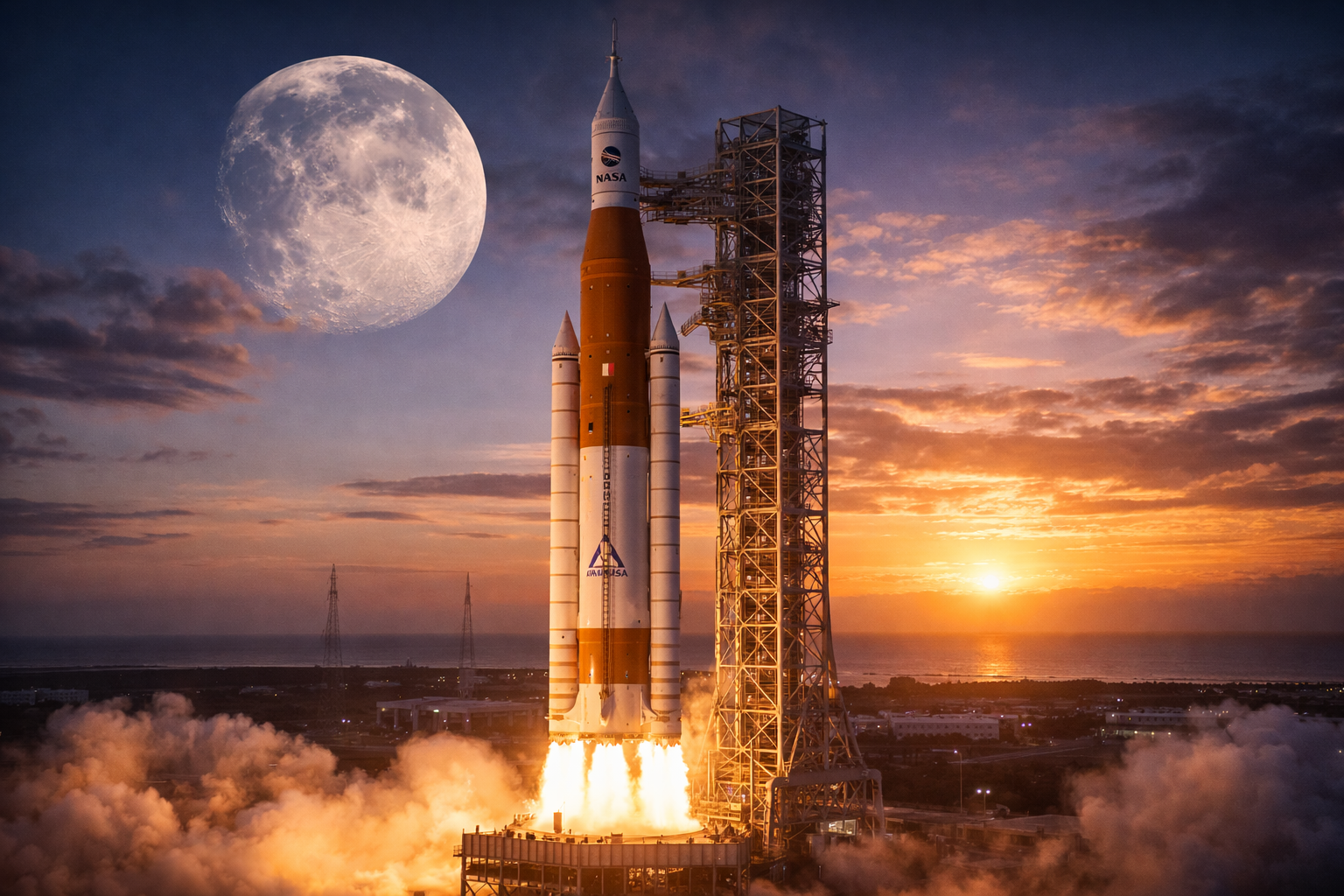
The next great investment frontier isn’t just digital—it’s orbital.
As headlines around the Artemis II mission dominate global attention, investors are once again turning their focus toward the rapidly evolving space economy. The high-profile mission, led by NASA with participation from Canadian astronauts, marks a major milestone in humanity’s return to the Moon—and a pivotal moment for capital markets.
But beyond the scientific and symbolic significance, Artemis II is sending a clear signal to investors:
space is no longer a speculative niche—it’s becoming a strategic, government-backed growth sector with real economic implications.
A Defining Moment for the Space Economy
The Artemis II mission, scheduled as a crewed lunar flyby, represents the first time astronauts will travel beyond low Earth orbit since the Apollo era. According to Reuters (April 8, 2026), the mission is drawing significant global attention, reinforcing the importance of international collaboration in space exploration.
The program itself is part of NASA’s broader Artemis initiative, which aims to establish a sustainable human presence on the Moon and eventually pave the way for missions to Mars.
What makes Artemis particularly significant from an investment standpoint is its structure:
- It is a public-private partnership at scale
- It integrates contributions from commercial aerospace firms
- It involves international partners, including Canada and Europe
This hybrid model is accelerating innovation while distributing financial and operational risk—making the sector more attractive to private capital.
Why Investors Are Paying Attention Now
The renewed interest in space is not happening in isolation. It aligns with several broader market trends:
1. Governments Are Increasing Strategic Spending
Space is increasingly viewed as a matter of national security, economic competitiveness, and technological leadership. As a result, government budgets for space and defense are expanding.
According to estimates from NASA and global defense agencies, space-related spending is expected to grow significantly over the next decade, driven by:
- Lunar exploration programs
- Satellite infrastructure
- Defense and surveillance capabilities
For investors, this creates a stable demand base—often backed by long-term government contracts.
2. Private Capital Is Scaling Rapidly
The rise of commercial players has transformed the economics of space.
Companies involved in:
- Launch services
- Satellite manufacturing
- Space-based data and communications
are attracting increasing levels of investment.
Industry research from Morgan Stanley and McKinsey estimates that the global space economy could surpass $1 trillion by 2040, driven by advances in technology and declining launch costs.
Artemis II serves as a powerful validation of this growth trajectory, demonstrating that space exploration is moving from experimental to operational.
3. Technology Convergence Is Accelerating Growth
The space economy is benefiting from convergence with other high-growth sectors, including:
- Artificial intelligence (for data analysis and autonomous systems)
- Telecommunications (satellite internet and 5G/6G integration)
- Defense technology (missile tracking, surveillance, and cybersecurity)
This intersection is expanding the addressable market and creating new revenue streams across industries.
The Rise of Public-Private Collaboration
One of the most important structural shifts highlighted by Artemis II is the deepening collaboration between governments and private companies.
NASA’s approach involves outsourcing key components of missions to commercial partners, including:
- Launch systems
- Spacecraft development
- Logistics and support services
This model reduces costs, increases efficiency, and accelerates innovation.
For investors, it also means that exposure to the space economy is no longer limited to government agencies—it is increasingly accessible through publicly traded companies and private market opportunities.
Why This Matters for Investors
The implications of this shift extend far beyond the space sector itself.
Space Is Becoming a Strategic Asset Class
Historically, space investments were considered high-risk and long-duration. Today, they are evolving into a more structured and strategic allocation.
Key characteristics include:
- Long-term government-backed demand
- High barriers to entry
- Technological differentiation
- Expanding commercial applications
This combination makes the sector attractive for investors seeking exposure to long-duration growth themes.
Defense and Aerospace Are Major Beneficiaries
The overlap between space and defense is becoming increasingly pronounced.
Companies involved in:
- Satellite systems
- Missile defense
- Aerospace engineering
are likely to benefit from increased spending and strategic prioritization.
According to Bloomberg Intelligence, defense budgets in North America and allied nations are expected to remain elevated, providing sustained support for aerospace and space-related companies.
Satellite Economy Is Expanding Rapidly
One of the most immediate opportunities lies in the satellite sector.
Applications include:
- Broadband internet (low Earth orbit constellations)
- Earth observation and data analytics
- Navigation and logistics
The demand for real-time data and global connectivity is driving rapid growth in satellite deployments, creating opportunities across the value chain.
Future Trends to Watch
1. Lunar Economy Development
Artemis II is a stepping stone toward a broader lunar economy, which could include:
- Resource extraction (e.g., rare minerals)
- Infrastructure development
- Scientific research hubs
While still in early stages, these developments could unlock entirely new markets.
2. Space-Based Data Monetization
As satellite networks expand, the ability to collect and monetize data will become a key revenue driver. This includes applications in agriculture, climate monitoring, and urban planning.
3. Commercial Space Stations
With the eventual retirement of the International Space Station, private companies are exploring commercial alternatives. This could create new opportunities in tourism, research, and manufacturing.
4. Regulatory and Policy Frameworks
As the space economy grows, regulatory clarity will become increasingly important. Policies related to orbital traffic, resource ownership, and international collaboration will shape the industry’s trajectory.
Key Investment Insight
The Artemis II mission underscores a critical shift:
space is transitioning from a speculative frontier to a strategic, investable sector.
Investors should consider positioning around:
- Defense contractors with space exposure
- Satellite and communications companies
- Launch infrastructure and aerospace firms
- Emerging private space companies with scalable business models
At the same time, patience is essential. While the long-term growth potential is significant, the sector remains capital-intensive and subject to technological and regulatory risks.
From Exploration to Commercialization
The significance of Artemis II extends beyond its immediate mission objectives. It represents a broader transition—from exploration-driven initiatives to commercialization-driven ecosystems.
This shift is redefining how capital flows into the space sector and how value is created over time.
As governments, private companies, and investors align around a shared vision, the space economy is poised to become one of the most transformative growth stories of the coming decades.
Investors looking to stay ahead of emerging trends should keep a close eye on developments in the space economy, particularly as public-private partnerships continue to expand. For daily insights, in-depth analysis, and actionable investment opportunities, stay connected with MoneyNews.Today—your trusted source for global investor news.