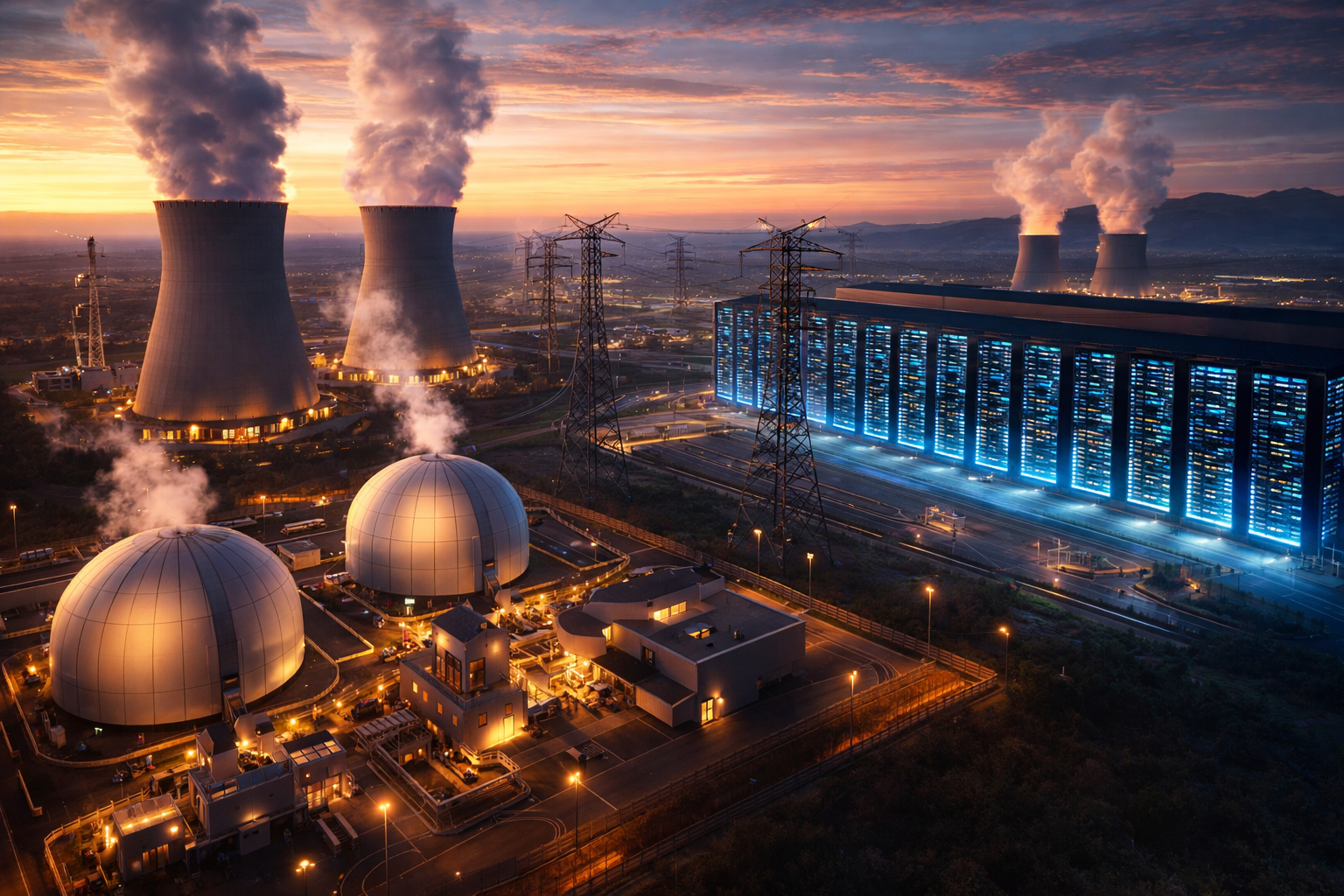
The artificial intelligence boom is no longer just about flashy software platforms and chatbot headlines — it’s rapidly becoming a global infrastructure arms race.
In one of the most striking signals yet of where institutional capital believes the real long-term opportunity lies, Australian AI infrastructure developer Firmus has secured a $10 billion debt package led by global investment giant Blackstone, alongside Coatue Management, to accelerate the expansion of its AI-focused data center network.
The deal, first reported by Reuters, highlights a major shift underway in global markets: investors are increasingly treating AI compute capacity as the next essential utility — similar to energy, telecom networks, or cloud infrastructure. And the biggest players in private capital are moving quickly to secure their position.
For investors, this isn’t just another funding headline. It’s a clear signal that AI infrastructure is becoming one of the most powerful and investable themes of the decade.
A Landmark Deal Signals the “Next Phase” of AI Investing
Firmus’ $10 billion financing package is significant not only because of its size, but because of what it represents.
Large-scale institutional investors like Blackstone do not deploy billions into projects based on hype cycles. Their capital typically targets long-duration assets with predictable cash flow potential — such as logistics hubs, real estate, energy systems, and major infrastructure.
By backing Firmus, Blackstone and Coatue are effectively making a high-conviction bet that AI data centers will become one of the most critical assets in the global digital economy, and that demand for compute will continue rising sharply for years.
According to Reuters, Firmus’ project aims for multi-gigawatt capacity, placing it in the same category as some of the largest global data center expansion efforts currently underway.
That scale matters because AI workloads are fundamentally different from traditional cloud computing. They require massive energy usage, specialized hardware, and high-performance networks — making them extremely capital intensive, but also potentially highly profitable.
Why This Matters for Investors
AI has already transformed public markets, driving major rallies in semiconductor stocks and mega-cap technology names. But as investors increasingly look beyond the obvious winners, a new narrative is emerging:
The real bottleneck in AI is infrastructure.
Training and running advanced AI models requires:
- AI chips (GPUs and accelerators)
- hyperscale data centers
- high-bandwidth networking equipment
- stable energy supply
- cooling systems and grid upgrades
Without these, AI cannot scale.
This is why AI infrastructure is attracting huge institutional financing — because demand is becoming structural rather than speculative.
The $10B Firmus deal reinforces that AI infrastructure is evolving into a long-term investment category, similar to renewable power projects or transportation infrastructure. Investors are no longer asking if AI will expand, but rather who will own the backbone supporting it.
Australia’s Strategic Advantage in the Global AI Build-Out
Firmus’ expansion also highlights why Australia is increasingly positioned as a strategic hub in the AI compute race.
Australia offers several key advantages:
1. Energy Resources
AI data centers consume massive power. Countries with access to stable energy supply — including renewable potential — become more attractive for AI infrastructure investment.
2. Political and Economic Stability
Institutional investors prioritize predictable regulatory environments. Australia’s stability gives it an edge compared to emerging markets with higher policy risk.
3. Geographic Positioning
Australia sits in a strategic location for Asia-Pacific digital infrastructure connectivity, making it valuable for international AI workloads.
As global competition intensifies, investors are increasingly looking at AI infrastructure as a geopolitical asset, not just a tech investment.
Blackstone’s Move Highlights Institutional Conviction
Blackstone’s involvement is one of the biggest takeaways for investors.
As one of the world’s largest alternative asset managers, Blackstone has been expanding aggressively into data center investment and digital infrastructure, reflecting a broader shift among private equity and credit funds toward technology-backed real assets.
This deal suggests that Blackstone sees AI compute demand as resilient and long-term, potentially comparable to the early stages of cloud adoption — except with significantly higher capital requirements.
Coatue’s participation is also notable, as the firm has been highly active in technology and growth-focused investing, reinforcing the view that AI infrastructure sits at the intersection of real assets and tech growth.
For public market investors, this provides a clear signal: AI is becoming an infrastructure economy, not just a software economy.
Future Trends to Watch in AI Infrastructure
Firmus’ financing comes as global investors accelerate funding into compute capacity. Several major trends are now shaping the AI infrastructure investment thesis:
Rising Data Center Demand
According to multiple industry estimates from firms such as McKinsey and major cloud providers, global data center demand is expected to surge due to AI workloads, pushing capacity constraints worldwide.
Power and Grid Bottlenecks
Energy access is becoming the limiting factor. Investors should watch grid upgrade projects, renewable integration, and energy partnerships tied to AI facilities.
Data Center REIT and Utility Opportunities
Public market exposure is expanding through REITs, power producers, and infrastructure-related industrial companies supporting AI build-outs.
Global Competition for Compute Sovereignty
Governments are increasingly concerned about “compute independence,” which could drive subsidies, tax incentives, and strategic infrastructure partnerships.
Key Investment Insight: AI Infrastructure Is Becoming a New Mega-Theme
For investors, the biggest takeaway is clear:
The next wave of AI investment opportunity may come from infrastructure — not software.
While AI software remains a growth story, the Firmus deal suggests that institutional capital is shifting toward tangible assets that enable AI at scale.
Investors looking to align with this trend may want to monitor:
- data center operators and REITs
- semiconductor supply chains
- electrical equipment manufacturers
- renewable energy providers tied to hyperscale projects
- industrial firms supporting cooling and grid expansion
This is where AI demand becomes measurable and recurring — and where capital-intensive projects can generate long-term revenue streams.
In many ways, AI infrastructure is beginning to resemble the early stages of the cloud computing buildout, where the biggest winners were often the companies supplying compute, storage, and network capacity.
Firmus securing a $10 billion financing package led by Blackstone and Coatue is more than a corporate milestone — it’s a market signal.
It confirms that AI is entering a new investment cycle where the focus is shifting from consumer-facing AI hype toward the physical backbone of the AI economy: data centers, power systems, and compute infrastructure.
As Reuters reporting highlights, institutional investors are treating AI infrastructure as a long-term strategic asset class — and that shift is creating new opportunities well beyond traditional tech stocks.
For daily coverage of the most important developments shaping markets, stay with MoneyNews.Today — your trusted source for investor news, actionable insights, and trend-driven financial analysis.