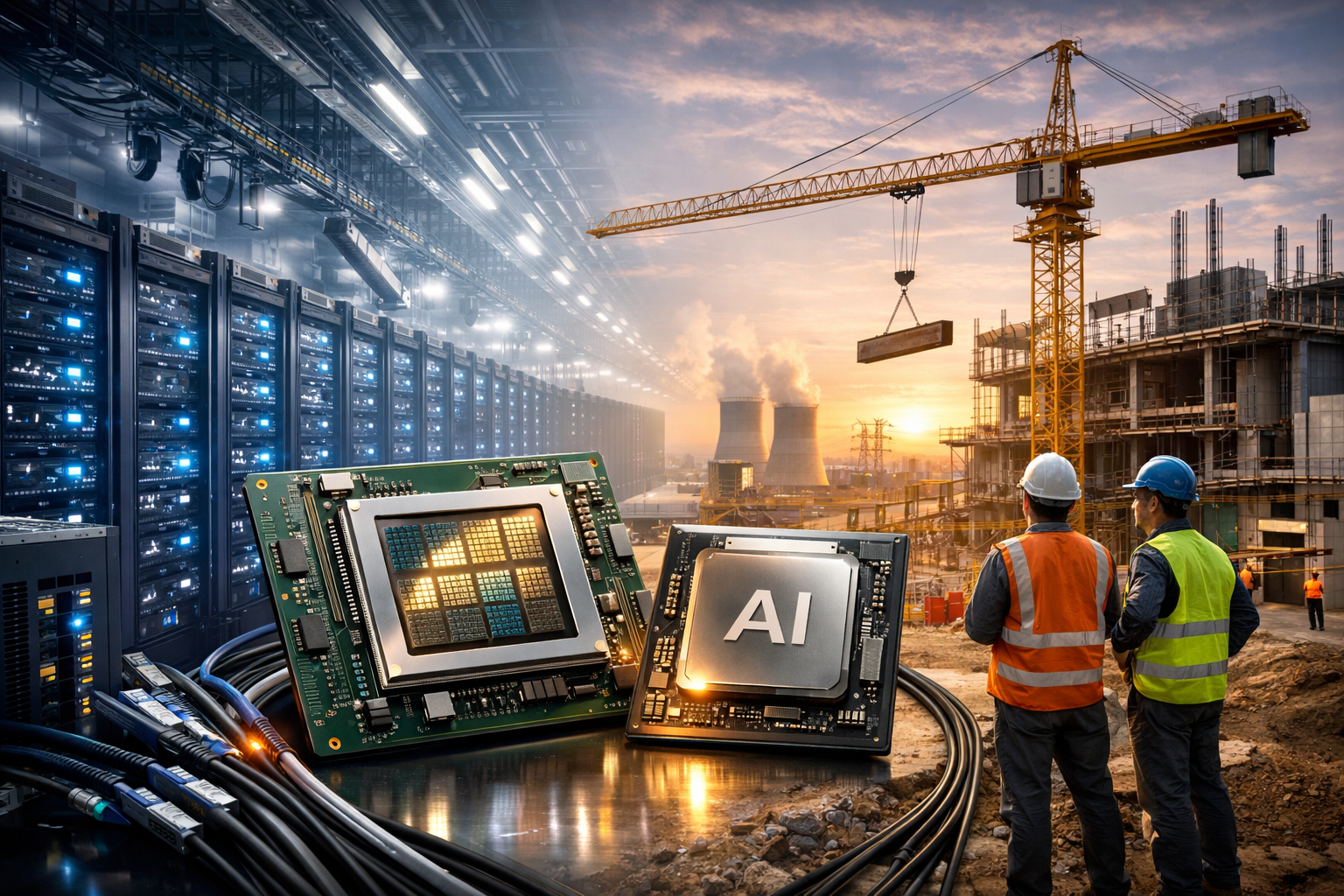
The artificial intelligence arms race is entering a new—and far more capital-intensive—phase. Across Wall Street and Silicon Valley, investors are increasingly focused not just on AI innovation headlines, but on the massive infrastructure spending required to sustain them.
Over the past week, reports from Reuters and Bloomberg have highlighted a sharp escalation in capital expenditures from leading technology giants, including Microsoft, Alphabet, and Amazon. These companies are pouring billions into AI data centers, advanced semiconductors, and cloud infrastructure—raising a critical question for investors: when will the returns justify the costs?
The AI Spending Surge: A New Capex Supercycle
The scale of investment currently flowing into AI infrastructure is unprecedented. Unlike previous tech cycles—such as mobile or cloud—AI requires significantly more computational power, specialized hardware, and energy resources.
According to recent reporting from Bloomberg, hyperscalers are dramatically increasing capital expenditures to support generative AI workloads. This includes building out next-generation data centers optimized for AI training and inference, as well as investing heavily in custom silicon to reduce dependency on third-party chipmakers.
Microsoft continues to expand its Azure AI footprint, integrating AI copilots across its enterprise software ecosystem while scaling infrastructure to meet surging demand. Meanwhile, Alphabet is doubling down on its AI-first strategy, embedding generative AI into search and cloud services while investing in proprietary chips such as Tensor Processing Units (TPUs).
Amazon, through AWS, is similarly ramping up spending on AI infrastructure, positioning itself as the backbone for enterprise AI deployment. The company is also investing in its own AI chips to optimize performance and cost efficiency.
This surge in spending signals the emergence of what many analysts are calling an AI infrastructure supercycle—a multi-year investment wave that could rival or exceed the cloud computing boom of the 2010s.
Monetization Remains the Key Question
While demand for AI capabilities is clearly accelerating, monetization remains a central concern for investors.
Enterprise adoption of AI tools—ranging from copilots and chatbots to predictive analytics—has grown rapidly. However, translating that adoption into sustainable, high-margin revenue streams is still a work in progress.
Analysts cited by Reuters note that many AI services are currently being offered at competitive or even subsidized pricing to drive adoption. This raises concerns about whether companies can eventually command premium pricing without slowing demand.
For instance, while Microsoft has introduced paid AI copilots across its product suite, the long-term revenue contribution relative to infrastructure costs remains uncertain. Similarly, Alphabet faces the challenge of monetizing AI-enhanced search without disrupting its highly profitable advertising model.
The risk is clear: if monetization lags behind spending, margins could come under pressure—even as revenues grow.
Margin ضغط vs. Growth: A Delicate Balance
The current phase of AI investment presents a classic trade-off between growth and profitability.
On one hand, companies that invest aggressively in AI infrastructure are likely to capture significant market share in what could become a trillion-dollar market. On the other hand, the upfront costs are substantial and could weigh on near-term earnings.
Data center construction, for example, involves not only hardware costs but also significant expenditures on energy, cooling systems, and real estate. Additionally, the development of custom AI chips requires heavy R&D investment and long lead times.
According to industry estimates referenced by Bloomberg, capital expenditures among major hyperscalers could grow at double-digit rates through 2026, driven largely by AI-related investments.
This dynamic is already influencing investor sentiment. While AI-focused companies have been among the top performers in recent years, markets are becoming more selective—rewarding firms that demonstrate clear paths to monetization while penalizing those with rising costs and uncertain returns.
Why This Matters for Investors
The implications of this AI spending boom extend far beyond Big Tech.
1. Ripple Effects Across the Supply Chain
The surge in AI infrastructure investment is benefiting a wide range of industries, from semiconductor manufacturers to energy providers. Companies involved in data center construction, cooling technologies, and power generation are also seeing increased demand.
2. Increased Earnings Volatility
As capital expenditures rise, earnings volatility is likely to increase. Investors should expect fluctuations in margins, particularly for companies in the early stages of AI monetization.
3. Competitive Moats Are Being Reinforced
Large-scale AI infrastructure investments create significant barriers to entry. Companies with the resources to invest billions in AI are likely to strengthen their competitive positions, potentially leading to greater market concentration.
4. Valuation Sensitivity
High valuations in the tech sector are increasingly tied to AI growth expectations. Any संकेत that adoption or monetization is slowing could trigger sharp market reactions.
Future Trends to Watch
Enterprise AI Adoption Curve
The pace at which enterprises integrate AI into core operations will be a key driver of revenue growth. Early adopters are already seeing productivity gains, but widespread adoption will determine the scale of the opportunity.
Pricing Power Evolution
Investors should monitor whether companies can transition from promotional pricing to sustainable pricing models without losing customers.
AI Chip Innovation
Custom silicon development by companies like Amazon and Alphabet could reshape the competitive landscape, reducing reliance on external suppliers and improving cost efficiency.
Energy and Infrastructure Constraints
AI workloads are energy-intensive, and power availability could become a limiting factor. This introduces a new variable into the investment equation, particularly as sustainability concerns grow.
What the Analysts Are Saying
Market analysts remain broadly optimistic about the long-term potential of AI, but caution that the current phase is investment-heavy.
Reports from Reuters emphasize that while AI is expected to drive significant revenue growth over the next decade, the near-term impact on profitability is less certain.
Similarly, Bloomberg highlights that investors are increasingly scrutinizing capital allocation strategies, with a focus on return on invested capital (ROIC) and free cash flow generation.
This shift in focus suggests that execution—not just innovation—will be the defining factor for AI leaders in 2026 and beyond.
Key Investment Insight
AI remains one of the most compelling long-term investment themes in the market, but the current phase demands a more nuanced approach.
Investors should prioritize companies that demonstrate:
- Clear monetization strategies for AI products
- मजबूत balance sheets capable of sustaining high capital expenditures
- Operational efficiency in managing infrastructure costs
- Evidence of enterprise adoption translating into recurring revenue
At the same time, diversification across the broader AI ecosystem—including semiconductors, energy, and infrastructure—can provide exposure to the trend while mitigating company-specific risks.
The AI revolution is no longer just about breakthrough models and applications—it’s about the infrastructure that powers them. As Big Tech doubles down on investment, the stakes are rising for both companies and investors.
Stay ahead of the curve with MoneyNews.Today, your trusted source for daily investor insights, market trends, and actionable financial news.