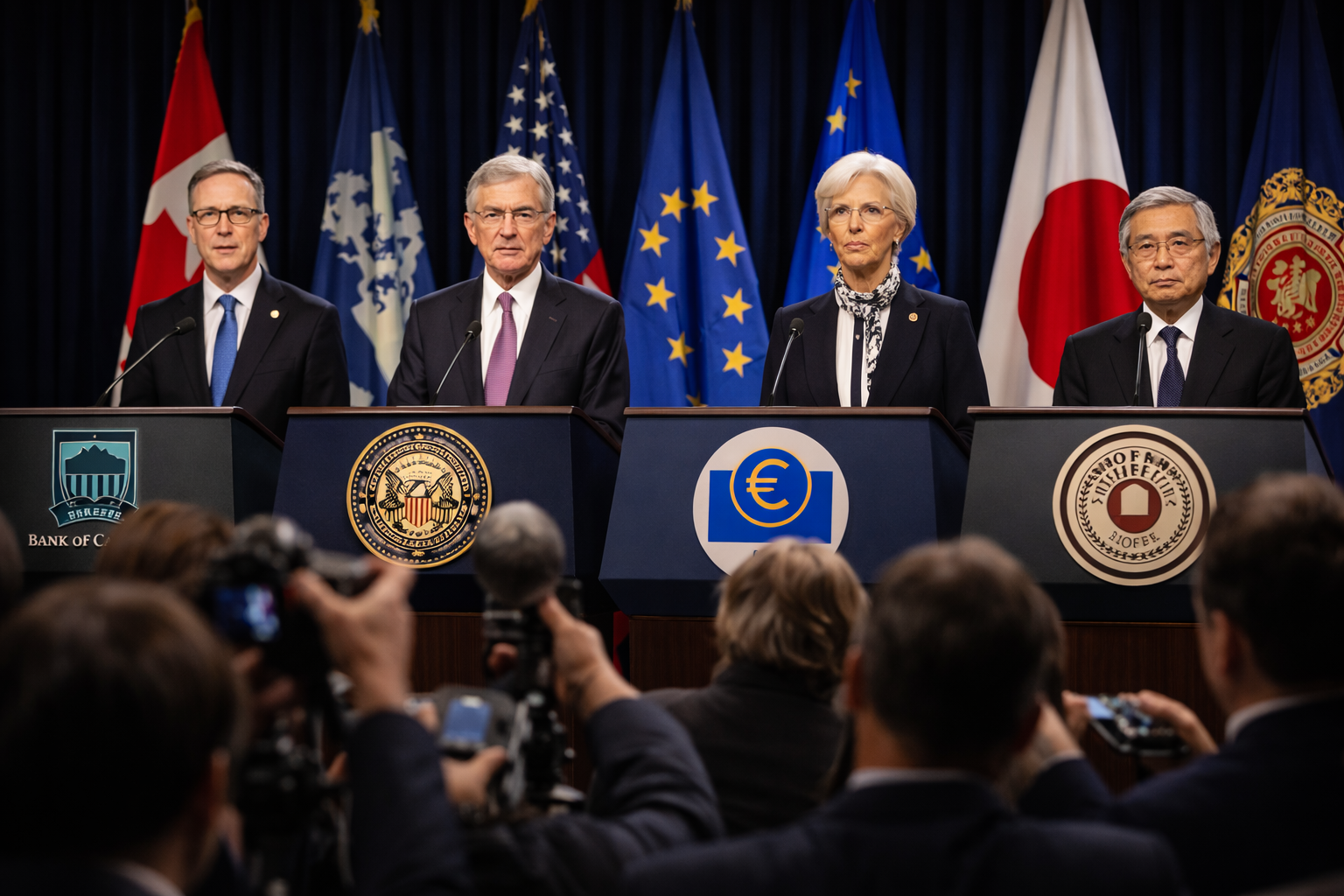
Financial markets are once again confronting a familiar but unsettling theme: political pressure on central bank independence. This week, investors took notice after top global central bankers — including the Governor of the Bank of Canada — issued a rare joint defense of U.S. Federal Reserve Chair Jerome Powell, underscoring the importance of insulating monetary policy from political influence. The coordinated response, reported by Reuters, highlights how sensitive markets have become to any perceived erosion of central bank autonomy amid shifting U.S. political dynamics.
For investors, the implications stretch far beyond Washington. Confidence in independent monetary policy is a cornerstone of market stability, influencing everything from bond yields and equity valuations to currency strength and capital flows.
Why Markets Are Paying Attention Now
The backdrop to this development is a heightened political environment in the United States, where economic policy rhetoric — particularly around interest rates and growth — has intensified. Federal Reserve Chair Jerome Powell has faced renewed public criticism linked to the pace and direction of monetary policy, reviving concerns about political interference.
According to Reuters, central bank leaders emphasized that independence is essential for maintaining credibility, controlling inflation expectations, and anchoring long-term financial stability. Such public alignment among central bankers is unusual and signals that policymakers view the current situation as a material risk to global markets, not merely a domestic political dispute.
Market reaction has been measured but cautious. Currency traders, fixed-income investors, and equity strategists are closely monitoring rhetoric from policymakers, aware that even subtle shifts in perceived independence can amplify volatility.
Central Bank Independence and Asset Pricing
Independent central banks play a critical role in keeping inflation expectations stable. Research frequently cited by institutions such as the International Monetary Fund and Bank for International Settlements shows that economies with strong central bank autonomy tend to experience lower inflation volatility and more stable growth outcomes.
When independence is questioned, risk premiums can rise quickly. Bond investors may demand higher yields to compensate for uncertainty, equity valuations can compress as discount rates increase, and foreign exchange markets may reprice currencies perceived as politically influenced.
For the U.S. dollar, credibility of the Federal Reserve is especially important. As the world’s primary reserve currency issuer, any erosion of confidence can have ripple effects across global trade, commodities, and capital markets.
Trump-Era Policy Signals and Investor Sensitivity
The renewed focus on central bank independence comes amid broader scrutiny of potential economic policy shifts tied to U.S. political leadership. Markets are weighing the possibility of more direct pressure on monetary authorities, alongside fiscal policy changes that could affect inflation, deficits, and growth.
Analysts quoted by Bloomberg have noted that political involvement in rate-setting discussions — even rhetorically — can increase uncertainty around future policy paths. This uncertainty tends to favor defensive positioning, particularly during periods when inflation risks and geopolitical tensions are already elevated.
Equities sensitive to interest rates, such as technology and growth stocks, are often the first to react. Fixed income markets, meanwhile, can experience curve steepening or sudden repricing as investors reassess long-term inflation and policy credibility.
Why This Matters for Investors
For portfolio managers and individual investors alike, central bank credibility is not an abstract concept — it directly affects returns. A stable, independent Federal Reserve helps anchor expectations, reducing the likelihood of abrupt market moves.
When that independence is questioned, correlations between asset classes can shift. Traditional diversification benefits may weaken, making risk management more challenging. This is why periods of policy uncertainty often see renewed interest in alternative hedges and high-quality defensive assets.
Gold, for example, has historically benefited during episodes of political and monetary uncertainty. Similarly, high-quality government bonds from countries with strong institutional credibility can regain appeal as safe-haven assets.
Future Trends to Watch
Investors should closely monitor official statements from central banks, not only in the U.S. but globally. Coordinated messaging, such as the recent defense of Powell, suggests heightened concern among policymakers about preserving credibility.
Upcoming Federal Reserve communications, inflation data, and fiscal policy signals will be critical in shaping market expectations. Additionally, currency market movements may offer early clues about shifting confidence in monetary policy frameworks.
Political developments tied to economic policy platforms will remain a key variable. Markets tend to react less to ideology and more to perceived risks to institutional stability.
Key Investment Insight
Rising political pressure on monetary policy underscores the importance of diversification and risk-aware positioning. During periods of heightened policy risk, investors may benefit from exposure to macro hedges such as gold, high-quality bonds, and defensive equity sectors. Maintaining flexibility and monitoring policy credibility indicators can help navigate volatility across equities, fixed income, and foreign exchange markets.
Stay connected with MoneyNews.Today for daily insights into global politics, central bank policy, and the forces shaping investor sentiment worldwide.