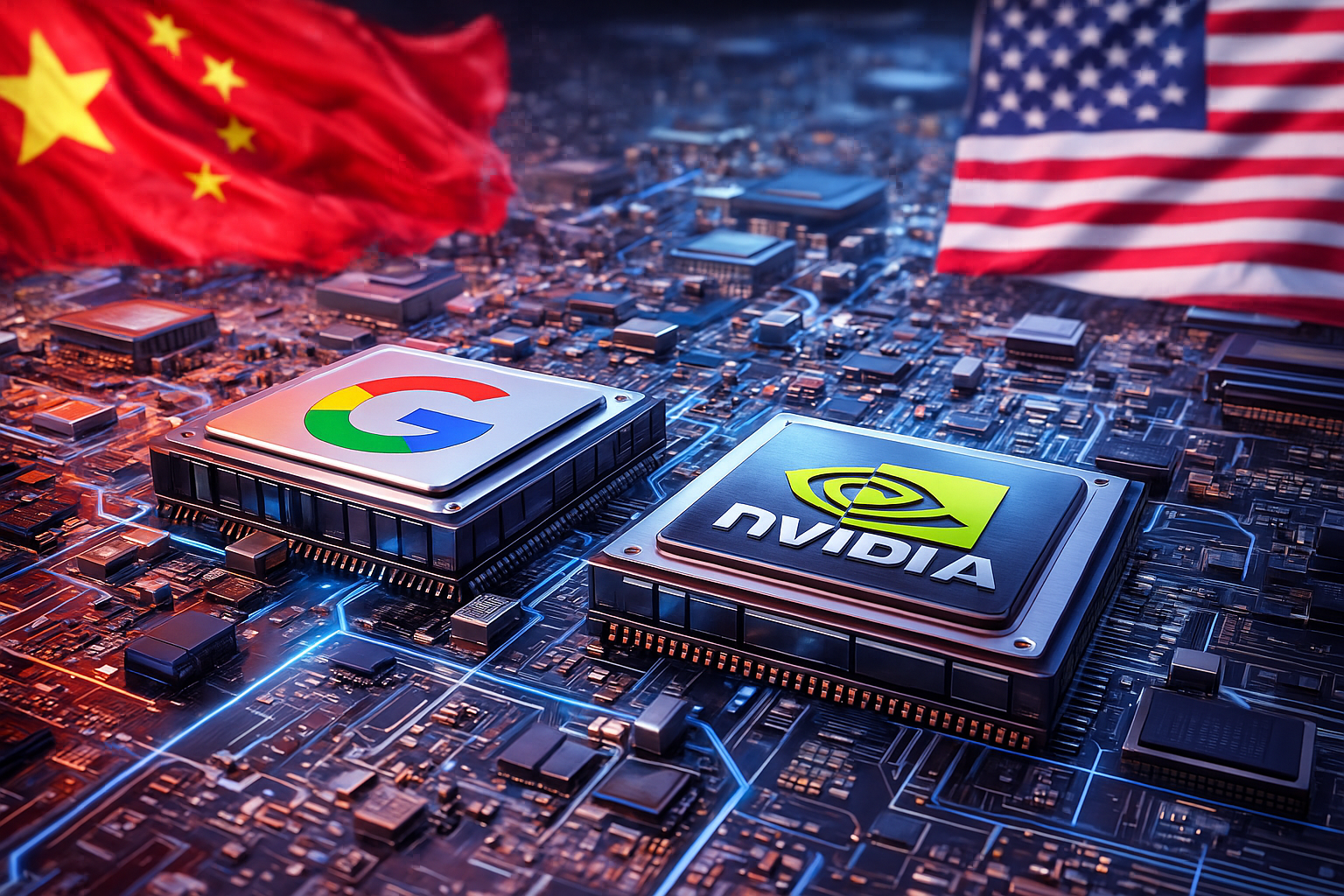
A dramatic shift is unfolding across the global AI landscape—one that investors can’t afford to ignore. As markets increasingly reward companies capable of scaling AI infrastructure, new data reveals that China has now surpassed the United States in downloads of “open” AI models. At the same time, Google is making rapid progress in the AI-chip arena, threatening Nvidia’s long-held dominance. For investors navigating the next phase of AI growth, these dual developments signal an accelerating race for innovation, hardware supremacy, and global influence.
China’s Growing AI Influence Is Reshaping Global Competition
According to a recent Financial Times analysis of industry data, China now accounts for 17% of global downloads of open-source AI models, edging past the United States for the first time. The shift underscores Beijing’s rising influence as an AI development powerhouse, supported by state-backed initiatives, expanding research capacity, and a new class of globally competitive AI startups.
This surge fits a broader pattern: despite U.S. efforts to restrict access to cutting-edge chips, Chinese developers have doubled down on open-source models—many of which do not require the most advanced hardware to train or deploy. Firms like Alibaba and Tencent are releasing increasingly capable architectures, while independent labs have gained traction across developer communities.
Industry analysts note that open-source AI is flourishing in China partly because of its flexibility, lower development costs, and regulatory alignment. The downloads metric, while not a perfect proxy for innovation, highlights a rapid expansion of China’s AI ecosystem, particularly in education, enterprise software, and consumer tech.
For global investors, the story here is not merely about domestic competition—it’s about a deepening bifurcation in AI development models.
Google’s Renewed AI-Chip Push Tightens Pressure on Nvidia
While China’s AI-model momentum attracts global attention, another major shift is happening in the U.S.: Google is accelerating its bid to catch Nvidia in the AI-chip race. As highlighted by the Financial Times, Google’s advancements in both AI models and custom tensor processing units (TPUs) have sparked speculation that it may challenge Nvidia’s near-monopoly on AI compute hardware.
This year alone, Google has announced multiple infrastructure upgrades, including improvements to its next-generation TPUs and more efficient data-center architecture optimized for scaled AI workloads. With hyperscalers under pressure to cut compute costs, Google’s vertically integrated stack—spanning chips, cloud infrastructure, and foundation models—creates a compelling value proposition.
Nvidia still controls a commanding share of the global AI-hardware market, but competition is intensifying. Meta, Microsoft, and AWS are developing custom chips; startups like Cerebras and Graphcore continue innovating; and now Google is emerging as a credible challenger at the high end of the market.
For investors, this signals that AI hardware is entering a more competitive era, where performance gains and pricing power could shift dramatically over the next two years.
Why This Matters for Investors
1. Open-Source AI Is Becoming a Global Battleground
China’s rise in open-AI model usage signals a structural shift in how AI tools are adopted, developed, and deployed. Countries with constraints on advanced chip imports may increasingly lean on open-source models—allowing rapid innovation despite hardware limitations.
Companies positioned to support open-source ecosystems—through data services, model tuning, cloud infrastructure, or enterprise integration—are poised for durable long-term demand.
2. AI-Chip Competition Could Pressure Valuations
Nvidia remains a core component in most AI-linked portfolios, but the competitive landscape is changing. The entry of Google’s TPUs into mainstream enterprise and cloud deployments could compress margins across the AI-hardware sector. This dynamic favors diversified exposure over single-stock concentration.
3. The Next Phase of AI Growth Won’t Be U.S.-Only
Investors who have focused exclusively on U.S. AI companies may be overlooking emerging opportunities in Asia—especially in software, semiconductors, and model infrastructure. As China expands its footprint in global AI development, cross-border AI partnerships and regional innovation hubs may become more influential.
Future Trends to Watch
The Rise of Specialized AI Chips
General-purpose GPUs may soon give way to custom accelerators tailored for inference, edge devices, and high-efficiency workloads. Watch for growth in companies developing ASICs for automotive AI, robotics, and large-scale cloud environments.
AI-Ready Data Centers
Demand for next-generation data centers—especially those optimized for AI inference—will continue to surge. Real estate investment trusts (REITs), energy providers, and cooling-tech companies could see multi-year tailwinds.
Regulatory Divergence Between the U.S. and China
Both countries are moving toward more structured AI governance—though in very different ways. Diverging regulatory paths could shape market access, R&D funding, and capital flows, with implications for multinational AI players.
Key Investment Insight
The emerging two-speed AI world—open-source dominance in China and intensifying hardware competition in the U.S.—creates a broader, more complex investment landscape. Investors should consider diversifying beyond the usual mega-cap names and explore companies positioned within AI compute infrastructure, open-source model ecosystems, cloud optimization, and alternative semiconductor solutions.
Competition may increase volatility, but it also creates new entry points for long-term growth.
Stay ahead of the evolving AI race with MoneyNews.Today, where investors get timely, data-driven insights into the technologies shaping tomorrow’s markets.