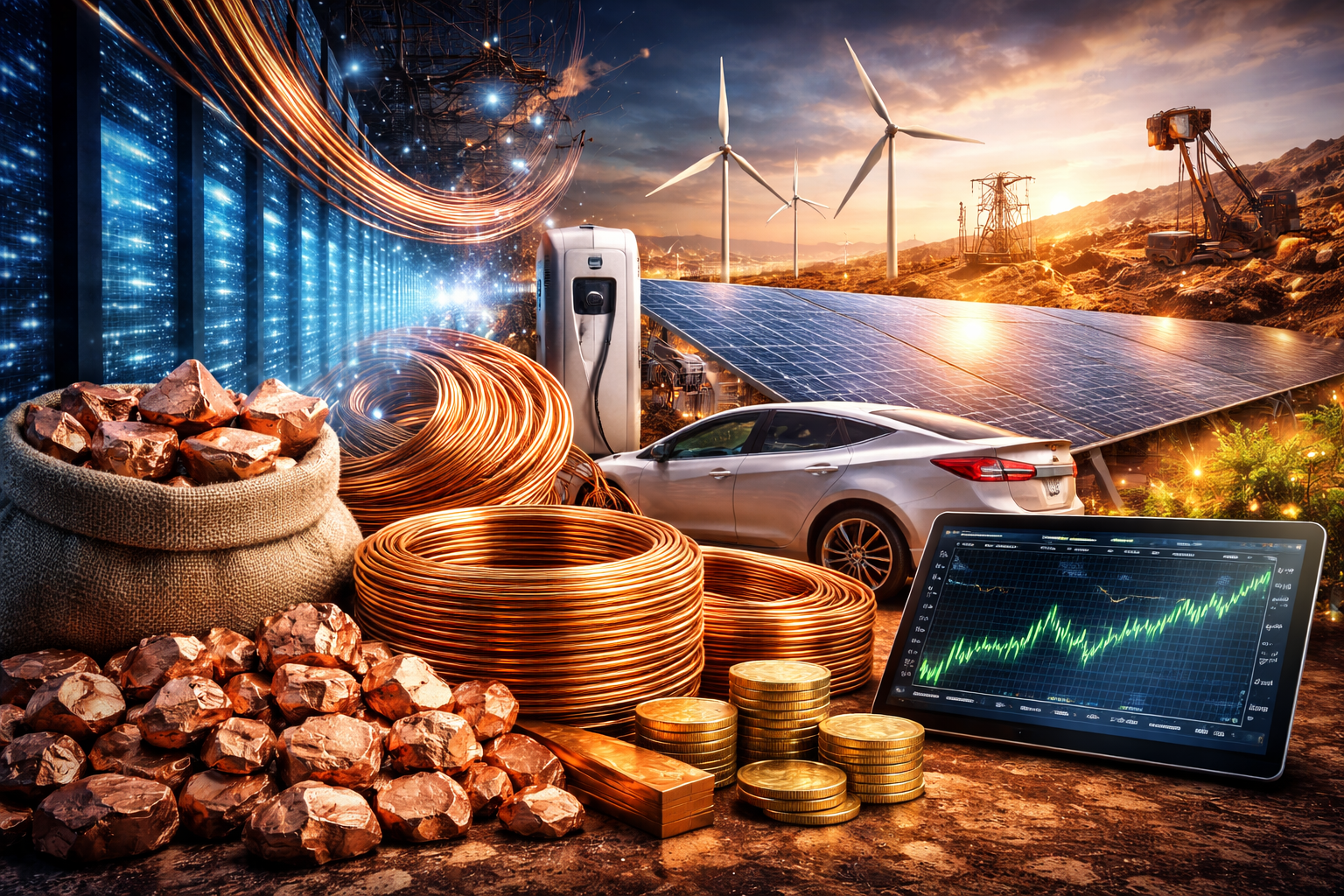
Copper is once again commanding investor attention as structural demand from artificial intelligence infrastructure and the global energy transition tightens an already constrained supply outlook. Often described as the “metal with a PhD in economics,” copper’s price movements have long served as a barometer of industrial health — and current signals suggest a market bracing for sustained demand growth.
Recent analysis cited by Investing.com projects copper prices in the range of $11,000 to $14,000 per metric ton, with upside risk if demand accelerates faster than supply can respond. For investors, the copper market now sits at the intersection of technology, electrification, and long-term infrastructure investment.
Why This Matters for Investors
Copper’s importance has expanded well beyond traditional construction and manufacturing. Today, it is a critical input for data centers, electric vehicles, renewable energy systems, and power grid expansion — all areas seeing heavy capital investment.
According to market analysts referenced by Investing.com, AI-driven demand is emerging as a meaningful new consumption driver. High-performance computing, advanced semiconductors, and hyperscale data centers require significantly more copper for wiring, cooling systems, and power delivery than conventional IT infrastructure.
At the same time, global decarbonization efforts are accelerating copper usage across wind turbines, solar installations, battery storage, and electric vehicle charging networks. This dual demand from technology and energy transition trends creates a powerful structural tailwind that investors are increasingly factoring into long-term price forecasts.
Supply Constraints Add to the Bullish Case
While demand continues to build, copper supply remains structurally challenged. Large-scale mining projects often take more than a decade to move from discovery to production, and capital discipline among miners has limited aggressive expansion.
According to Bloomberg and industry data from the International Copper Study Group, ore grades at many existing mines are declining, increasing production costs and limiting output growth. Geopolitical risks, regulatory hurdles, and water scarcity in key producing regions such as Chile and Peru further complicate supply expansion.
This imbalance between rising demand and constrained supply underpins bullish long-term projections — but it also increases the potential for price volatility.
China’s Role and Near-Term Risks
Despite strong structural demand, copper prices remain sensitive to short-term macro factors — particularly economic conditions in China, the world’s largest copper consumer.
Analysts cited by Investing.com caution that speculative positioning and shifts in Chinese industrial activity can drive sharp price swings. Any slowdown in China’s construction or manufacturing sectors could temporarily weigh on prices, even as longer-term fundamentals remain supportive.
Additionally, copper markets have historically attracted speculative capital during periods of strong momentum, increasing the risk of short-term corrections. For investors, this makes timing and risk management especially important when gaining exposure to the metal.
Future Trends Investors Should Watch
Several key developments will shape copper’s trajectory in the coming years:
- AI Infrastructure Expansion: Continued investment in data centers and high-performance computing could accelerate demand beyond current forecasts.
- Energy Transition Spending: Government incentives and private investment in renewable energy and grid modernization remain major demand drivers.
- Mining Investment: Any shift toward aggressive mine development or technological breakthroughs in extraction could alter supply dynamics.
- China’s Economic Signals: Industrial production, infrastructure spending, and policy support in China will remain critical short-term indicators.
Market strategists emphasize that copper’s role as a strategic metal is only growing as economies digitize and electrify.
Key Investment Insight
Copper offers investors exposure to multiple long-term growth themes, but it is not without risk. Structural demand from AI and clean energy supports a bullish long-term outlook, yet speculative activity and macroeconomic shifts can produce sharp price swings.
Investors may consider diversified exposure through mining equities, base metals ETFs, or commodity-linked funds rather than concentrated bets. Emphasizing companies with strong balance sheets, low production costs, and stable geopolitical footprints can help mitigate downside risk while maintaining upside potential.
Copper’s evolving role in the global economy makes it one of the most closely watched commodities in today’s markets. For ongoing coverage of metals, commodities, and the trends shaping global supply chains, stay connected with MoneyNews.Today, your trusted source for daily investor insights and market-moving analysis.