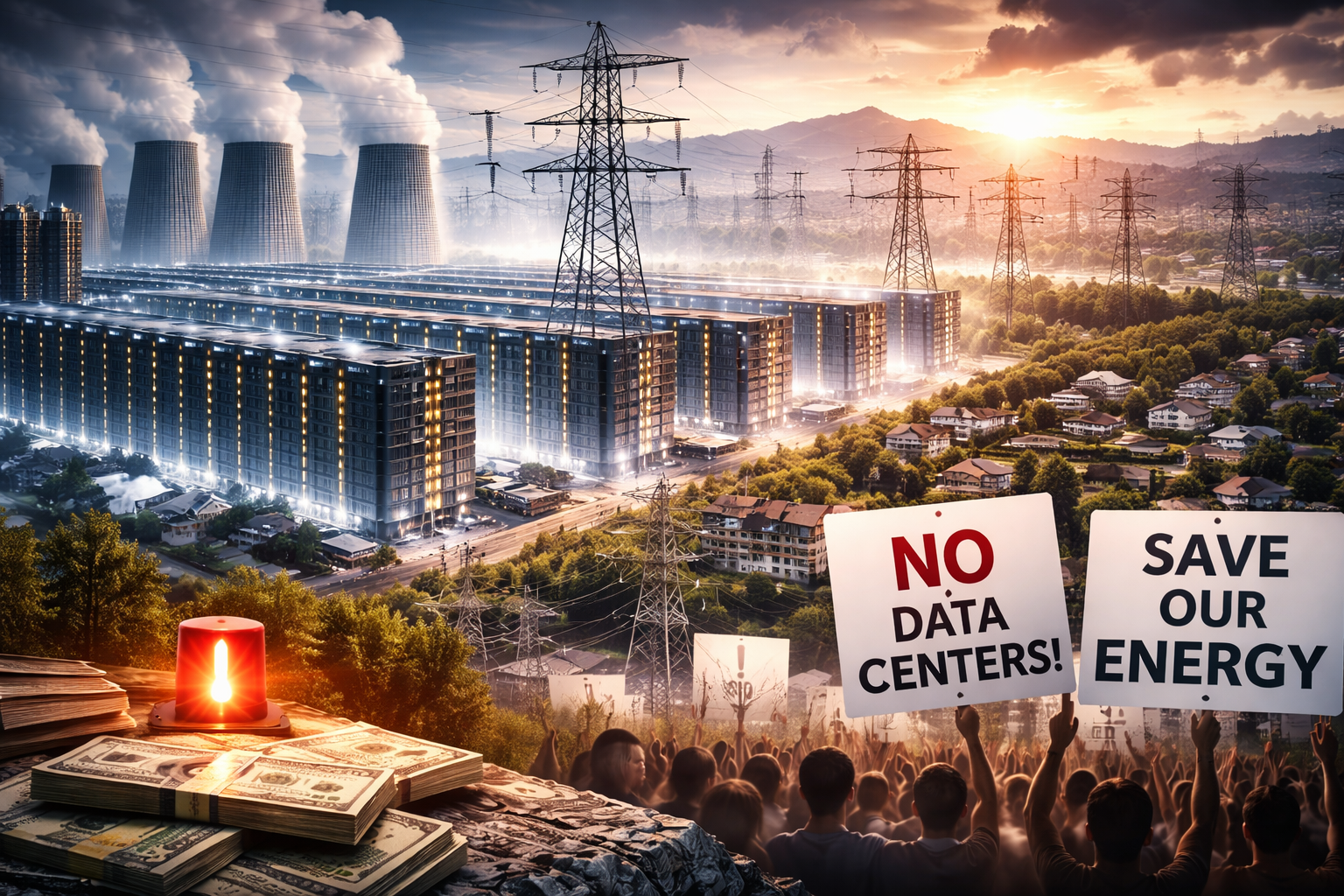
The artificial intelligence boom is rewriting the global infrastructure playbook — but not without resistance. As hyperscalers race to build massive data centers to power AI models and cloud services, a political and regulatory backlash is emerging across parts of the United States, raising new questions for investors about where — and how fast — AI infrastructure can scale.
From Pennsylvania to other power-constrained regions, local governments and regulators are pushing back against data center projects tied to companies such as Google, Amazon, Microsoft, and Meta, citing electricity cost pressures, grid strain, and environmental concerns. What began as a clear growth narrative is now evolving into a more complex investment landscape.
AI Infrastructure Meets Political Reality
According to Investor’s Business Daily, opposition to data center expansion is intensifying as communities confront the real-world costs of hosting energy-hungry AI facilities. Data centers can consume as much electricity as small cities, placing stress on local grids and, in some cases, pushing up power prices for residents and businesses.
In Pennsylvania, officials have raised concerns about whether existing infrastructure can support new hyperscale developments without significant upgrades. Similar debates are unfolding in other U.S. states where AI investment is accelerating faster than grid modernization.
For investors, this signals a critical shift: AI infrastructure growth is no longer just a capital expenditure story — it is increasingly a regulatory and political one.
Why This Matters for Investors
The market has largely priced AI data centers as a straightforward long-term growth driver, benefiting cloud providers, semiconductor companies, and construction and engineering firms. However, political resistance introduces new variables that could affect project timelines, costs, and geographic allocation of capital.
Investor’s Business Daily notes that utilities, regulators, and local governments are demanding greater clarity around who bears the cost of grid upgrades and environmental mitigation. In some cases, approvals are being delayed or conditions tightened, increasing uncertainty for infrastructure investors.
This matters because data centers underpin the entire AI ecosystem. Any slowdown or redirection of buildouts could ripple across sectors — from chipmakers and networking firms to real estate investment trusts focused on digital infrastructure.
Grid Constraints and Power Economics
At the heart of the backlash is electricity. AI workloads require constant, high-density power, often at levels existing grids were not designed to handle. According to industry estimates cited by Bloomberg, U.S. data center electricity demand could double within the decade if AI deployment continues at its current pace.
Utilities are now facing pressure to invest billions in transmission, generation, and storage — costs that often become politically sensitive when passed on to consumers. Environmental groups have also raised concerns about emissions and water usage, particularly in regions still reliant on fossil fuels.
For investors, this creates a bifurcated opportunity set. While some regions may slow approvals, others with surplus power, faster permitting, or renewable capacity could emerge as preferred destinations for AI infrastructure capital.
Emerging Winners and Losers
The backlash does not mean the AI data center boom is ending — but it may become more selective. Regions with business-friendly regulatory frameworks, robust grids, and access to renewable energy are likely to attract a disproportionate share of future investment.
This shift could benefit:
- Power technology companies specializing in grid optimization
- Energy storage providers that help balance peak demand
- Renewable energy developers tied to data center power contracts
Conversely, hyperscalers may face higher costs or longer timelines in politically sensitive regions, potentially impacting near-term capital efficiency.
Analysts tracking the sector suggest that infrastructure adaptability — not just scale — will define the next phase of AI expansion.
Future Trends to Watch
Several developments will shape the investment outlook:
- State-level regulation: Diverging policies could reshape where data centers are built.
- Utility partnerships: Joint investments in power infrastructure may ease resistance.
- On-site generation: Companies may increasingly deploy dedicated power solutions to bypass grid bottlenecks.
- Environmental disclosures: Transparency around emissions and water use is becoming a prerequisite for approval.
As McKinsey and other consultancies have highlighted, AI’s physical footprint is now as important as its digital promise.
Key Investment Insight
The AI infrastructure story is evolving from rapid expansion to strategic optimization. Investors should recognize that grid constraints and local regulation are becoming material factors in AI-related growth narratives.
Rather than broad exposure to data center expansion, consider targeted opportunities in enabling technologies — power management, energy storage, and grid modernization — as well as regions positioned to absorb AI infrastructure with fewer political frictions.
Understanding where capital can flow freely — and where it may stall — will be essential as AI moves from hype to hard infrastructure reality.
For daily insights on emerging industries, policy shifts, and the investment forces shaping tomorrow’s economy, stay connected with MoneyNews.Today — your trusted source for clear, investor-focused analysis.