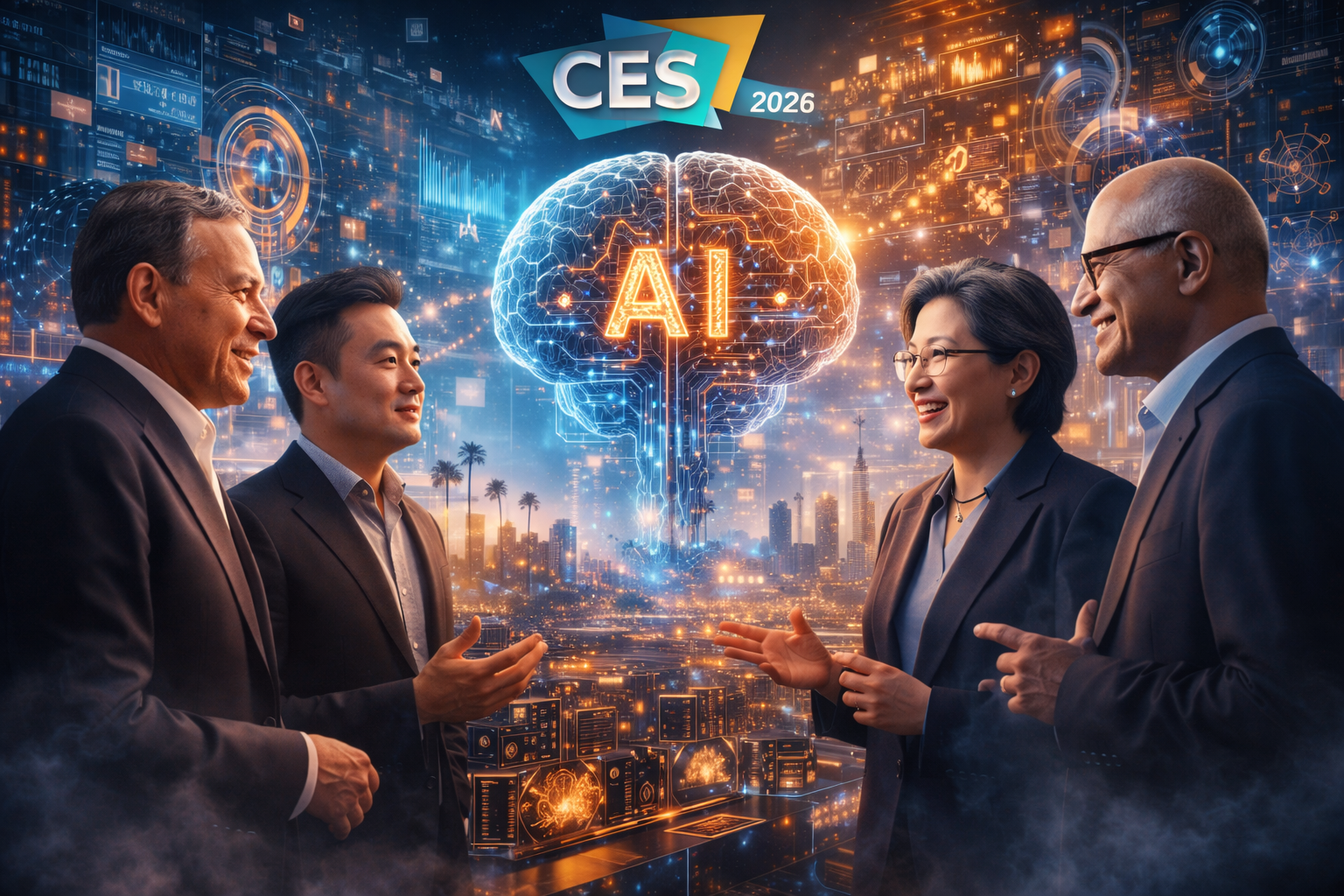
Artificial intelligence once again dominated the global tech conversation this week as CES 2026 opened in Las Vegas, with executives from entertainment, computing, and enterprise technology sectors converging around a shared message: AI is no longer a future promise — it is rapidly becoming the backbone of content creation, software platforms, and digital infrastructure.
From generative AI-driven media tools to enterprise automation platforms and AI-enhanced consumer devices, CES reaffirmed that the next phase of artificial intelligence adoption will be defined by integration, scale, and monetization, not experimentation. For investors, this shift marks a critical inflection point as AI moves beyond hardware headlines and into multi-sector revenue engines.
Why CES 2026 Matters for Investors
CES has long served as a forward-looking indicator of where consumer and enterprise technology spending is headed. This year’s event underscores a clear pivot: AI is evolving from a single-sector trade — dominated by semiconductors and cloud infrastructure — into a cross-industry growth catalyst spanning media, software, consumer electronics, and enterprise services.
According to coverage from Yahoo Finance, leaders across entertainment and technology highlighted how generative AI is being embedded into creative workflows, personalization engines, and customer engagement platforms. These integrations suggest AI-driven efficiencies and new revenue streams are beginning to materialize at scale, especially in content-heavy industries historically constrained by labor and production costs.
For investors, this signals that AI’s earnings impact is broadening — and with it, the opportunity set.
From Chips to Platforms: The Next Phase of AI Monetization
While AI hardware remains foundational, the dominant narrative at CES 2026 was the shift from compute to application. Software platforms that leverage AI for automation, personalization, and real-time decision-making are increasingly positioned to capture recurring revenue.
Industry analysts cited by Bloomberg and McKinsey have consistently noted that the largest economic value from AI will come from productivity gains and software-layer deployment rather than infrastructure alone. McKinsey estimates that generative AI could add trillions of dollars annually to global productivity, with media, retail, enterprise software, and customer service among the top beneficiaries.
At CES, this thesis was reflected in demonstrations of AI-powered content engines, adaptive user interfaces, and automated enterprise workflows — all pointing toward software-driven margin expansion rather than capital-intensive hardware cycles.
Entertainment, Media, and the AI Productivity Shift
One of the most notable themes was AI’s accelerating role in entertainment and media. Generative tools showcased at CES are now capable of assisting with scripting, editing, localization, and personalized content delivery — areas that represent substantial cost centers for media companies.
This has direct implications for publicly traded firms across streaming, gaming, and digital advertising. As AI reduces production timelines and enables personalized experiences at scale, companies that effectively deploy these tools could see operating leverage improve even in competitive pricing environments.
According to Yahoo Finance reporting, executives emphasized that AI is no longer a novelty within creative industries but a strategic necessity to remain competitive amid rising content demand and tighter margins.
Enterprise AI: Automation Moves to the Forefront
Beyond entertainment, enterprise-focused AI dominated discussions around workflow automation, customer service, and data analytics. Platforms integrating generative AI into CRM systems, supply chain management, and decision-support tools reflect a broader trend: enterprises are prioritizing return on investment, not experimentation.
Research from Gartner indicates that enterprise AI spending is increasingly shifting toward solutions that can demonstrate immediate efficiency gains. This aligns with what investors saw at CES — fewer conceptual demos and more production-ready AI deployments.
For markets, this reinforces the case for companies offering scalable AI platforms, vertical-specific software solutions, and enterprise automation tools rather than purely experimental AI ventures.
Key Investment Insight
The takeaway from CES 2026 is clear: AI is transitioning from a hardware-led trade to a platform-driven, multi-sector growth story.
Investors should watch for:
- Software companies integrating AI into core enterprise and consumer platforms
- Media and entertainment firms leveraging AI to improve margins and scalability
- Technology providers enabling AI-powered personalization and automation
- Infrastructure leaders that benefit indirectly as AI workloads scale across industries
Rather than focusing solely on headline AI chipmakers, the next leg of AI-driven returns may come from companies embedding AI into everyday business models.
What Comes Next
As earnings season approaches, investors should listen closely for commentary on AI-driven revenue contributions, cost efficiencies, and customer adoption metrics. CES 2026 suggests that AI’s financial impact will increasingly show up not just in capital expenditure trends, but in operating margins, productivity gains, and recurring revenue growth.
The convergence of entertainment, enterprise software, and AI platforms signals that artificial intelligence is entering its commercialization phase — a development with lasting implications for equity markets.
Stay with MoneyNews.Today for daily, investor-focused insights as we track how AI adoption reshapes technology, markets, and global capital flows.