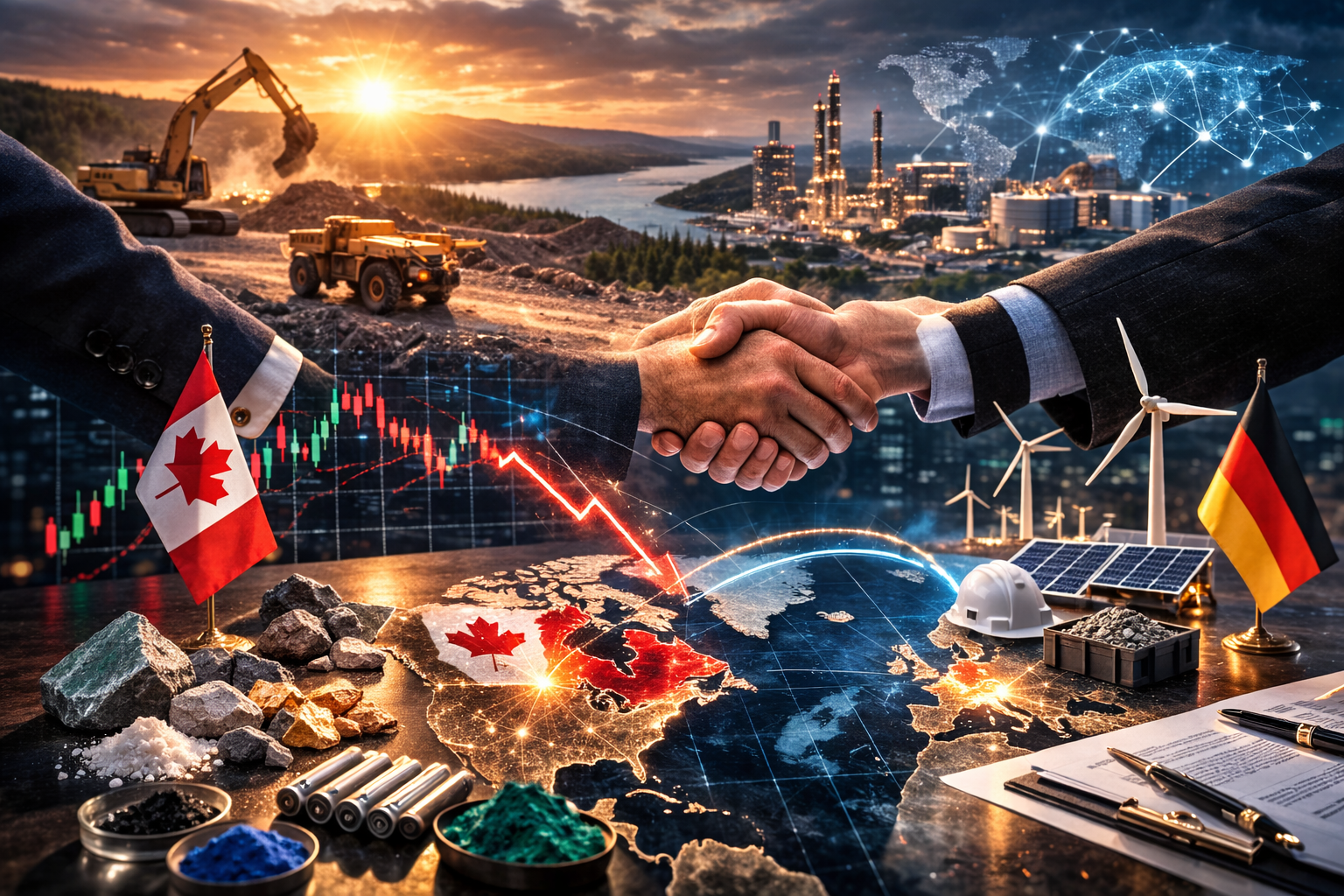
As global markets grapple with energy volatility and intensifying geopolitical fragmentation, one sector continues to rise above the noise: critical minerals. At the world’s largest mining convention — the Prospectors & Developers Association of Canada (PDAC) conference in Toronto — Germany and Quebec formalized a series of agreements aimed at strengthening supply chains for strategic raw materials essential to electric vehicles, defense technologies, semiconductors, and renewable energy systems.
According to reporting from Reuters, the agreements include a joint political declaration and multiple corporate partnerships designed to secure long-term access to key inputs such as lithium, nickel, cobalt, graphite, and rare earth elements. For investors, this isn’t merely a diplomatic headline — it represents a structural shift in how advanced economies are approaching industrial security, supply chain resilience, and capital allocation in emerging industries.
The race for critical minerals is no longer theoretical. It is now central to economic and national security policy — and markets are beginning to price that reality.
A Strategic Pivot in the Global Resource Landscape
Over the past several years, Western governments have moved aggressively to reduce reliance on concentrated mineral supply chains. China currently dominates processing capacity for many critical minerals, particularly rare earths and battery-grade materials. This concentration has amplified concerns among NATO-aligned economies seeking to secure inputs for EV manufacturing, aerospace, clean energy infrastructure, and defense systems.
The agreements between Germany and Quebec represent a practical step toward diversification. Quebec, rich in lithium and other strategic deposits, has emerged as a cornerstone of North America’s critical minerals strategy. Germany, Europe’s industrial powerhouse and a leader in automotive manufacturing, has strong incentives to lock in upstream access to battery metals.
The joint declaration signed at PDAC signals political alignment, while accompanying corporate agreements provide the commercial framework to advance exploration, extraction, and processing collaboration.
Why This Matters for Investors
1. Critical Minerals Are Moving From Commodity to Strategic Asset
For decades, many base and specialty metals were treated as cyclical commodity plays. That narrative is shifting. As electrification accelerates and defense modernization intensifies, materials such as lithium, nickel, and graphite are increasingly viewed as strategic enablers rather than simple inputs.
According to the International Energy Agency (IEA), global demand for lithium alone could multiply several times over the next decade under net-zero scenarios. Meanwhile, BloombergNEF projects continued growth in battery capacity installations worldwide, further tightening long-term supply-demand balances.
The Germany–Quebec agreements underscore a growing policy consensus: securing mineral supply is now a national priority. That political backing reduces regulatory uncertainty and may accelerate permitting timelines for projects in stable jurisdictions.
2. Risk Premium Compression for Western Projects
Geopolitical risk has historically inflated the cost of capital for mining projects in certain regions. Binding bilateral agreements and government-backed cooperation frameworks can reduce perceived risk, potentially lowering financing costs for qualifying projects.
Investors often assign premium valuations to mining assets located in politically stable, ESG-aligned jurisdictions. Quebec’s regulatory environment and resource base position it as an attractive alternative to higher-risk regions.
The alignment with Germany — a major European industrial buyer — further enhances demand visibility, which is a key valuation driver for long-life mining assets.
Corporate Implications: Beyond Exploration
While the headlines focus on upstream mining, the broader story encompasses processing, refining, and downstream integration. Western economies have recognized that extraction alone does not secure supply; refining capacity must also expand domestically or within trusted trade networks.
Recent McKinsey research highlights that battery value chains require coordinated development across mining, processing, cell manufacturing, and recycling. Bilateral agreements such as this one can catalyze private-sector capital across the full value chain.
For investors, this widens the opportunity set beyond miners to include:
- Midstream processing facilities
- Battery materials producers
- Infrastructure developers
- Specialized engineering firms
The ripple effects extend into capital equipment manufacturers and logistics providers supporting mineral transport.
Market Reaction and Sector Trends
Mining equities have already shown relative strength in recent months, particularly companies exposed to lithium, copper, and nickel. The broader sector has benefited from geopolitical tensions that highlight supply vulnerabilities.
According to Reuters, the PDAC announcements were received as part of a broader push by Western governments to de-risk supply chains. Market participants are increasingly differentiating between miners based on jurisdiction, resource grade, and government alignment.
Commodity prices themselves remain sensitive to global growth expectations and Chinese demand. However, structural demand from EV adoption and renewable energy deployment provides a longer-term tailwind independent of near-term cyclical swings.
Future Trends to Watch
Acceleration of Transatlantic Resource Alliances
The Germany–Quebec deal may serve as a template for additional agreements between Europe and North America. Investors should monitor similar announcements involving other resource-rich provinces and states.
Policy Incentives and Subsidies
Government incentives — such as tax credits or infrastructure funding — could materially improve project economics. Monitoring official releases from Canadian federal authorities and European Union policymakers will be critical.
Processing and Refining Investments
Announcements related to new refining plants or battery material facilities in North America or Europe could signal the next phase of the supply chain buildout.
M&A Activity
Heightened strategic importance often leads to consolidation. Large diversified miners or industrial buyers may pursue acquisitions to secure future supply.
Key Investment Insight
The Germany–Quebec agreements highlight a long-term structural theme: critical minerals are transitioning from cyclical commodities to geopolitically strategic assets.
For investors, this suggests potential opportunity in:
- Mining companies with advanced-stage projects in stable jurisdictions
- Firms involved in battery material processing and refining
- Infrastructure plays tied to mineral transport and export
- Exchange-traded funds focused on critical minerals or battery supply chains
Diversification remains essential, as commodity markets can remain volatile in the short term. However, the policy alignment between major industrial economies strengthens the long-term investment thesis for strategic materials.
Investors should also consider how these supply chain shifts intersect with broader themes including electrification, AI-driven data center expansion, and defense modernization — all of which depend heavily on secure mineral inputs.
A Structural Realignment Underway
The agreements signed at PDAC represent more than diplomatic symbolism. They reflect a structural realignment of global supply chains driven by energy transition goals, geopolitical recalibration, and industrial policy.
As Western economies prioritize resilience over pure cost efficiency, capital flows are likely to follow. Strategic minerals are becoming foundational assets in the emerging industrial era.
For investors seeking to position portfolios for long-term transformation rather than short-term headlines, developments like the Germany–Quebec deal offer valuable insight into where capital, policy support, and industrial demand are converging.
Stay connected with MoneyNews.Today for daily, data-driven analysis of emerging industries, global markets, and the investment trends shaping tomorrow’s economy.