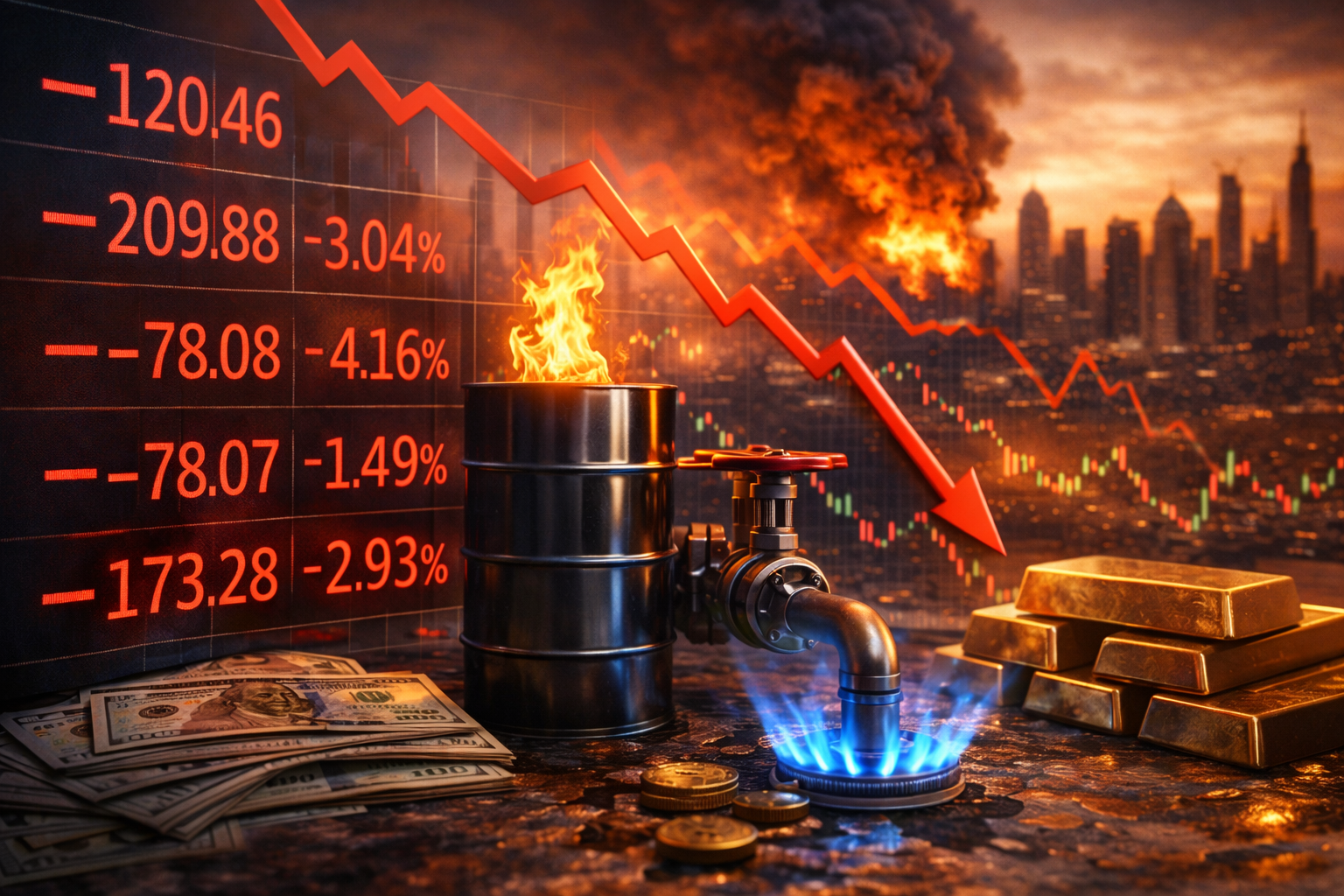
A surge in oil and natural gas prices is rippling through global financial markets, reigniting inflation fears and triggering a sharp selloff in equities. As geopolitical tensions in the Middle East escalate, traders are rapidly repositioning portfolios — rotating out of risk assets and into defensive havens.
According to Reuters, major global stock indices posted steeper declines in the latest session, with U.S. equity futures signaling further downside. At the same time, bond yields climbed, the U.S. dollar strengthened, and energy benchmarks jumped — a classic risk-off configuration that has investors recalibrating their near-term outlook.
For investors, this is more than a headline-driven pullback. It’s a macro inflection point with implications for inflation, central bank policy, corporate margins, and sector rotation.
Energy Shock Reignites Inflation Concerns
Oil and gas markets reacted sharply to renewed geopolitical tensions, pushing crude prices higher and lifting natural gas futures. Energy supply disruptions — whether actual or anticipated — tend to transmit quickly through global markets because of their central role in transportation, manufacturing, and power generation.
Reuters reported that global equity markets weakened broadly as energy prices surged, underscoring investor concern that higher input costs could squeeze corporate profitability. Rising fuel prices also complicate the inflation outlook at a time when central banks have been navigating a delicate balance between price stability and economic growth.
Higher energy costs feed directly into:
- Transportation and logistics expenses
- Consumer fuel prices
- Industrial production costs
- Headline inflation readings
For policymakers such as the Federal Reserve, renewed energy-driven inflation pressure could limit flexibility on rate cuts — a scenario markets had been increasingly pricing in earlier this year.
Why This Matters for Investors
1. Equity Valuations Face Margin Pressure
Elevated energy costs are effectively a tax on corporate earnings and household consumption. Sectors with high energy intensity — including airlines, chemicals, and manufacturing — are particularly vulnerable to margin compression.
If companies cannot pass higher input costs onto consumers, profit estimates may face downward revisions. Earnings season commentary will be critical in assessing whether executives view the spike as temporary or structurally disruptive.
Market history suggests that energy shocks often lead to:
- Earnings downgrades
- Reduced forward guidance
- Higher equity risk premiums
For growth-oriented equities, especially those trading at premium valuations, rising macro uncertainty can amplify volatility.
2. Bond Yields and the Dollar Strengthen
As reported by Reuters, U.S. bond yields rose alongside the energy spike, reflecting concerns that inflation could reaccelerate. Simultaneously, the U.S. dollar gained as investors sought liquidity and perceived safety.
A stronger dollar presents additional headwinds for multinational corporations, as foreign earnings translate into fewer dollars. Emerging markets, often sensitive to dollar strength and commodity volatility, may experience capital outflows under sustained pressure.
Investors should monitor:
- Treasury yield movements
- Inflation breakevens
- Dollar index trends
- Commodity-linked currency performance
These cross-asset signals often provide early clues about how durable the current equity weakness may be.
Defensive Rotation Takes Hold
The current market configuration reflects a textbook defensive rotation. Capital is moving toward assets perceived as more resilient during geopolitical stress:
- Energy equities benefiting from higher commodity prices
- Utilities and consumer staples
- U.S. Treasurys
- The U.S. dollar
Historically, geopolitical shocks have triggered short-term volatility spikes followed by sector dispersion rather than uniform declines. While broad indices may weaken, certain industries can outperform significantly.
Energy producers, for example, typically benefit directly from rising crude prices, although sustainability depends on the duration of the supply disruption.
Volatility Is Repricing Risk
Equity market volatility often accelerates during geopolitical flare-ups due to uncertainty around escalation, policy response, and economic spillover effects.
Implied volatility indicators have ticked higher, reflecting increased demand for downside protection. Options markets are pricing wider expected trading ranges, signaling caution among institutional participants.
From a portfolio management perspective, rising volatility can present both risk and opportunity:
- Risk, through potential drawdowns
- Opportunity, through dislocated valuations
Investors employing systematic or tactical strategies may find relative value in sectors that overshoot fundamentals.
Historical Context: Energy Shocks and Market Performance
Energy-driven equity declines are not unprecedented. Past geopolitical crises — including conflicts that disrupted oil supply chains — have typically led to short-term equity weakness, followed by recovery once clarity emerged.
However, the magnitude of impact depends on:
- Duration of the energy disruption
- Broader economic conditions
- Central bank policy stance
- Consumer confidence trends
If energy prices remain elevated for an extended period, the risk of stagflation — slower growth combined with persistent inflation — increases. That scenario historically pressures both equity and bond markets simultaneously.
Future Trends to Watch
Central Bank Communication
Federal Reserve commentary will be closely scrutinized for signals about how policymakers interpret energy-driven inflation. Any shift toward a more cautious rate outlook could further pressure equities.
Corporate Earnings Guidance
Management commentary during upcoming earnings calls will reveal how companies are managing input cost pressures and hedging strategies.
Commodity Sustainability
If oil and natural gas prices retreat quickly, markets may stabilize. A sustained rally, however, would increase the probability of broader macro recalibration.
Safe-Haven Flows
Monitoring Treasury demand, gold prices, and dollar strength can help gauge the depth of risk aversion.
Key Investment Insight
Elevated geopolitical risk is prompting a rotation away from high-beta equities into defensive assets. Investors may consider reviewing portfolio exposure to energy-sensitive sectors and assessing hedging strategies through options, volatility instruments, or diversification into defensive industries.
While short-term volatility can create compelling entry points, discipline remains essential. Monitoring inflation data, bond yields, and commodity trends will be critical in determining whether this equity pullback is a temporary shock or the beginning of a broader repricing cycle.
For long-term investors, periods of market stress often provide opportunities to accumulate quality assets at more attractive valuations — provided macro risks are carefully managed.
Markets are once again reminding investors that geopolitical developments can swiftly reshape risk dynamics. With energy prices acting as the catalyst, the coming weeks may test both corporate resilience and central bank flexibility.
For daily, data-driven insights on global markets, macro trends, and sector rotations, stay connected with MoneyNews.Today — your trusted source for actionable investor intelligence.