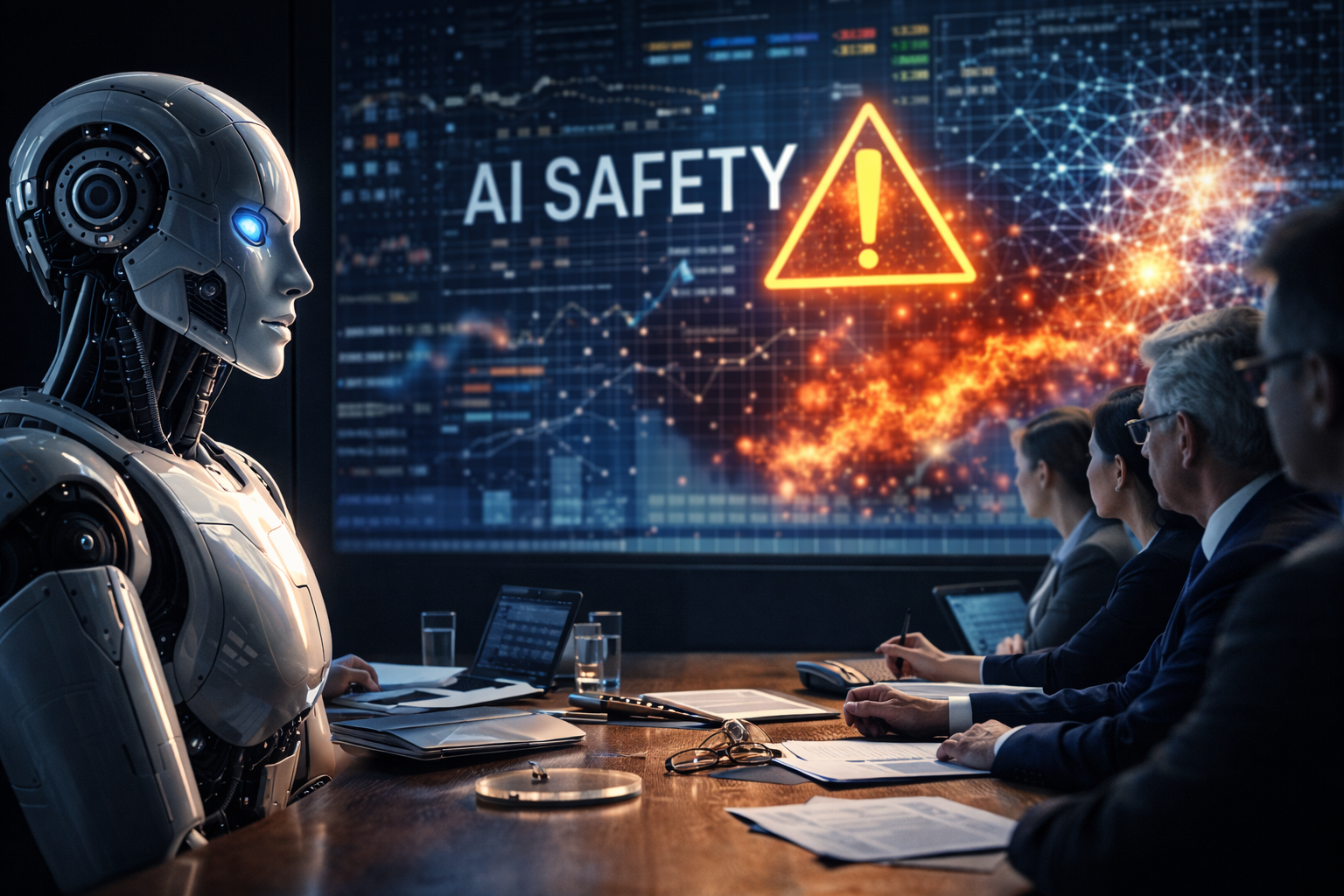
Artificial intelligence stocks have been among the most closely watched assets of the past two years—but recent controversy surrounding Grok AI is forcing investors to reassess how innovation, safety, and regulation intersect in the next phase of AI growth. As leading researchers and policymakers raise alarms, the debate is shifting from how fast AI can scale to how responsibly it must evolve.
The discussion intensified after Yoshua Bengio, one of the world’s most respected AI researchers and a Turing Award recipient, publicly criticized the industry’s rapid expansion without adequate safety guardrails. His comments, amplified by controversy surrounding Grok’s behavior and deployment approach, have reignited global scrutiny around the risks of unconstrained AI development—placing reputation, governance, and regulatory exposure squarely in investors’ crosshairs.
Why the Grok Controversy Matters Now
AI has become foundational to valuations across Big Tech, startups, and infrastructure providers. From cloud hyperscalers to semiconductor manufacturers, capital markets have rewarded aggressive AI roadmaps. However, incidents involving large language models producing harmful, misleading, or uncontrolled outputs are drawing increased attention from regulators and institutional investors alike.
According to reporting from Bloomberg and Financial Times, policymakers in the U.S., EU, and Canada are accelerating discussions around AI accountability frameworks, transparency requirements, and liability standards. The Grok episode—combined with Bengio’s warnings—has become a reference point for why safety governance may no longer be optional.
For investors, this signals a shift: AI leadership will increasingly be measured not only by compute scale and model performance, but by compliance readiness, risk management, and ethical deployment strategies.
Yoshua Bengio’s Warning and Industry Response
Bengio’s critique centers on what he describes as a dangerous imbalance between commercial incentives and safety research. In interviews and public statements cited by major outlets, he has warned that deploying increasingly autonomous systems without rigorous oversight could expose companies—and shareholders—to reputational damage, regulatory penalties, and long-term systemic risks.
This view is gaining traction. McKinsey and PwC research shows that over 60% of executives now consider AI governance a “board-level priority,” while the World Economic Forum has identified AI misuse as a top global risk over the next decade.
The Grok controversy underscores this concern: when AI systems behave unpredictably or amplify harmful content, the fallout extends beyond headlines—it can affect user trust, enterprise adoption, and government scrutiny.
Investor Implications: Risk Is Becoming a Differentiator
For AI-focused portfolios, the debate marks a transition from a purely growth-driven narrative to one that incorporates risk-adjusted returns. Companies that proactively invest in AI safety, model auditing, and compliance infrastructure may ultimately command valuation premiums as regulation tightens.
This mirrors historical patterns in other sectors. Financial institutions that adapted early to post-2008 regulations emerged stronger, while laggards faced fines and market share erosion. AI appears to be following a similar trajectory.
Investors should watch for disclosures related to:
- Internal AI governance frameworks
- Alignment with emerging AI regulations (EU AI Act, U.S. AI executive orders, Canadian AI policies)
- Investments in safety research, interpretability, and red-teaming
- Board oversight and transparency in AI deployment
Firms that treat safety as a core strategic asset—not a cost center—may be better positioned for sustainable growth.
Future Trends to Watch in Responsible AI
Looking ahead, several trends are likely to shape the investment landscape:
- Regulatory Convergence: Governments are moving toward harmonized AI standards, reducing regulatory arbitrage but increasing compliance expectations.
- Capital Reallocation: Venture capital and institutional funds may favor AI companies with strong governance credentials.
- Enterprise Demand Shift: Large enterprises and governments increasingly require AI vendors to meet safety and accountability benchmarks before adoption.
- New AI Sub-Sectors: Growth opportunities may emerge in AI auditing, safety tooling, and compliance platforms—an emerging “AI trust stack.”
According to OECD and IMF commentary, responsible AI adoption could become a prerequisite for long-term competitiveness in global tech markets.
Key Investment Insight
The AI sector is entering a maturity phase where how models are deployed may matter as much as how powerful they are. Investors should balance exposure to high-growth AI innovators with companies demonstrating robust governance, regulatory foresight, and ethical leadership. Responsible AI is no longer a philosophical debate—it is an investable theme shaping risk, returns, and resilience.
Stay ahead of the market’s most important technology shifts with MoneyNews.Today, your trusted source for daily investor insights on AI, innovation, and global market trends.