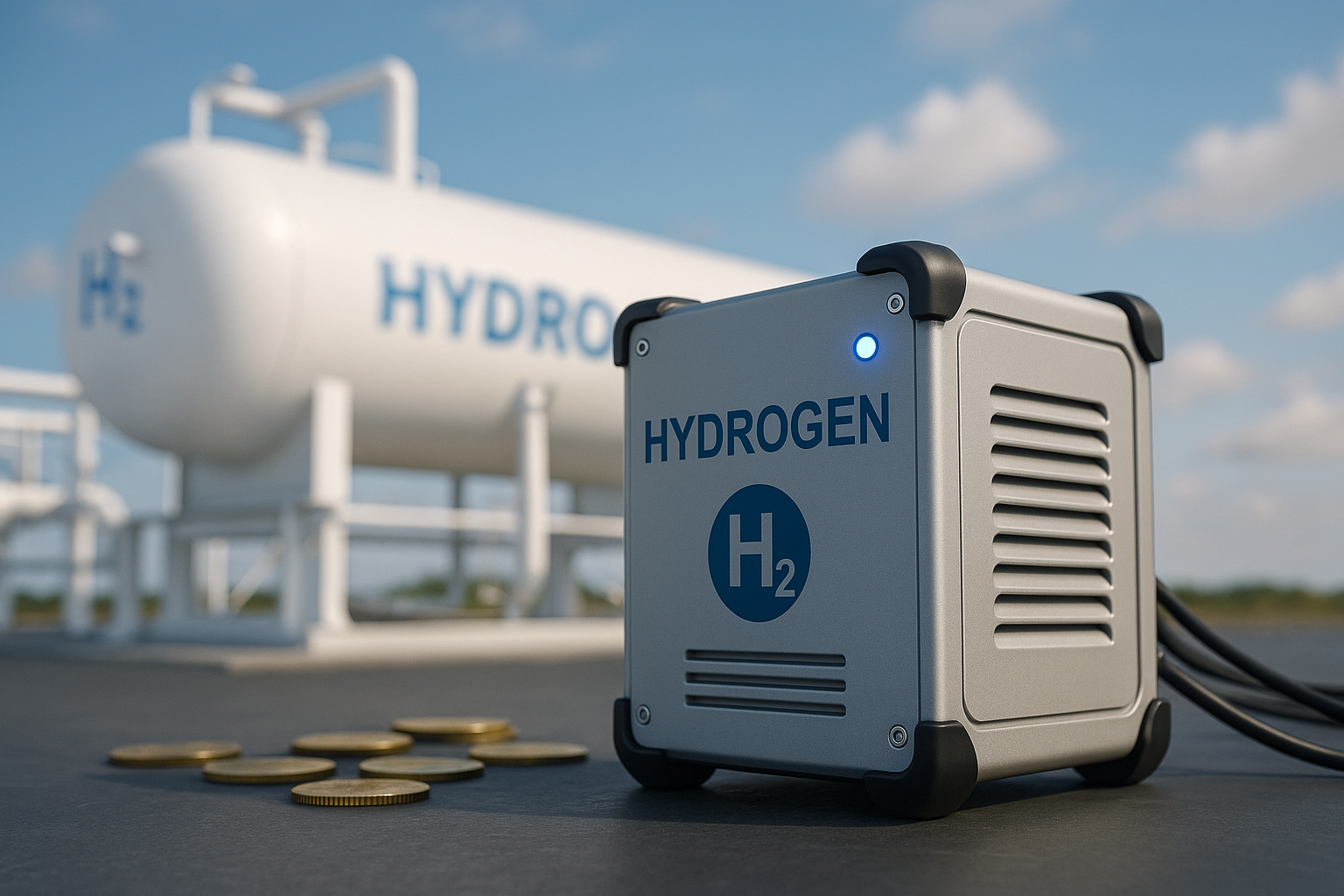
Across global clean-energy markets, few segments are gaining momentum as rapidly as hydrogen—particularly low-carbon and naturally occurring “white hydrogen.” The latest signal comes from Estonia, where PowerUP Energy Technologies, a hydrogen fuel-cell startup, has secured €10 million in new funding to scale portable generators for defense and off-grid industrial use, according to Tech Funding News and GlobeNewswire.
This funding round lands at a moment when investors are reassessing the role of hydrogen in the broader decarbonization shift. With the white-hydrogen market projected to grow from US$5.75 billion in 2025 to roughly US$15.1 billion by 2034, interest is rising not just in breakthrough startups, but also in scalable infrastructure that underpins hydrogen’s long-term viability.
For emerging-industry investors, the story isn’t simply about one company raising capital—it reflects a maturing theme in the clean-tech cycle, one where hydrogen is evolving from hype to commercial feasibility.
Hydrogen Funding Returns as Investors Shift Toward Practical Use-Cases
The financing round for PowerUP Energy Technologies is notable for two reasons: the sector’s recent cooling period, and the company’s focus on practical, immediate-use applications—especially for defense, remote installations, maritime operations, and off-grid scenarios where diesel generators still dominate.
Fuel-cell generators offer silent operation, reduced emissions, and improved efficiency, making them particularly attractive for defence ministries across Europe and Asia. With geopolitical fragmentation reshaping energy-security priorities, hydrogen-based systems are gaining attention as reliable alternatives to fossil-dependent hardware.
Reports from Tech Funding News and GlobeNewswire highlight that the company plans to expand manufacturing capacity and accelerate commercial deployment across NATO-aligned markets. These developments dovetail with recent analyses from Bloomberg New Energy Finance (BNEF), which note increased demand for modular hydrogen technologies, especially in logistics, critical infrastructure, and remote industrial operations.
In short, capital is returning to hydrogen—but in a more disciplined, application-driven manner.
Why This Matters for Investors
1. Hydrogen Is Entering a Multi-Segment Growth Phase
While green hydrogen grabbed headlines in recent years, the emerging “white hydrogen” segment—naturally occurring underground hydrogen—has become a breakout area. Geologists and energy researchers increasingly see it as a potentially abundant, low-cost source.
Forecasts projecting the market to grow past US$15 billion by 2034 illustrate that hydrogen is transitioning from concept to investable market category. Investors should expect increased exploration activity, government pilots, and early offtake agreements.
2. Defense and Off-Grid Markets Are Becoming Hydrogen’s First Scalable Revenue Channels
Unlike passenger vehicles or mass-scale industrial hydrogen production, small-to-medium-scale portable fuel-cell systems have clear value propositions today. Defense ministries, mining companies, construction firms, and critical-infrastructure agencies are rapidly testing alternatives to diesel generators.
Companies positioned in these early revenue verticals may offer more stable cash-flow potential than consumer-oriented hydrogen plays.
3. Clean-Tech Investors Need to Balance Promise With Realistic Risk
Hydrogen remains a highly capital-intensive sector. Many early-stage companies lack scale, supply-chain depth, or defensible intellectual property. Recent failures in the sector serve as reminders that investors should prioritize:
- Companies with infrastructure partnerships
- Clear regulatory alignment
- Access to critical minerals used in fuel-cell technologies
- Demonstrated manufacturing scale rather than laboratory innovation
The winners will be those who can commercialize at speed while integrating into defense, industrial, and energy systems—not those relying solely on future demand scenarios.
4. Policy Momentum Is Strengthening
Government incentives in the EU, U.S., Japan, and Australia are accelerating hydrogen adoption. The U.S. Department of Energy’s Hydrogen Shot Initiative, Europe’s Hydrogen Bank, and national defense modernization plans collectively signal long-term tailwinds for commercial deployment.
Policy-backed demand creates a more durable framework for sector growth—an important factor for investors wary of clean-tech cycles.
Future Trends to Watch
Hydrogen Exploration & White Hydrogen Discoveries
Geological projects in France, the U.S., Spain, and Australia are uncovering new white-hydrogen deposits. If extraction proves cost-competitive, it could reshape the energy-transition landscape.
Fuel-Cell Supply Chain Maturity
Investors should monitor PEM fuel-cell cost curves, platinum-group-metal availability, and localized manufacturing capacity. These will determine whether early hydrogen firms can scale sustainably.
Defense Procurement Cycles
Defense contractors with hydrogen-aligned technologies may see increased procurement budgets in 2025–2028 as NATO and allied regions prioritize resilient, low-emission energy systems.
Key Investment Insight
Hydrogen is entering a new phase—one defined not by hype, but by targeted deployment, policy support, and practical industrial use-cases. While early-stage firms like PowerUP Energy Technologies highlight momentum, investors should prioritize companies with scale advantages, supply-chain resilience, and clear commercial pathways. Selective exposure—rather than broad bets—is the most prudent approach in this maturing, high-potential sector.
Stay informed with MoneyNews.Today for more daily insights into emerging industries, clean-tech innovations, and market-shaping investment trends.