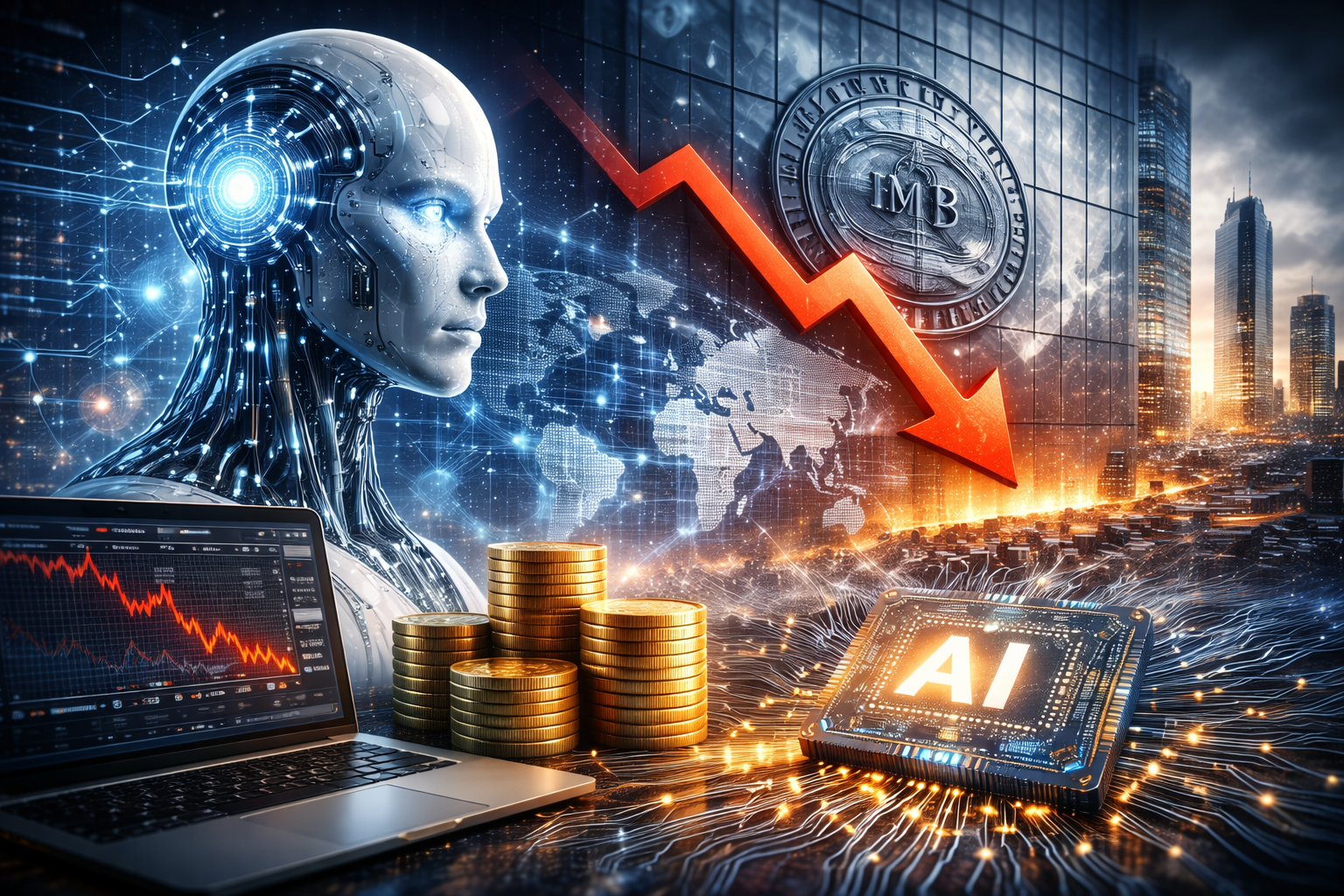
Artificial intelligence has been the dominant growth engine powering global markets over the past two years. From soaring equity valuations to record capital spending by major technology firms, AI has become deeply embedded in investor expectations. Now, a warning from the International Monetary Fund is prompting markets to reassess just how critical sustained AI investment has become to the global economic outlook.
According to recent IMF analysis reported by the Financial Times, a sharp slowdown or correction in AI investment could reduce global GDP growth by as much as 0.4 percentage points, underscoring both the transformative potential of artificial intelligence and the risks tied to its rapid expansion.
Why AI Has Become a Systemic Growth Driver
The IMF’s assessment highlights how artificial intelligence has evolved from a niche technology theme into a macroeconomic pillar. AI-driven productivity gains are increasingly embedded across sectors — from cloud computing and semiconductors to healthcare, finance, and manufacturing automation.
The Fund notes that the United States remains at the center of this transformation, with U.S.-based technology leaders accounting for the bulk of global AI investment, research, and deployment. According to data cited by the IMF, capital spending by major tech firms on AI infrastructure — including data centers, advanced chips, and cloud services — now represents one of the largest components of private investment growth in developed economies.
This concentration of investment means that any pullback in AI spending would not remain isolated to the technology sector. Instead, it could ripple through employment, capital markets, and productivity growth worldwide.
Why This Matters for Investors
The IMF’s warning arrives at a sensitive moment for markets. AI-linked equities have delivered outsized gains, driving a significant portion of broader index performance. Valuations across parts of the AI ecosystem — particularly semiconductor manufacturers, cloud infrastructure providers, and AI software platforms — remain elevated by historical standards.
According to the Financial Times, the IMF cautioned that excessive optimism and capital concentration could increase vulnerability to market corrections if earnings growth fails to meet expectations. A sudden slowdown in AI investment could compress multiples, pressure earnings forecasts, and weigh on overall market sentiment.
For investors, this reinforces a key reality: AI is no longer just a growth opportunity — it is a potential source of systemic risk if expectations become misaligned with fundamentals.
Balancing Opportunity and Valuation Risk
Despite these risks, the IMF does not view AI as a speculative bubble. Instead, it frames artificial intelligence as a long-term productivity engine that could meaningfully lift global output over the next decade. Research from consulting firms such as McKinsey and PwC has previously estimated that AI could add trillions of dollars to global GDP by 2030 if adoption continues at scale.
The challenge for investors lies in balancing long-term structural growth against near-term valuation risk. Markets have already priced in aggressive AI adoption scenarios, leaving little margin for disappointment. This dynamic increases the importance of selectivity within the AI trade.
Legacy technology firms with diversified revenue streams may offer more resilience during periods of volatility, while emerging AI specialists could deliver higher growth — but with increased downside risk if capital spending slows.
Future Trends Investors Should Watch
Several indicators will help determine whether AI investment momentum remains sustainable:
- Capital Expenditure Trends: Quarterly capex guidance from major U.S. technology companies will provide early signals of any slowdown in AI infrastructure spending.
- Earnings Quality: Investors should focus on revenue growth tied directly to AI adoption rather than speculative future projections.
- Policy and Regulation: Governments are increasingly shaping AI development through regulation, national security policy, and public investment — factors that could influence long-term returns.
- Global Diffusion: Broader adoption of AI beyond U.S. tech leaders into industrial, healthcare, and financial sectors could reduce concentration risk.
The IMF has emphasized that wider global participation in AI investment would strengthen economic resilience, reducing reliance on a small number of firms or regions.
Key Investment Insight
AI remains one of the most powerful long-term investment themes of the decade, but it is entering a more complex phase. Investors may benefit from balancing exposure between established technology leaders with proven cash flows and emerging AI-focused companies with higher growth potential.
Portfolio diversification, disciplined valuation analysis, and attention to macro signals — particularly corporate spending trends — will be critical as AI transitions from a momentum-driven trade to a fundamentals-driven one.
Artificial intelligence is reshaping markets, productivity, and economic forecasts — but its growing influence means that shifts in AI investment now carry global consequences. Stay ahead of these critical trends with MoneyNews.Today, your trusted source for daily investor insights, market-moving analysis, and the stories shaping tomorrow’s economy.