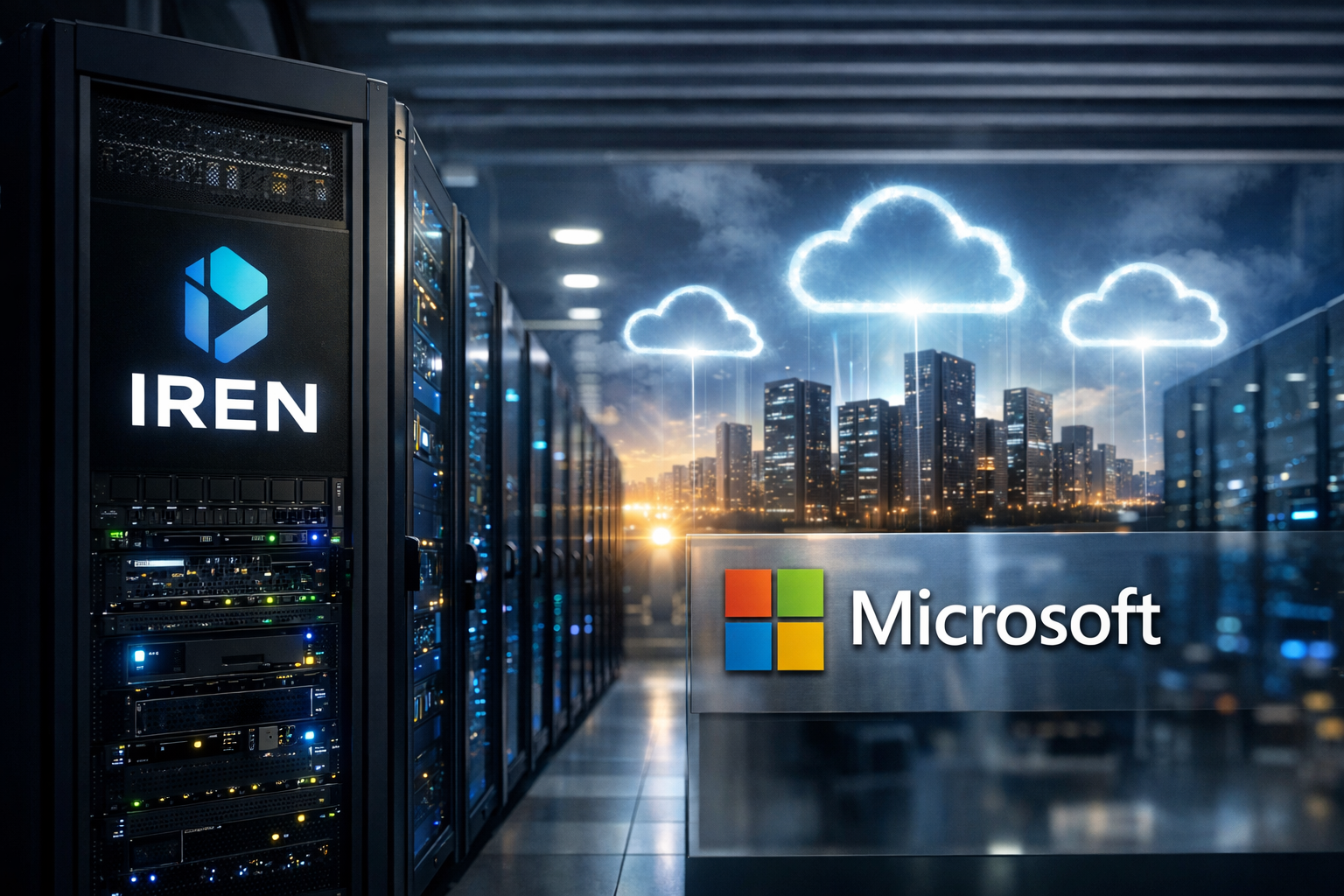
The race to build the backbone of the artificial intelligence economy just delivered one of its clearest signals yet. IREN (Nasdaq: IREN) has secured a $9.7 billion, five-year AI cloud services contract with Microsoft, thrusting the company into the spotlight as investors hunt for the next wave of AI winners beyond headline-grabbing chipmakers.
The announcement has quickly gained traction across financial media and social platforms, not only because of the deal’s size, but because it reinforces a powerful narrative shaping markets in 2026: AI demand is moving decisively from experimentation to long-term, enterprise-scale deployment.
Why This Deal Has Investors Paying Attention
According to analysis highlighted by Simply Wall St, the contract dramatically expands IREN’s visibility into future revenue while validating its infrastructure capabilities at an enterprise level. Microsoft’s willingness to commit nearly $10 billion over five years underscores just how critical scalable, reliable AI cloud infrastructure has become for major technology platforms.
For investors, this represents a meaningful shift. While much of the AI rally over the past two years has centered on semiconductors and hyperscalers, this deal highlights the growing importance of infrastructure providers operating behind the scenes—the companies enabling AI workloads to run at scale.
Market participants have increasingly focused on firms that can support energy-intensive AI computing, optimize data center efficiency, and deliver long-term capacity under contract. IREN now finds itself squarely in that category.
The Bigger Picture: Enterprise AI Spending Is Accelerating
The IREN-Microsoft agreement aligns with broader industry data showing sustained momentum in AI investment. Major consultancies such as McKinsey and PwC have repeatedly pointed to AI infrastructure as one of the fastest-growing segments of global technology spending, driven by cloud migration, generative AI adoption, and enterprise automation.
Microsoft, in particular, has been vocal about its long-term AI strategy, committing tens of billions of dollars annually to data centers, cloud services, and AI platforms. Deals like this suggest that hyperscalers are increasingly locking in multi-year capacity to avoid bottlenecks as AI usage scales.
For IREN, the contract provides not only financial stability but strategic credibility. Securing a long-term partnership with one of the world’s most influential technology companies significantly lowers execution risk in the eyes of institutional investors.
What This Means for AI Infrastructure Stocks
This development could mark a turning point for how investors evaluate AI exposure. Instead of focusing solely on chipmakers or consumer-facing applications, capital may increasingly rotate toward AI-adjacent infrastructure plays—including cloud service providers, data center operators, energy-efficient computing firms, and specialized AI hardware suppliers.
Smaller and mid-cap companies that integrate into Microsoft’s AI ecosystem may also benefit indirectly. Long-term contracts tend to create downstream demand for networking equipment, power solutions, cooling technologies, and specialized software, opening the door for multiple layers of value creation.
Analysts have noted that predictable, contracted revenue streams are especially attractive in an environment where investors are becoming more selective about AI valuations and profitability timelines.
Risks and Factors Investors Should Watch
Despite the optimism, investors should remain mindful of execution risks. Large-scale infrastructure projects require significant capital investment, operational precision, and cost discipline. Margins, energy costs, and regulatory considerations—particularly around data centers and power usage—will be key variables to monitor.
Additionally, broader market sentiment toward AI remains sensitive to interest rates, capital spending cycles, and earnings delivery. While long-term demand appears solid, short-term volatility should not be ruled out.
Key Investment Insight
The IREN-Microsoft deal reinforces a critical investment theme for 2026: AI infrastructure is evolving into a contract-driven, utility-like business model with multi-year visibility and strategic importance. Investors looking beyond headline AI names may find compelling opportunities in companies that enable, rather than market, AI technologies.
Long-term cloud contracts with hyperscalers could become a defining differentiator between speculative AI plays and durable, cash-flow-generating businesses.
As enterprise AI adoption accelerates, deals like this may be remembered as early markers of where sustainable value in the AI ecosystem truly resides.
Stay ahead of the stories shaping markets, technology, and capital flows with MoneyNews.Today—your trusted source for timely, investor-focused insights every trading day.