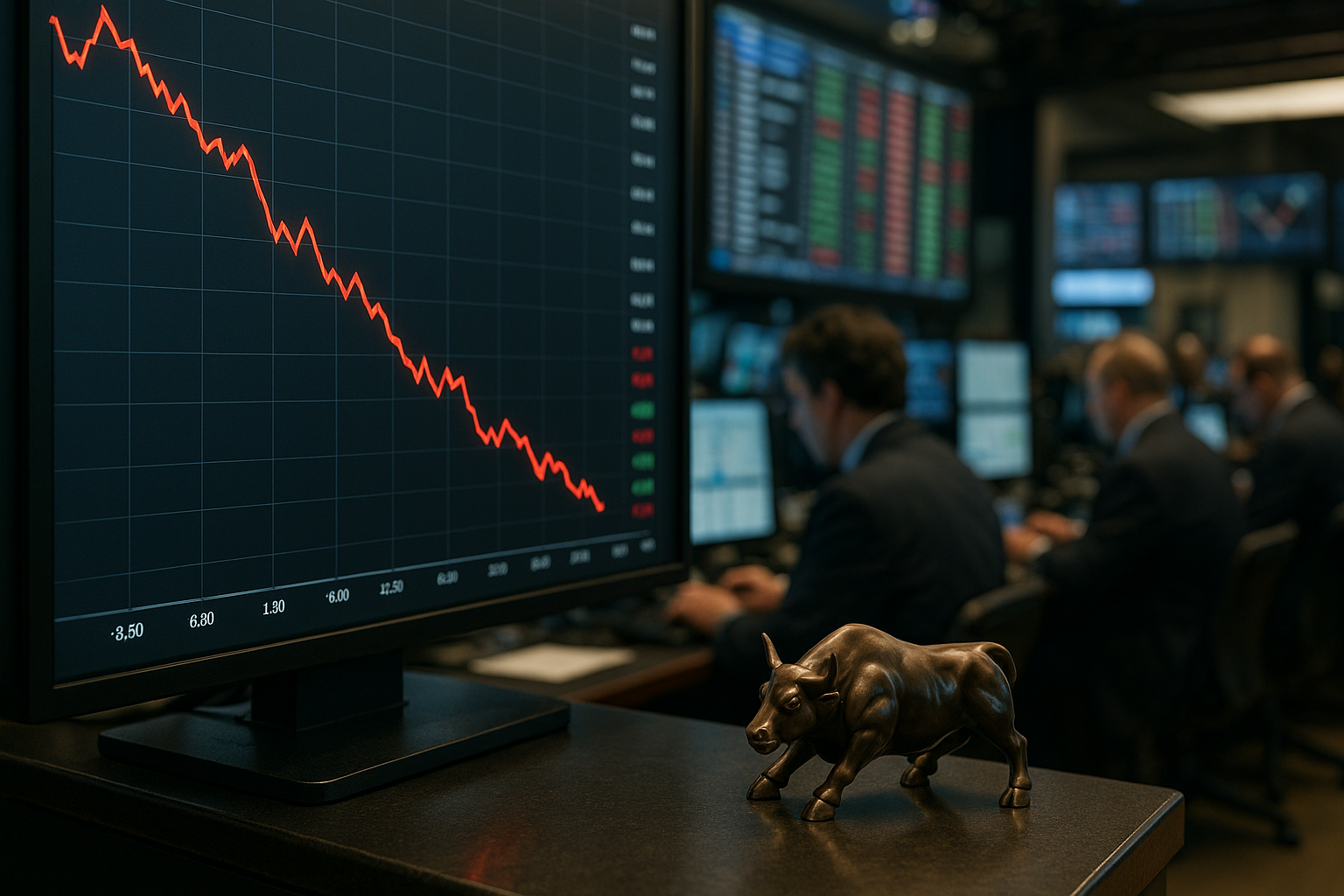
Stocks retreated across Wall Street as investors positioned cautiously ahead of the Federal Reserve’s upcoming policy decision — a moment that could set the tone for global markets heading into year-end. With Treasury yields ticking higher and uncertainty building over the Fed’s interest-rate path, major U.S. indexes closed in the red, reflecting a broader risk-off sentiment sweeping through the market.
A Volatile Session Reflects Deepening Pre-Fed Anxiety
U.S. equities stumbled on Tuesday, with the S&P 500, Nasdaq Composite, and Dow Jones Industrial Average all ending lower, according to data cited by The Economic Times. Investors have been unwinding positions across growth-sensitive sectors, particularly technology, as benchmark Treasury yields climbed — a sign markets increasingly expect the Fed to maintain its restrictive stance for longer.
Bond markets were equally tense. The 10-year U.S. Treasury yield rose, pressuring valuations in sectors that depend heavily on future earnings growth. As Bloomberg notes, elevated yields tend to compress price-to-earnings multiples, especially in long-duration assets like mega-cap tech stocks.
The anxiety is not unfounded. Recent economic data — including resilient labor-market readings and sticky services inflation — suggests the Fed may be reluctant to signal imminent rate cuts. As a result, traders on Wall Street are recalibrating their expectations, reducing exposure to high-flying growth names and rotating into pockets of the market that can better withstand higher-for-longer rates.
Why This Matters for Investors
1. Rate Expectations Are Dictating Market Direction
With the Fed at the center of the market narrative, interest-rate expectations have become the strongest driver of equity performance. Even small shifts in tone or language from policymakers can move yields sharply, triggering broad market rotations.
Bloomberg’s FedWatch analysis shows that while some investors still hope for easing in the coming quarters, a growing share now expect rate cuts to arrive later than previously forecast. This uncertainty has created a challenging environment for portfolio positioning.
2. Growth Tech Is Feeling the Pressure
Rising yields are particularly painful for growth and momentum-heavy sectors — notably technology, AI-linked equities, and high-valuation innovators. These companies typically trade at higher multiples because investors expect strong earnings in future years. But when yields rise, those future earnings become less valuable in present-value terms.
The Nasdaq suffered the steepest declines, reflecting this sensitivity. Investors should expect elevated volatility in high-growth tech until the Fed’s trajectory becomes clearer.
3. Value, Financials, and Cyclicals May Gain Relative Strength
Historically, sectors such as financials, energy, industrials, and certain value-oriented areas tend to hold up better when yields rise. Banks benefit from higher net-interest margins, while industrial and commodity-linked sectors often outperform during periods of economic resilience paired with restrictive monetary policy.
As noted by analysts at Goldman Sachs, value stocks could see increasing inflows if rate uncertainty persists, especially compared to overextended tech valuations.
4. Defensive Posturing Could Persist Until the Fed Speaks
Market participants are reducing leverage, tightening risk parameters, and adopting defensive strategies across portfolios. Until investors receive clarity from the Fed — whether through the statement, dot plot, or press conference — markets are likely to remain choppy.
Future Trends to Watch
- Yield Movements After the Fed Decision: Whether yields rise or fall post-meeting will dictate the next major market rotation.
- Inflation Data Releases: Any upside surprise in CPI or PCE could quickly reprice rate expectations.
- Earnings Season Impact: With more companies warning about margin pressure and economic uncertainty, earnings risk may intensify.
- Liquidity Conditions: QT (quantitative tightening) remains in effect, reducing excess liquidity — a factor that historically increases volatility.
- Geopolitical Overhangs: Energy markets, supply-chain disruptions, and election-year uncertainty could amplify rate-driven swings.
Key Investment Insight
The market’s move lower is a reminder that monetary policy remains the dominant force steering asset prices. For now, investors may consider:
- Reducing exposure to rate-sensitive growth stocks until yields stabilize.
- Increasing allocation to financials and select value sectors, which historically fare better during rising-rate environments.
- Maintaining liquidity and flexibility heading into the Fed’s announcement.
- Monitoring bond-market signals, as Treasury yields often lead equity moves by days or weeks.
With volatility poised to rise around the Fed decision, disciplined positioning is essential.
Stay ahead of the market with the latest analysis, real-time policy insights, and sector-level opportunities from MoneyNews.Today — your trusted source for daily investor intelligence.