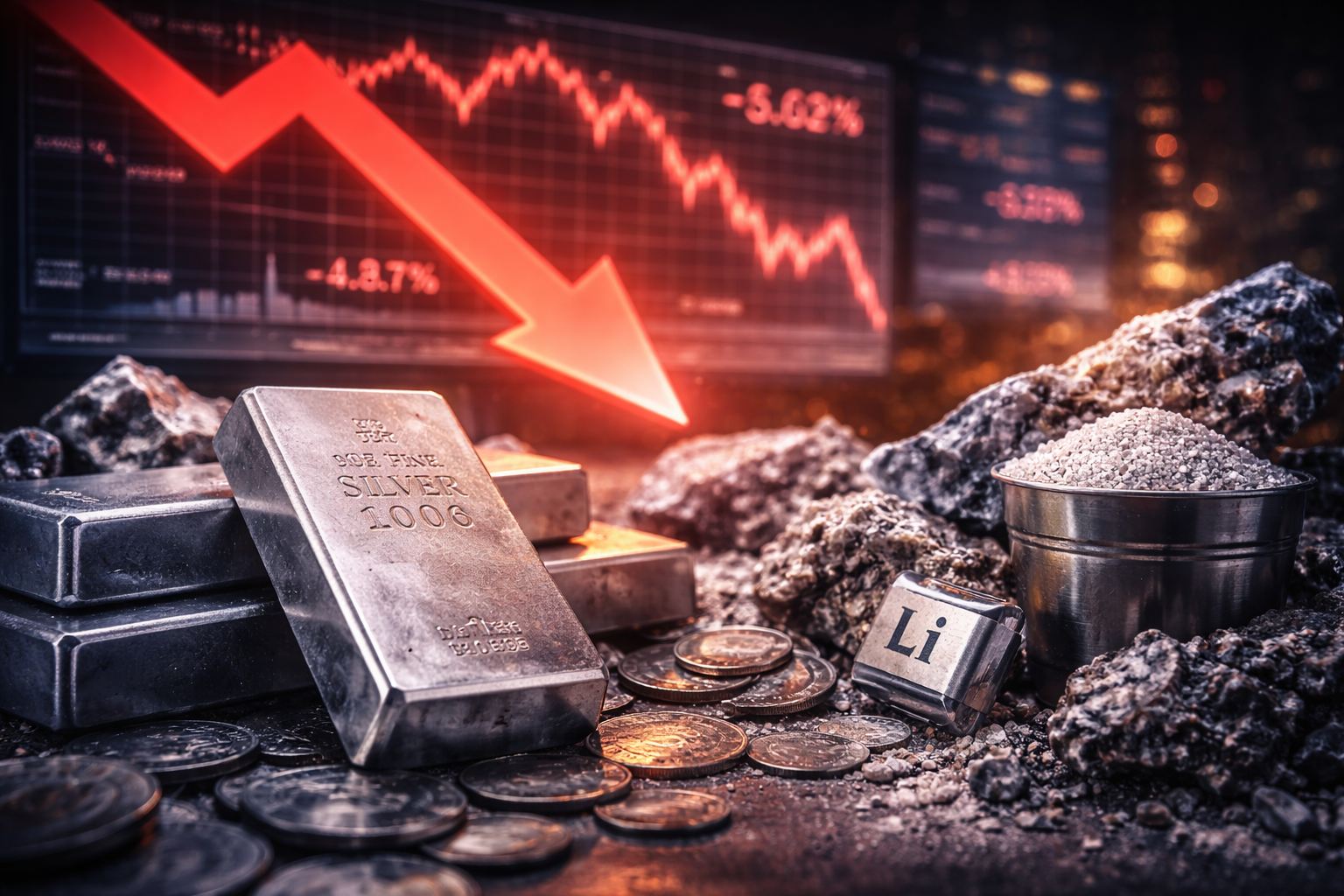
The global commodities trade is flashing a warning sign investors can’t ignore: metals are no longer behaving like a safe haven.
On February 5, 2026, precious and industrial metals prices fell sharply alongside weakening equity markets, putting fresh pressure on the broader materials and mining sector. Silver prices slid as investors rotated away from risk, while industrial-linked commodities like lithium and uranium also weakened across major global exchanges. The pullback is spilling directly into mining stocks, dragging down sentiment in a sector that had previously been viewed as a long-term beneficiary of electrification and energy transition demand.
According to MarketIndex and Australian market coverage, the downturn has been particularly noticeable in lithium-linked equities, with investors reassessing near-term demand expectations, project profitability, and the ability of producers to maintain margins under volatile pricing conditions.
For investors, the message is clear: metals are not immune to risk-off markets—and the current decline may be signaling broader macro weakness ahead.
Metals Are Falling with Stocks — A Shift Investors Are Watching Closely
Traditionally, certain metals such as gold and silver can serve as defensive assets during periods of uncertainty. However, the latest market action suggests that investors are prioritizing liquidity and capital preservation over commodity exposure.
Silver’s decline is particularly important because it sits at the intersection of two worlds:
- a precious metal used as a store of value
- an industrial metal tied to manufacturing and technology demand
When silver sells off alongside equities, it often reflects not just market fear—but a broader reduction in expectations for industrial activity.
Meanwhile, industrial commodities such as lithium and uranium are showing increased weakness, raising concerns that investor enthusiasm for the energy transition trade may be cooling in the near term.
MarketIndex reporting highlights that metals weakness has been synchronized with equity declines, reinforcing the idea that markets are currently in a “de-risking” cycle rather than a rotation into inflation hedges.
Why Lithium Is Under Pressure
Lithium has been one of the most heavily discussed commodities of the past decade, fueled by the global boom in electric vehicles, battery storage, and renewable energy infrastructure.
But lithium markets are now facing a reality check.
The recent price slide reflects several factors that investors are increasingly focused on:
1. Oversupply Concerns
Major lithium producers have expanded output aggressively, and new projects continue to come online globally. When supply growth outpaces demand growth—even temporarily—prices can fall quickly.
2. EV Demand Normalization
While EV adoption remains a structural growth trend, investors are watching for slower growth rates in key regions, especially as higher interest rates impact consumer affordability and auto financing.
3. Margin Compression Risks
Lithium mining is capital intensive, and profitability is highly dependent on spot prices. Falling prices can rapidly reduce cash flow expectations, forcing companies to cut spending or delay expansions.
For investors, lithium’s sell-off is a reminder that even “future-facing” commodities are still cyclical in the short term.
Uranium Weakness Signals a Broader Risk-Off Trade
Uranium’s decline is also notable because nuclear energy has regained investor interest over the past several years, driven by energy security concerns and decarbonization policy support.
However, uranium remains a sentiment-driven market with relatively low liquidity compared to major metals. That makes it vulnerable to sharp moves during global risk-off periods.
When uranium stocks weaken, it often reflects institutional investors reducing exposure to smaller, more volatile commodity plays. It can also suggest that capital is temporarily shifting away from speculative energy transition assets and toward defensive allocations.
In other words, uranium weakness may not be about nuclear fundamentals—it may be about global positioning.
Silver’s Decline Matters More Than It Looks
Silver is often seen as “gold’s more volatile cousin,” but it is also heavily tied to industrial applications, including:
- solar panels
- electronics
- automotive components
- semiconductors
A decline in silver prices during an equity pullback can indicate that investors are bracing for slower manufacturing activity or weakening industrial demand expectations.
Unlike gold—which is more purely driven by monetary policy and safe-haven flows—silver tends to amplify broader market sentiment.
If silver continues to fall, it may reinforce concerns that industrial activity is softening globally, especially in Asia and Europe.
Why This Matters for Investors
Metals markets act as an economic thermometer, and the current weakness across silver, lithium, and uranium may reflect growing skepticism about global growth momentum.
For investors, the metals sell-off carries several key implications:
1. Mining Stocks Could Face Further Pressure
Mining equities often behave like leveraged versions of the underlying commodity price. When metals fall quickly, mining shares frequently decline faster due to earnings sensitivity and margin concerns.
2. The Materials Sector May Lag Broader Markets
If commodity weakness persists, materials and mining-heavy indexes could underperform, especially in markets like Canada and Australia where resource stocks represent a major portion of equity exposure.
3. The Energy Transition Narrative May Be Entering a Pause Phase
Lithium and uranium are critical to long-term electrification and energy security trends, but the market may be entering a period where valuations reset to reflect near-term earnings uncertainty.
4. Stronger U.S. Dollar Adds Pressure
Risk-off periods often strengthen the U.S. dollar, which can push commodity prices lower since most commodities are priced in USD. This creates a headwind for metals across global markets.
Future Trends to Watch
Investors looking for early reversal signals in metals markets should focus on a few key macro indicators:
Interest Rates and Central Bank Messaging
Lower rate expectations tend to support commodities by weakening the dollar and improving liquidity conditions.
Energy Prices
Rising oil and natural gas prices often signal stronger industrial demand, which can lift broader commodities sentiment.
China Demand Signals
China remains one of the largest drivers of industrial metal demand. Any policy stimulus, infrastructure push, or manufacturing rebound could trigger a metals recovery.
Equity Market Stability
If stock markets continue selling off, metals may remain under pressure as investors reduce exposure to cyclical trades.
Key Investment Insight: Metals Can Move Fast — Position for Volatility
Materials and mining assets can deliver powerful upside during reflation cycles, but they are also among the most volatile sectors during risk-off market regimes.
Investors should consider:
- focusing on mining companies with strong balance sheets and low-cost production
- avoiding highly leveraged developers that depend on strong commodity prices to survive
- monitoring lithium and uranium for oversold conditions, which can create sharp rebound opportunities
- using metals ETFs or diversified miners rather than single-stock concentration during uncertain macro periods
The best opportunities in commodities often emerge when sentiment is weak—but timing matters, and macro indicators will likely determine whether this sell-off is a temporary reset or the start of a longer downturn.
Investor Outlook
The decline in silver, lithium, and uranium prices highlights a market increasingly driven by risk aversion and tightening liquidity conditions. With equities under pressure and investor sentiment turning defensive, metals are being treated less like a hedge and more like a high-volatility asset class.
For investors, the current weakness may present opportunity—but only for those willing to track macro signals closely and focus on quality producers with durable margins.
Stay with MoneyNews.Today for daily investor insights on commodities, mining equities, and the macro trends shaping global markets.