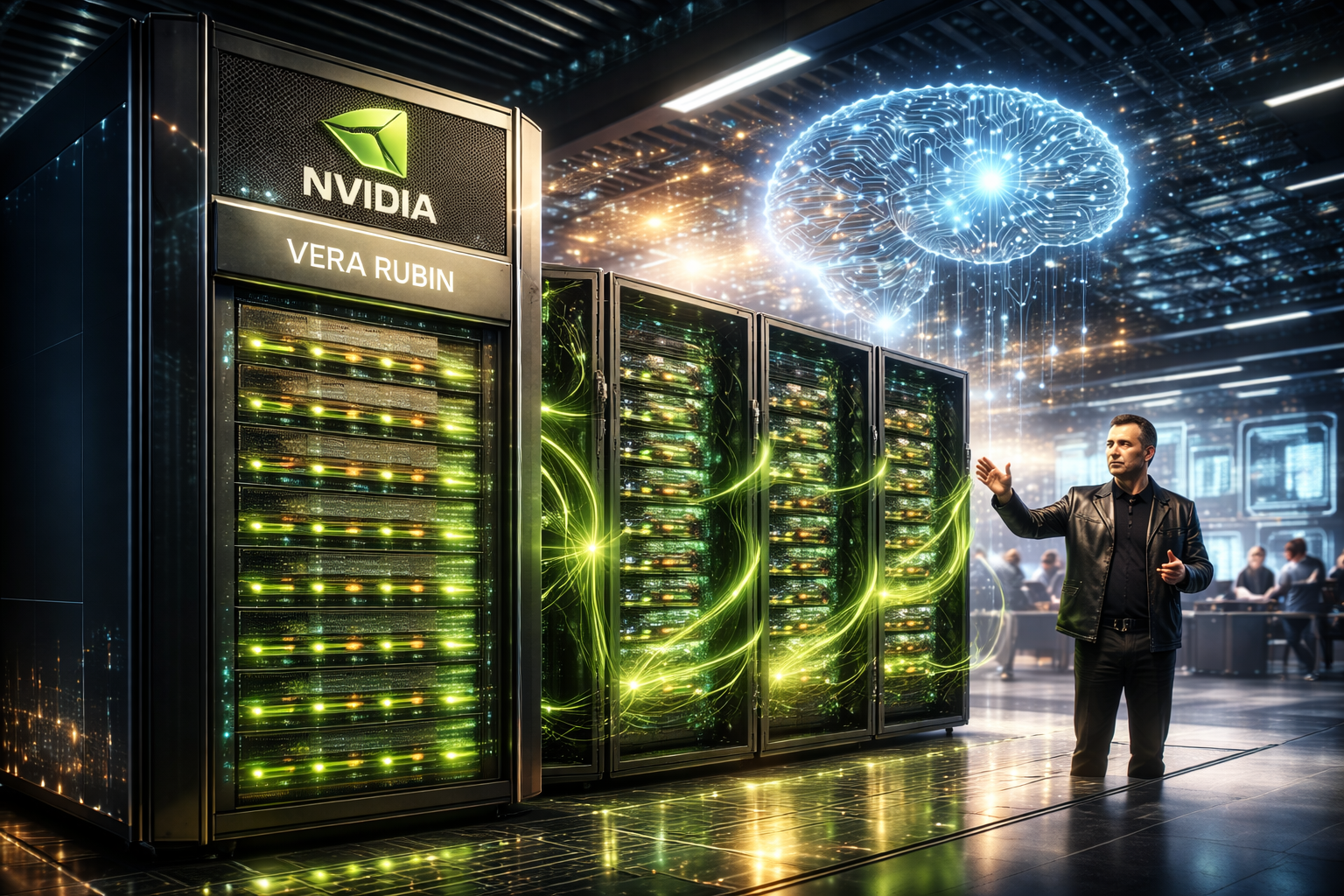
As global markets continue to reprice around artificial intelligence infrastructure, Nvidia has once again asserted its leadership position. At CES 2026, CEO Jensen Huang confirmed that Nvidia’s next-generation AI hardware platform, Vera Rubin, has entered full production—an announcement that immediately captured investor attention across equities, semiconductors, and cloud infrastructure supply chains.
The news lands at a pivotal moment. Enterprise AI spending remains resilient despite macro uncertainty, hyperscalers continue to scale compute capacity, and investors are increasingly focused on which companies can sustain performance leadership as AI models grow exponentially in size and complexity.
Why This Matters for Investors
Nvidia’s announcement reinforces a critical investment thesis: AI compute demand is not slowing—it is accelerating.
According to Barron’s coverage of Huang’s CES remarks, the Vera Rubin platform is designed to support next-generation AI workloads by combining high-transistor-count GPUs and CPUs optimized for large-scale, enterprise-grade deployments. Nvidia positioned Rubin as a meaningful leap beyond its current Blackwell architecture, targeting training and inference requirements for increasingly sophisticated foundation models.
For investors, this signals three key developments:
- Sustained enterprise demand for AI compute infrastructure
- Extended revenue visibility for Nvidia and its ecosystem
- Higher barriers to entry for competitors attempting to close the performance gap
Bloomberg data shows Nvidia already dominates data center accelerator shipments, and continued innovation strengthens its pricing power and long-term margin profile.
The Strategic Importance of Vera Rubin
The Rubin platform reflects Nvidia’s long-term strategy: move faster than both customer demand curves and competitive roadmaps.
Key attributes highlighted at CES include:
- Enhanced compute density for large language models
- Optimized energy efficiency amid rising power constraints
- Scalable architecture for cloud, enterprise, and sovereign AI deployments
Analysts cited by Barron’s note that hyperscale customers increasingly prioritize total cost of ownership, not just raw performance. Nvidia’s ability to integrate hardware, software (CUDA, AI frameworks), and networking remains a competitive moat that competitors struggle to replicate.
This full-stack dominance continues to position Nvidia as the default supplier for AI infrastructure, even as alternative chips gain attention.
Ecosystem Impact: Beyond Nvidia
While Nvidia remains the focal point, Rubin’s production has broader implications across the AI value chain.
- Foundries and advanced packaging suppliers stand to benefit from higher-volume, cutting-edge chip production
- Memory providers, particularly high-bandwidth memory (HBM) manufacturers, could see sustained demand growth
- Data center infrastructure firms—from cooling to power management—may experience second-order tailwinds
Bloomberg Intelligence has repeatedly emphasized that AI infrastructure spending increasingly resembles a multi-year capex cycle rather than a short-term trend, reinforcing investor interest in adjacent beneficiaries.
Valuation and Risk Considerations
Despite the bullish narrative, valuation remains a central debate.
Nvidia’s stock has significantly outperformed the broader market over the past two years, leading some investors to question sustainability. However, analysts continue to point out that earnings revisions—rather than multiple expansion—have driven much of the stock’s appreciation.
Key risks investors should monitor include:
- Delays in customer capex cycles
- Competitive advances from custom silicon or rival GPU vendors
- Regulatory and geopolitical constraints impacting semiconductor supply chains
Position sizing and risk management remain essential, particularly given the stock’s outsized influence on major indices.
Future Trends to Watch
Looking ahead, several themes will shape investor sentiment:
- Expansion of enterprise AI adoption beyond hyperscalers
- Increased focus on inference efficiency, not just training performance
- Growing demand for sovereign and regulated AI infrastructure
Nvidia’s roadmap suggests it is positioning not only for today’s AI workloads but for a future where compute demand grows faster than traditional Moore’s Law assumptions.
Key Investment Insight
Nvidia’s Vera Rubin platform reinforces the company’s role as a cornerstone of global AI infrastructure. For investors, the opportunity extends beyond Nvidia alone—tracking the broader AI hardware and data center ecosystem may offer diversified exposure to one of the most durable secular growth themes in the market.
Stay informed with MoneyNews.Today for daily, investor-focused insights on AI, markets, and the technologies shaping tomorrow’s economy.
Effective Tags
AI Infrastructure, Nvidia, Semiconductor Stocks, CES 2026, Data Centers, Enterprise AI, Technology Investing, Growth Stocks
Effective Hashtags
#Nvidia, #AIInfrastructure, #Semiconductors, #CES2026, #TechStocks, #ArtificialIntelligence, #DataCenters, #InvestorNews, #MoneyNewsToday