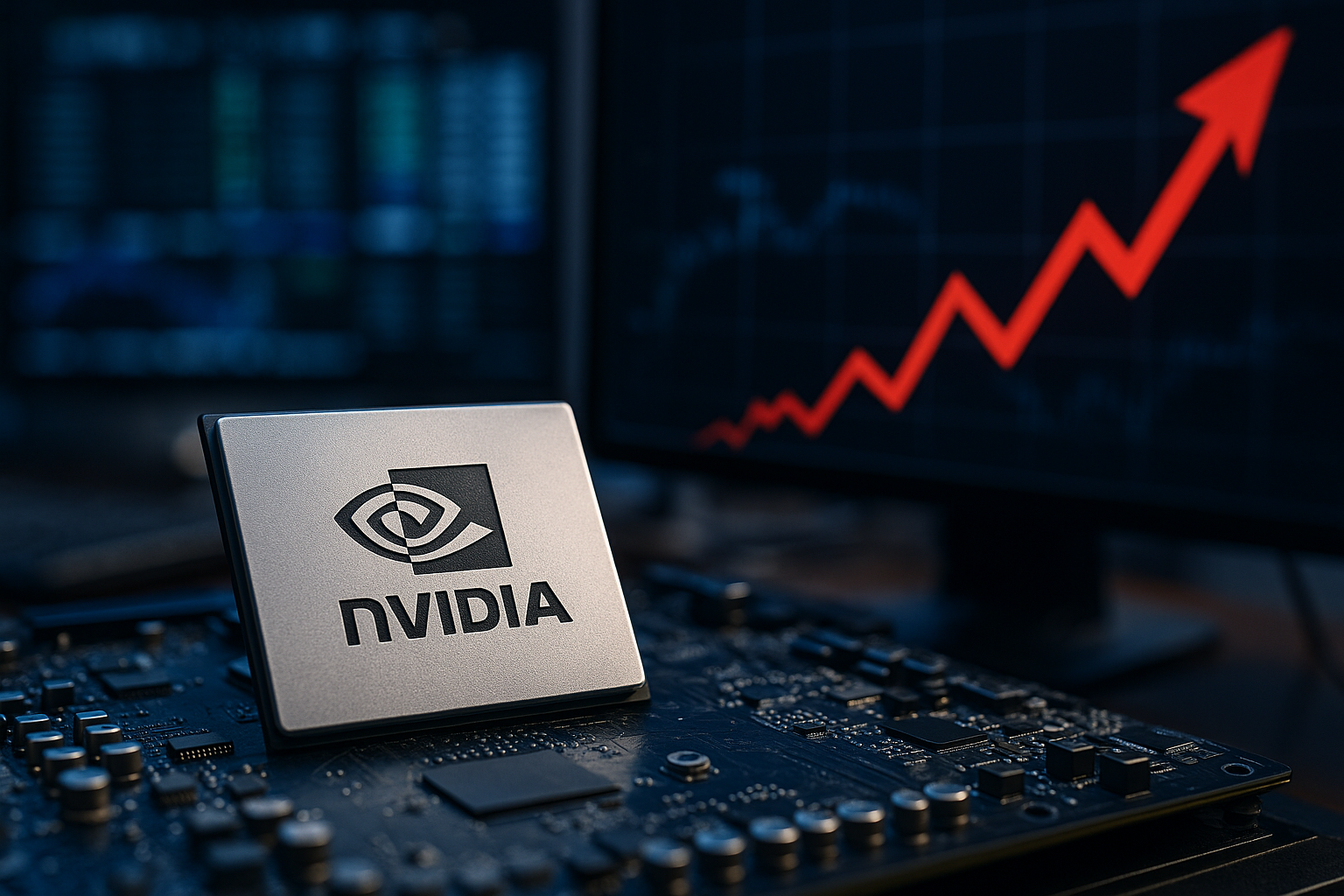
Global investors woke up to a fresh jolt in the semiconductor sector as the U.S. government granted Nvidia approval to export its advanced H200 AI accelerators to specific customers in China, under what sources describe as “strict, highly conditional frameworks.” The announcement — first reported by Reuters and later echoed by The Guardian — comes at a time when AI supply chains are under intense scrutiny, with the U.S.–China tech rivalry shaping capital flows, corporate strategy, and market valuations across the broader tech landscape.
The decision landed in a market already hypersensitive to policy shifts. Tech stocks swung sharply as investors weighed the near-term revenue uplift against the longer-term geopolitical and regulatory risks. For many portfolio managers, this development sits at the center of two megatrends: the worldwide race for AI dominance and the tightening of global export-control regimes.
A Policy Shift With Global Implications
Washington’s approval marks a notable recalibration in U.S. export policy. While restrictions on ultra-advanced AI hardware remain in place, the conditional clearance for H200 shipments signals a willingness to allow limited commercial activity — provided it does not compromise national-security objectives.
According to the Reuters report, U.S. officials are permitting Nvidia to sell tailored versions of the H200 chip, with performance caps and safeguards designed to meet export-control requirements. While exact specifications remain undisclosed, analysts at Bernstein and Raymond James noted that even a constrained H-series chip opens meaningful commercial opportunities in China’s AI ecosystem, which remains one of the world’s fastest-growing markets for machine-learning deployment.
For Nvidia, China represented nearly 20–25% of data-center revenue before restrictions tightened in 2023–2024, according to prior earnings disclosures. Re-entering this segment — even partially — could bolster revenue visibility in 2026 and beyond.
Tech Stocks React as Markets Weigh the Upside
The market response was immediate. Semiconductor names rallied at the open but retreated intraday as traders reassessed the policy’s durability. Shares of Nvidia saw heightened volatility, while peers such as AMD, Broadcom, and Marvell Technology also moved in sympathy.
Tech-heavy indices mirrored the sector’s uncertainty. While investors welcomed the prospect of renewed demand from China, they remained cautious about the possibility of future restrictions or abrupt rule changes — a theme that has defined the geopolitical tech landscape since 2022.
Bloomberg analysts said the approval could “normalize” parts of the global AI supply chain in the near term, but warned that any escalation in U.S.–China tensions could reverse the decision just as quickly.
Why This Matters for Investors
1. Reopening a high-demand market
Even limited access to China supports Nvidia’s multi-year AI roadmap. Demand for training and inference hardware continues to outstrip supply, with AI infrastructure spending expected to exceed $400 billion by 2027, according to McKinsey. China remains a critical consumption market for AI-optimized compute, particularly in cloud services, autonomous systems, and industrial automation.
2. Regulatory tail-risk remains elevated
Investors must recognize that U.S. export policy is fluid. H200 shipments may face ongoing compliance checks or future tightening. Fund managers have increasingly emphasized diversification across regions — not just for supply chains, but for revenue exposure.
3. Sector-wide ripple effects
The approval could catalyze demand across the semiconductor supply chain: memory producers, substrate suppliers, data-center operators, and power-infrastructure firms. However, it also sharpens competitive pressure on Chinese chipmakers, potentially accelerating Beijing’s push for domestic AI-chip independence.
Future Trends to Watch
• AI Infrastructure Expansion in APAC
If Nvidia’s tailored H200 chips gain traction in China, expect follow-through demand for data-center buildouts, liquid-cooling systems, and high-bandwidth memory (HBM). South Korean suppliers such as Samsung and SK Hynix may see indirect upside.
• Watching for next-phase U.S. policy updates
Congressional committees and the U.S. Commerce Department are expected to issue further guidance on export-control frameworks. Any amendments could quickly reshape revenue expectations for chipmakers.
• China’s domestic AI-chip acceleration
The decision may push Chinese firms like Huawei, Biren, and state-backed semiconductor initiatives to double down on achieving performance parity. Investors should watch for government subsidies or procurement programs supporting local alternatives.
Key Investment Insight
Nvidia’s regained foothold in China could strengthen earnings visibility and provide new tailwinds for the semiconductor ecosystem. But the move also highlights the ongoing volatility in U.S.–China tech relations — meaning investors may benefit from diversified exposure across global chipmakers rather than relying too heavily on any single regulatory jurisdiction. Allocating a portion of tech holdings toward AI-infrastructure firms, semiconductor equipment makers, and cloud-service providers may offer a more balanced risk-reward profile as geopolitical cycles continue to shift.
Stay tuned with MoneyNews.Today for daily, data-driven insights as the global AI and semiconductor story continues to evolve.