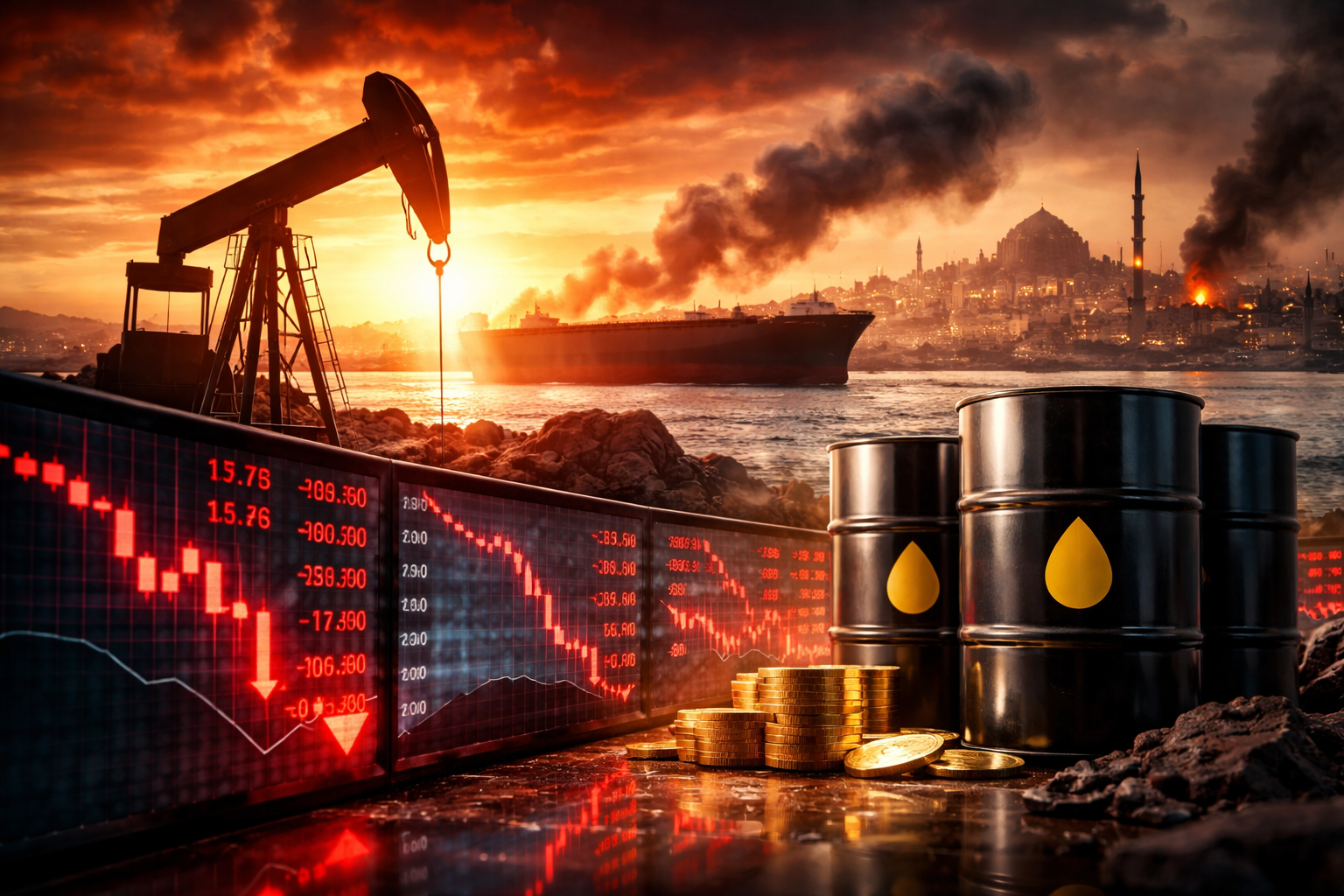
Global financial markets are once again confronting a familiar macro threat: surging oil prices tied to geopolitical instability in the Middle East. As crude prices climb toward the psychologically important $100-per-barrel level, investors across global equity markets are reassessing risk, inflation expectations, and the trajectory of central bank policy.
In recent days, heightened tensions involving Iran and key shipping routes through the Strait of Hormuz and surrounding Gulf waterways have sparked renewed volatility in commodities and equities alike. Energy traders are pricing in potential supply disruptions, while equity investors are increasingly concerned that a sustained rise in oil prices could derail the fragile balance between slowing inflation and anticipated interest rate cuts.
Reports from Reuters and other major financial media outlets highlight that global equities—from U.S. futures to Asian and European markets—have already begun to show signs of strain as oil prices move higher. The implications extend far beyond the energy market, potentially affecting everything from corporate margins to monetary policy decisions in the months ahead.
For investors, the resurgence of oil-driven macro risk is forcing a critical question: Is this just a short-term geopolitical spike, or the beginning of another energy-driven inflation cycle?
Oil Prices Approach a Critical Threshold
Crude oil has surged sharply amid escalating geopolitical tensions and supply concerns. Market analysts note that Brent crude and West Texas Intermediate (WTI) have both approached levels not seen since earlier periods of geopolitical instability.
The Middle East remains one of the most strategically important regions in the global energy supply chain. According to the U.S. Energy Information Administration (EIA), roughly 20% of the world’s petroleum supply passes through the Strait of Hormuz, making it one of the most critical chokepoints in global energy logistics.
Any disruption to this corridor—even the perception of risk—can rapidly push prices higher as traders factor in potential supply shortages.
Recent reports cited by Reuters and Business Standard market coverage indicate that geopolitical tensions involving Iran and regional shipping routes are increasing the risk premium embedded in crude oil prices. Traders are responding by bidding up futures contracts as a hedge against potential supply interruptions.
From a macroeconomic perspective, the significance of oil nearing $100 per barrel extends well beyond the commodity itself. Energy costs influence nearly every sector of the global economy, from transportation and manufacturing to consumer spending.
When oil prices rise sharply, inflationary pressure tends to follow.
Why Energy Prices Matter for Global Equities
The relationship between oil prices and stock markets is complex but historically well documented.
When energy prices spike, several key economic dynamics come into play:
- Rising production and transportation costs
- Higher inflation expectations
- Potential tightening or delay of monetary easing policies
These factors can significantly alter equity market performance.
For companies with energy-intensive operations—such as airlines, manufacturing firms, and logistics providers—higher oil prices can compress profit margins. Increased fuel and shipping costs are often difficult to pass on immediately to consumers, creating short-term financial pressure.
At the same time, inflation concerns triggered by rising energy prices can influence central bank policy decisions.
The U.S. Federal Reserve, the Bank of Canada, and other major central banks have been closely monitoring inflation data while considering potential interest rate cuts. However, a sustained rise in oil prices could complicate that outlook.
According to economic research from Bloomberg Intelligence and the International Monetary Fund, energy price spikes have historically been a key driver of unexpected inflation surges. If inflation begins to rise again, central banks may delay rate cuts or maintain higher interest rates for longer than markets currently anticipate.
That scenario typically weighs on growth-oriented sectors such as technology and consumer discretionary stocks, which tend to perform best in lower interest-rate environments.
Energy Stocks Become the Market’s Natural Hedge
While rising oil prices create challenges for many sectors, they simultaneously provide a powerful tailwind for energy companies.
Historically, periods of oil price strength have led to strong performance from:
- Oil and gas producers
- Energy exploration companies
- Oilfield service providers
- Integrated energy giants
Higher crude prices translate directly into stronger revenue and cash flow for these firms.
Investment analysts from Goldman Sachs and Morgan Stanley have frequently noted that energy stocks tend to act as a natural hedge against inflation-driven market volatility. When inflation rises due to energy costs, the companies producing those resources often benefit.
This dynamic explains why investors frequently rotate capital into the energy sector during commodity rallies.
In recent trading sessions, energy stocks across North American markets have already begun to outperform broader indices as crude prices climb.
For institutional investors managing diversified portfolios, increasing exposure to energy equities can provide a buffer against macroeconomic uncertainty.
Sector Rotation Could Reshape Market Leadership
One of the most significant implications of rising oil prices is sector rotation within the equity market.
During periods of economic uncertainty and inflation risk, investors often shift capital away from high-growth sectors toward more defensive or commodity-linked industries.
Potential beneficiaries of this shift include:
- Energy companies
- Commodity producers
- Utilities
- Defense contractors
- Consumer staples companies
These sectors tend to demonstrate more stable earnings during inflationary periods.
Conversely, high-growth sectors such as technology and speculative innovation stocks may face valuation pressure if interest rate expectations rise again.
This rotation dynamic has been observed in numerous historical market cycles. When inflation fears rise, investors prioritize cash flow stability and pricing power—traits commonly found in commodity and defensive sectors.
Geopolitics Returns as a Market Driver
Another key takeaway from the current situation is the re-emergence of geopolitical risk as a major market driver.
For much of the past year, investors have focused primarily on inflation data, AI-driven technology growth, and central bank policy. However, geopolitical tensions—particularly those involving global energy supply routes—can quickly reshape market sentiment.
The Middle East has historically been a focal point for such volatility.
According to the International Energy Agency (IEA), disruptions in the region have repeatedly triggered global oil price spikes that ripple across financial markets.
Even temporary disruptions or military tensions can produce large price swings as traders react to potential supply threats.
For equity markets, this introduces an additional layer of uncertainty that investors must account for when constructing portfolios.
Future Trends Investors Should Watch
Looking ahead, several factors will determine whether the current oil rally evolves into a sustained macro trend.
Key developments to monitor include:
Geopolitical escalation or de-escalation
If tensions in the Middle East worsen or threaten energy infrastructure, oil prices could climb further.
OPEC+ production decisions
Production adjustments by major oil exporters can amplify or offset geopolitical supply concerns.
Global demand trends
Strong economic activity in the United States, China, and emerging markets could increase energy demand and support higher prices.
Central bank policy responses
If oil-driven inflation emerges, the Federal Reserve and other central banks may delay interest rate cuts.
Each of these variables could influence the trajectory of both oil prices and global equities in the months ahead.
Key Investment Insight
For investors navigating this environment, the most important takeaway is the renewed role of commodities and energy exposure as portfolio stabilizers.
Periods of geopolitical uncertainty and rising oil prices historically reward portfolios that include:
- Energy producers
- Commodity-linked equities
- Inflation-resistant sectors
Meanwhile, investors may need to approach high-growth sectors more cautiously if interest rate expectations begin shifting upward again.
Strategic diversification across sectors remains essential during volatile macroeconomic cycles.
Market volatility driven by geopolitical events and commodity price swings is a reminder that global investing requires constant awareness of both economic and geopolitical developments.
Stay ahead of the markets and discover the latest investor insights, analysis, and breaking financial stories by following MoneyNews.Today, your trusted source for daily investor intelligence.