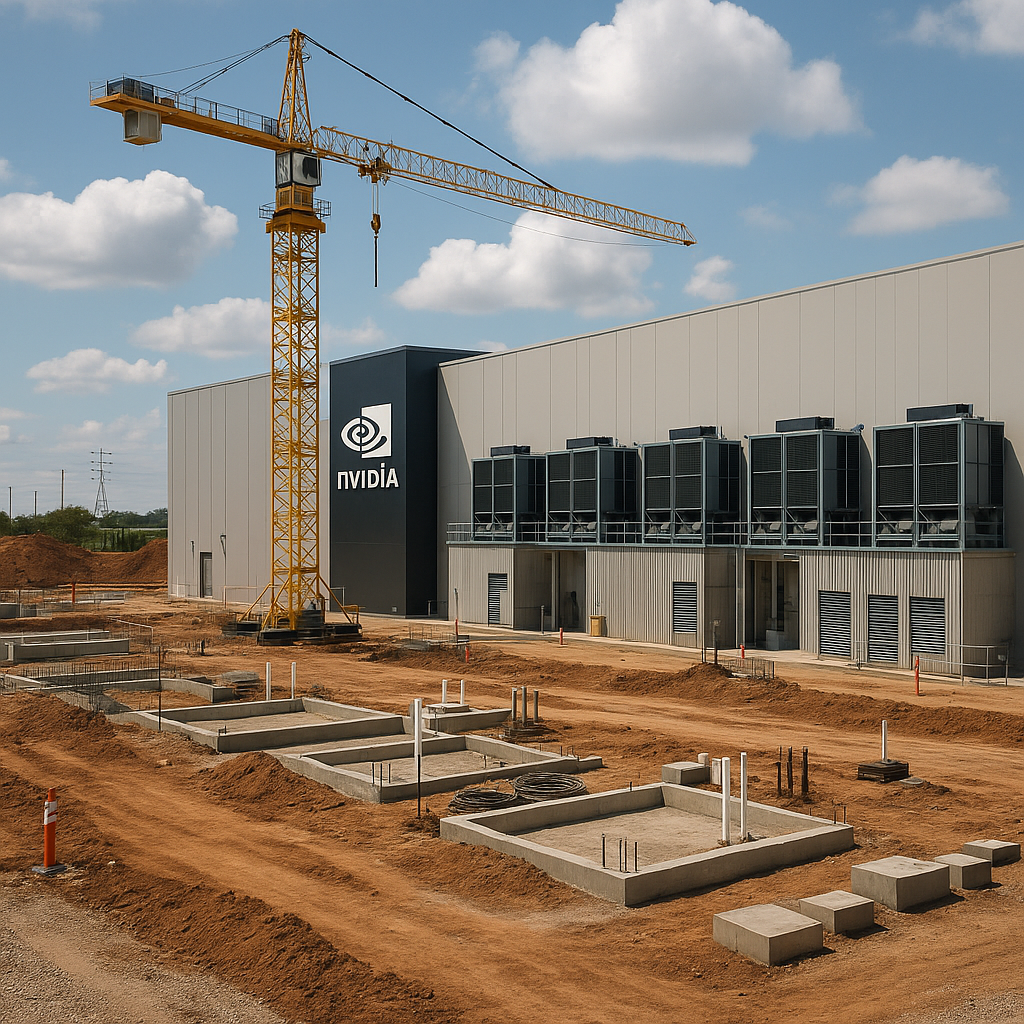
Rising demand for AI infrastructure has put unprecedented pressure on data-center build-outs, with hyperscalers and utilities racing to expand capacity fast enough to support exponential growth in AI model training and inference. Against this backdrop, Palantir Technologies, Nvidia, and CenterPoint Energy announced a strategic collaboration to dramatically speed up the construction of AI-ready data centers. Their new AI-powered platform, Chain Reaction, aims to compress regulatory, permitting, and construction timelines—an innovation that could reshape the economics and velocity of AI expansion in North America.
With AI capital expenditures by major U.S. tech firms projected to exceed $200 billion annually by 2026 (Goldman Sachs), accelerating infrastructure deployment is emerging as a competitive necessity rather than a long-term objective. Investors watching the rapid build-out of AI ecosystems now have a new signal: the industry is shifting from simply scaling compute to optimizing every phase of operational delivery.
A Strategic Alliance Designed for Speed
According to reporting from The Economic Times, Palantir, Nvidia, and CenterPoint Energy developed Chain Reaction to address one of the most persistent bottlenecks in AI-scale infrastructure: the slow, fragmented approval and construction pipeline. The tool leverages Palantir’s Foundry platform, Nvidia’s accelerated computing models, and CenterPoint’s deep operational data to create a unified planning system for utilities, developers, and data-center operators.
In today’s environment, delays can stretch 18–36 months due to supply-chain constraints, engineering reviews, grid-capacity evaluations, and complex regulatory processes. Chain Reaction applies AI-driven simulations to map out optimal sequencing, speed up inter-agency coordination, forecast risks, and automate documentation—capabilities that can shave months off development timelines.
This is not just a technical upgrade. It represents a shift toward AI-assisted industrial operations, a theme increasingly reflected in corporate earnings calls and infrastructure spending plans. Companies like Amazon Web Services, Microsoft, and Google have all warned of data-center supply constraints in 2025. Any technology that shortens time-to-build becomes economically disruptive.
Why This Matters for Investors
AI Infrastructure Is Becoming a Market of Its Own
AI adoption is no longer limited to consumer apps or enterprise productivity tools. It is an infrastructure story. Analysts at Morgan Stanley estimate that every incremental $1 in AI-model development drives $4–$5 in required infrastructure investment, spanning hardware, utilities, construction, and long-term operations.
This means the biggest winners in the next decade may not only be AI software companies—but the firms enabling the physical backbone of AI.
The Palantir-Nvidia-CenterPoint collaboration sits directly at the intersection of:
- AI-capable hardware and GPUs
- Data-center construction
- Utility-grid expansion
- Supply-chain intelligence
- Industrial automation
For investors, this signals rapid acceleration of a multi-trillion-dollar infrastructure cycle.
Utilities and REITs Could Become AI Beneficiaries
While Nvidia remains the dominant chip provider, this announcement also highlights the growing importance of utilities and power providers in the AI value chain. Power scarcity is increasingly recognized as the “new oil” of the AI era. U.S. utilities are reporting record levels of commercial power demand—something not seen since the early cloud-adoption boom.
CenterPoint Energy’s involvement underscores the trend of utilities positioning themselves as core enablers of AI infrastructure growth. This could create ripple effects across:
- Power generation
- Transmission and distribution
- Renewable energy developers
- Grid-modernization suppliers
Data-center REITs—such as Digital Realty and Equinix—also stand to gain, as time-to-build improvements directly enhance revenue scaling potential.
Palantir’s Positioning Strengthens
Palantir continues to expand from defense and intelligence markets into industrial and infrastructure optimization. The company’s AI optimization tools for energy grids, manufacturing, and logistics have already gained traction in government and enterprise contracts.
Chain Reaction strengthens Palantir’s narrative as a foundational AI-operations partner—not just a data-analytics platform. This aligns with comments from analysts at Bernstein and Citi, who have noted that high-margin industrial AI partnerships could become a meaningful revenue driver heading into 2026.
Future Trends to Watch
1. Acceleration of U.S. and Canadian Data-Center Build-Outs
Both countries are pushing policy incentives to boost domestic AI capability and reduce reliance on foreign supply chains. Faster permitting processes could attract more hyperscaler investment.
2. The Rise of AI-Enabled Industrial Planning Tools
From utilities to logistics to construction, AI optimization tools like Chain Reaction may become standard practice across industrial sectors.
3. A Tightening Race for Power Capacity
AI workloads are projected to demand over 10% of U.S. electricity consumption by 2030 (U.S. EIA), intensifying investment in grid-expansion and power-infrastructure modernization.
4. Supply-Chain Winners Beyond Silicon
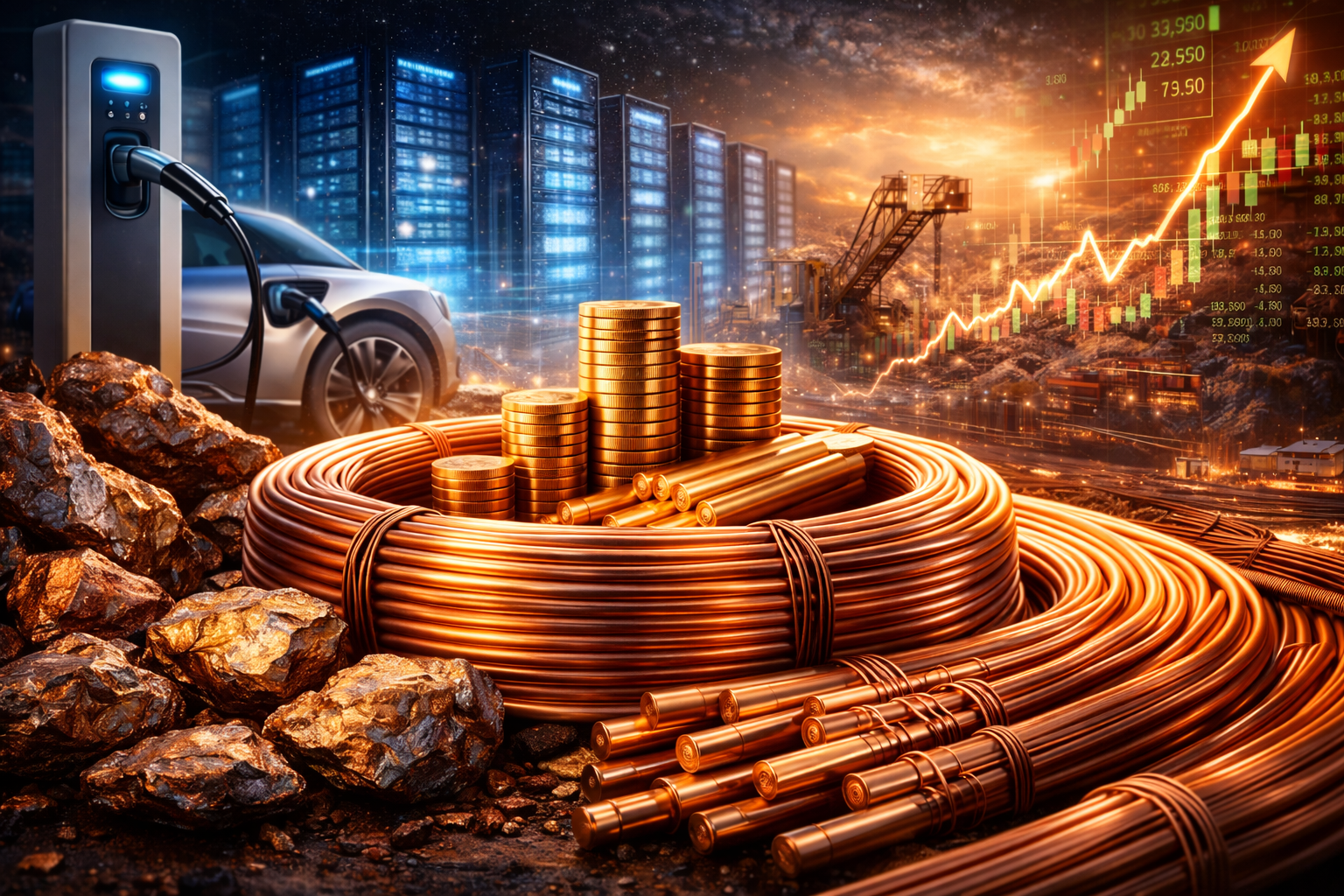
Steel, copper, specialized cooling systems, transformers, and modular-construction companies could see significant tailwinds.
Key Investment Insight
The collaboration between Palantir, Nvidia, and CenterPoint Energy signals a major shift: AI growth is no longer constrained by compute alone—it’s increasingly about how fast physical infrastructure can be built. Investors should monitor companies deeply involved in data-center development, power-grid expansion, AI-operations software, and industrial automation. The biggest multi-year opportunities may lie in the interconnected supply chain behind AI, not just in the headline tech names.
Stay informed with MoneyNews.Today for daily insights into the evolving AI-infrastructure landscape and how it’s reshaping capital flows across global markets.