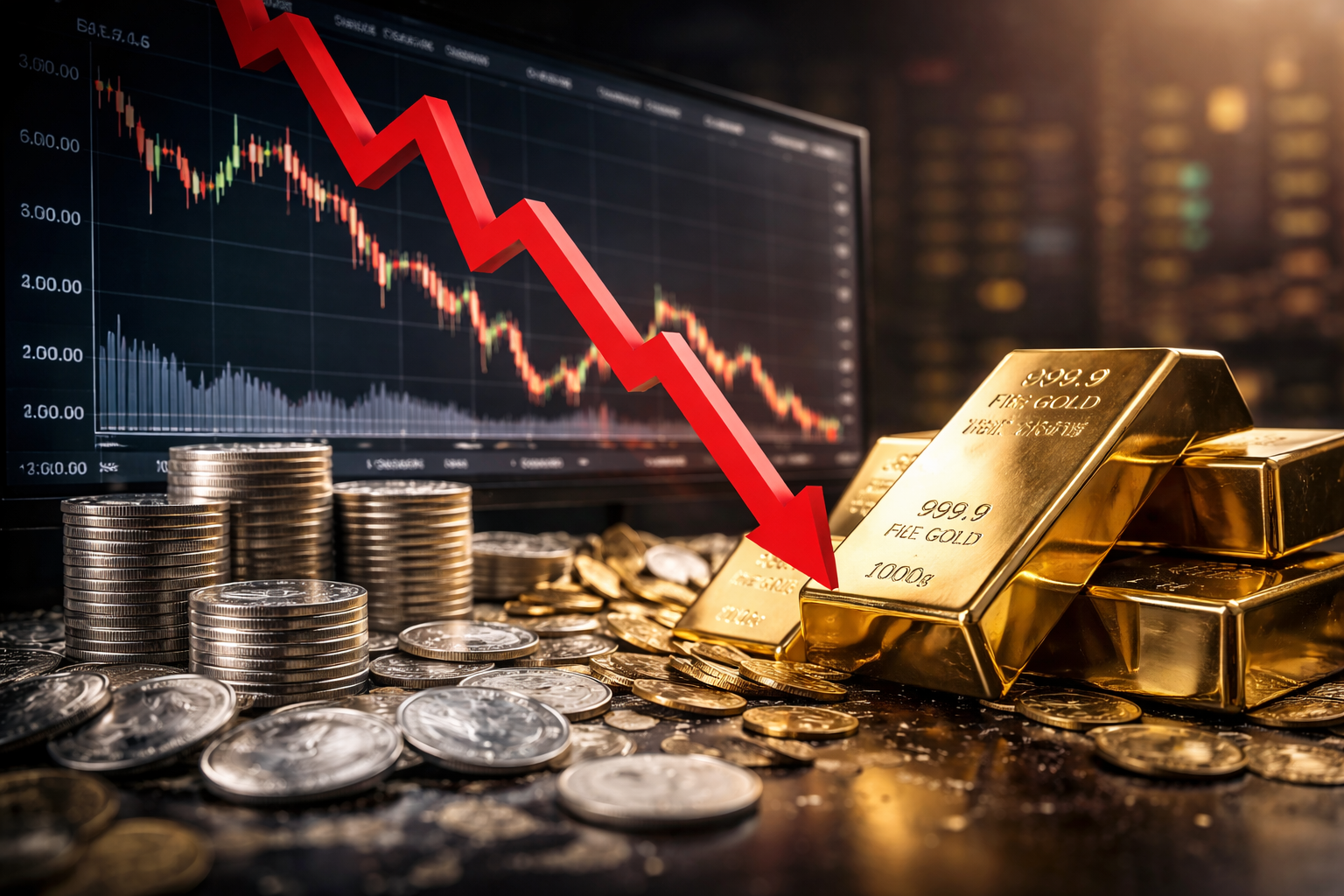
Gold and silver rarely move quietly—but their latest reversal has commanded global attention. After surging to record highs amid inflation fears and geopolitical uncertainty, precious metals prices pulled back sharply, erasing significant market value within minutes. The sudden drop has reignited debate among traders and analysts over speculative excess, market structure, and whether the rally had simply outrun fundamentals.
For investors, the episode serves as a reminder that even traditional “safe-haven” assets are not immune to violent corrections—especially in a market shaped by algorithmic trading, leveraged positioning, and shifting expectations around interest rates.
What Triggered the Sudden Pullback
According to reporting from Economic Times, gold and silver prices fell abruptly after reaching parabolic peaks, catching many short-term traders off guard. While no single headline triggered the sell-off, analysts point to a convergence of factors: profit-taking after a rapid run-up, stronger-than-expected U.S. dollar movements, and shifting expectations around global monetary policy.
When asset prices rise sharply in a short period, positioning can become crowded. In such environments, even modest changes in macro sentiment—such as firmer bond yields or a recalibration of inflation expectations—can trigger outsized moves. Automated trading strategies and stop-loss orders often amplify these declines, turning a pullback into a cascade.
The speed of the drop has also fueled online speculation around potential market manipulation, a recurring theme in precious metals markets. While regulators and exchanges closely monitor activity, analysts caution that sharp moves are often a function of liquidity dynamics rather than coordinated intervention.
Why This Matters for Investors
Precious metals occupy a unique role in portfolios. Gold, in particular, is widely viewed as a hedge against inflation, currency debasement, and systemic risk. Silver straddles two worlds—both a monetary metal and an industrial input—making it more volatile during periods of economic uncertainty.
The recent pullback underscores a key reality: metals can be long-term hedges but short-term trading vehicles. Investors who entered the market during the late stages of the rally may now be reassessing risk tolerance, while long-term holders are weighing whether the correction represents noise or a change in trend.
Bloomberg and other market analysts have repeatedly noted that gold’s long-term direction remains closely tied to real interest rates and central bank policy. When real yields rise, gold often faces headwinds; when they fall, demand tends to strengthen. The latest move suggests markets are rebalancing expectations rather than abandoning the inflation hedge narrative entirely.
Speculation vs. Fundamentals
A parabolic move often reflects more than fundamentals alone. Social media chatter, momentum-driven strategies, and retail participation can all contribute to rapid price appreciation—particularly in silver, which has a smaller and more volatile market than gold.
However, longer-term fundamentals remain intact. Central banks continue to be net buyers of gold, according to data from the World Gold Council, and geopolitical uncertainty remains elevated. At the same time, inflation risks have not disappeared, even as policymakers signal vigilance.
The key distinction for investors lies in time horizon. Short-term traders face elevated volatility and whipsaw risk, while strategic investors may view pullbacks as opportunities to rebalance exposure—provided allocations align with broader portfolio objectives.
Beyond Bullion: Industrial Metals Enter the Spotlight
One notable shift in investor conversation is the growing interest in industrial metals alongside traditional precious metals. Copper, nickel, lithium, and aluminum are increasingly seen as structural beneficiaries of electrification, renewable energy expansion, and AI-driven data-center buildouts.
McKinsey and other industry research firms have highlighted that data centers and electrification infrastructure are becoming significant drivers of metal demand. AI workloads require massive power capacity, advanced cooling systems, and extensive electrical infrastructure—each dependent on industrial metals.
For investors, this opens the door to diversification within the metals and mining space. Rather than relying solely on gold or silver as macro hedges, portfolios can balance exposure with metals tied to long-term technological and energy trends.
Key Investment Insight
Precious metals remain closely linked to inflation expectations, currency movements, and macro risk—but volatility is likely to persist. Investors may consider diversifying bullion exposure with industrial metals that benefit from electrification and AI infrastructure growth, helping balance defensive positioning with structural demand trends.
The sharp retracement in gold and silver is a timely reminder that even time-tested assets demand disciplined risk management. As markets reassess inflation, interest rates, and global growth, metals will remain at the center of the macro conversation. Stay with MoneyNews.Today for daily, investor-focused insights on commodities, markets, and the forces shaping global capital flows.