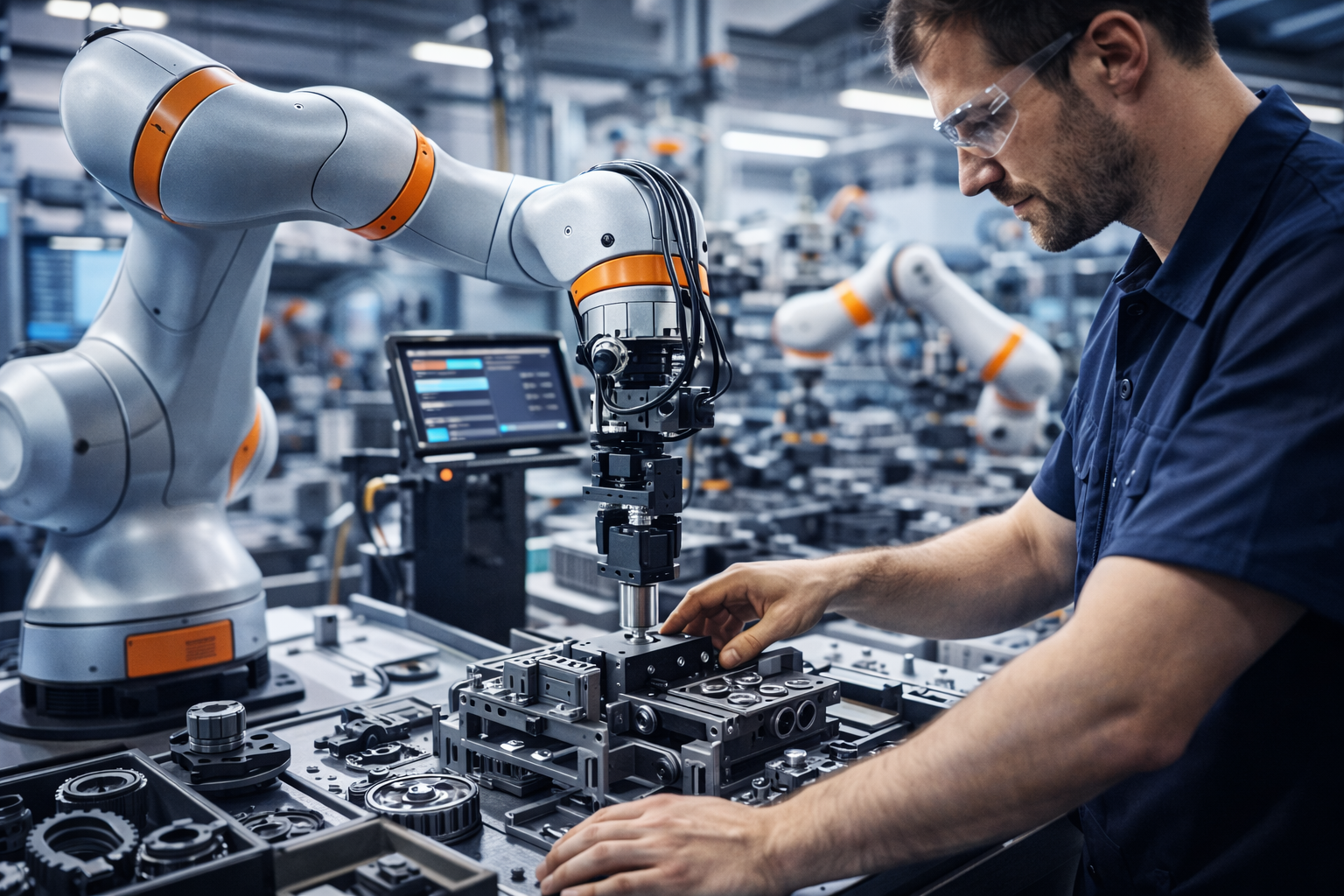
The automation revolution is entering a new phase—and it’s no longer limited to global manufacturing giants. Small and medium-sized enterprises (SMEs), once constrained by the high cost and complexity of industrial robotics, are increasingly adopting collaborative robots, or “cobots,” to boost productivity and compete in a rapidly evolving global economy.
According to industry reports highlighted by Yahoo Finance, the collaborative robotics market is projected to grow at a compound annual growth rate (CAGR) of roughly 21% through 2033, as advances in artificial intelligence, software automation, and robotics hardware make these systems more accessible than ever before.
For investors, this shift represents a potentially transformative opportunity. As automation spreads beyond large corporations to smaller manufacturers, logistics providers, and service companies, a new wave of demand is emerging for robotics technology, AI-driven manufacturing systems, and industrial automation platforms.
Companies positioned at the intersection of robotics, artificial intelligence, and digital manufacturing could become some of the most significant beneficiaries of this next phase of industrial transformation.
The Rise of Collaborative Robotics
Traditional industrial robots have long been used in large manufacturing facilities, particularly in industries such as automotive production and electronics assembly. However, these systems were often expensive, complex to install, and designed to operate in isolated environments separate from human workers.
Collaborative robots—commonly known as cobots—are changing that model.
Unlike traditional robots, cobots are designed to work safely alongside human employees, performing repetitive tasks while allowing workers to focus on higher-value activities such as quality control, design, and problem solving.
These systems are typically smaller, easier to program, and far more flexible than traditional industrial robots. Many modern cobots can be deployed with minimal programming knowledge thanks to user-friendly interfaces and low-code software platforms.
As a result, automation is becoming accessible to a much wider range of businesses.
Companies such as Universal Robots, ABB, and Fanuc are among the leading developers of collaborative robotics systems used across manufacturing and logistics environments.
Meanwhile, technology firms including Rockwell Automation and Siemens are building the digital platforms that connect robotics systems with factory automation and industrial data analytics.
Together, these companies form the backbone of a rapidly expanding automation ecosystem.
SMEs Are Driving the Next Wave of Automation
One of the most important trends shaping the robotics industry is the increasing adoption of automation by small and medium-sized enterprises.
Historically, large corporations dominated the use of industrial robotics due to the high upfront costs involved. But technological advances have significantly reduced the barriers to entry.
Today’s collaborative robots are often:
- Less expensive to purchase and maintain
- Simpler to install and program
- Flexible enough for multiple applications
These improvements are allowing SMEs to integrate robotics into their operations for the first time.
Manufacturers can deploy cobots to assist with tasks such as assembly, packaging, and machine tending. Logistics companies are using them to streamline warehouse operations, while service businesses are exploring automation for food preparation, medical diagnostics, and retail support.
According to research cited by McKinsey & Company, automation technologies could impact up to 30% of global working hours by 2030, fundamentally reshaping how work is performed across industries.
For smaller businesses facing rising labor costs and increasing competition, automation is becoming less of a luxury and more of a necessity.
Why This Matters for Investors
The expansion of robotics adoption among SMEs represents a significant growth opportunity for the global automation industry.
While large corporations have already integrated robotics into many of their production lines, the SME market remains relatively underpenetrated.
That means the potential addressable market for collaborative robots is enormous.
Industry analysts estimate that tens of millions of smaller businesses worldwide could eventually adopt some form of automation technology.
This growing demand is likely to benefit several segments of the technology and industrial sectors:
Robotics Manufacturers
Companies that design and produce collaborative robots stand to benefit directly from increased adoption. As prices decline and functionality improves, these systems are becoming viable for businesses across multiple industries.
Industrial Automation Platforms
Software platforms that manage robotics systems, factory automation, and industrial data analytics are becoming increasingly valuable as businesses digitize their operations.
AI-Driven Manufacturing Technologies
Artificial intelligence is playing a growing role in robotics, enabling machines to adapt to changing environments and improve efficiency through machine learning.
Supply Chain Automation
The rapid growth of e-commerce and global logistics networks is increasing demand for automation technologies capable of managing warehouses, distribution centers, and shipping operations.
As automation spreads, these sectors could experience sustained growth for years to come.
Labor Shortages Are Accelerating Automation
Another key factor driving robotics adoption is the global shortage of skilled labor in many industries.
Manufacturers, logistics companies, and service providers across North America and Europe are facing difficulties hiring workers for repetitive or physically demanding roles.
Automation offers a potential solution.
By deploying collaborative robots, businesses can maintain production levels while reducing reliance on hard-to-fill positions.
Rather than replacing workers entirely, many companies are using cobots to augment human labor, allowing employees to focus on tasks requiring creativity, decision-making, and customer interaction.
This hybrid model—where humans and robots work together—could define the future of work in many industries.
Future Trends to Watch
The collaborative robotics market is still in its early stages, and several emerging trends could shape its future growth.
1. AI-Powered Robotics
Advances in artificial intelligence are enabling robots to recognize objects, adapt to new tasks, and learn from experience, making automation even more versatile.
2. Robotics-as-a-Service (RaaS)
Some companies are offering robotics systems through subscription models rather than upfront purchases, making automation more accessible for smaller businesses.
3. Integration with Smart Factories
Collaborative robots are increasingly being integrated into “smart factories,” where sensors, software platforms, and AI systems work together to optimize production.
4. Expansion Beyond Manufacturing
While manufacturing remains the largest market for robotics, industries such as healthcare, agriculture, retail, and hospitality are beginning to adopt automation technologies as well.
Each of these trends could drive additional demand for robotics and automation solutions.
Key Investment Insight
The rapid growth of collaborative robotics highlights an important shift in the automation landscape: automation is no longer limited to the world’s largest companies.
As technology becomes more affordable and easier to deploy, SMEs are emerging as the next major driver of demand.
For investors, this creates opportunities across several sectors, including:
- Robotics manufacturers
- Industrial automation companies
- AI-driven manufacturing platforms
- Supply chain automation providers
Companies positioned at the intersection of robotics, artificial intelligence, and digital manufacturing could benefit from a multi-year expansion in automation adoption.
While the automation revolution began in large factories, its next phase may be powered by millions of smaller businesses embracing robotics to remain competitive in an increasingly digital economy.
Automation is reshaping industries around the world, and the companies building the technologies behind that transformation are becoming central players in the global economy.
Stay informed with MoneyNews.Today for daily insights into the market trends, emerging technologies, and investment opportunities shaping the future of global finance.