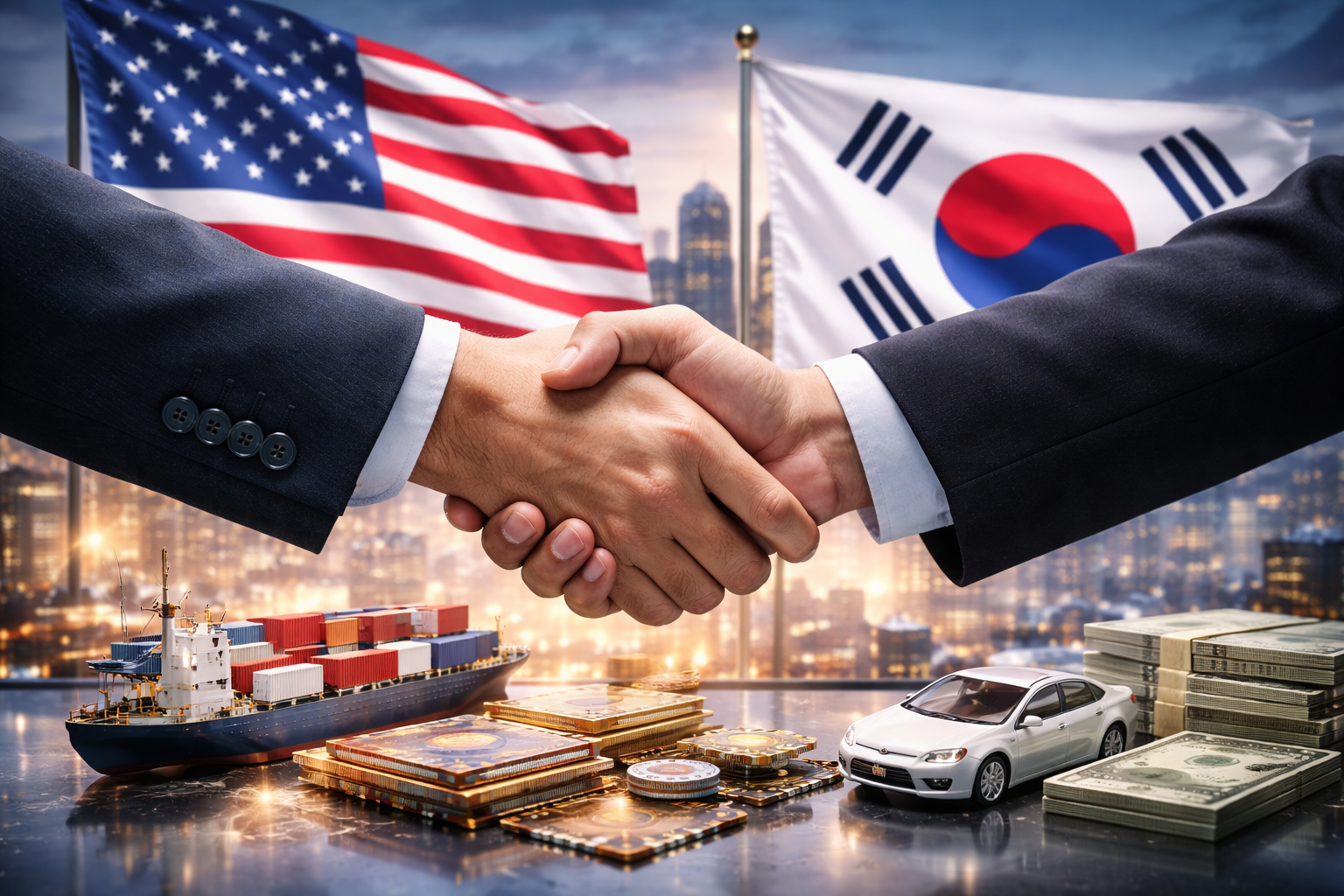
Global markets were jolted this week when renewed tariff rhetoric out of Washington reignited fears of another trade confrontation — but the fallout was short-lived. South Korea moved quickly to reaffirm its investment commitments to the United States, easing investor anxiety and helping stabilize Asian equities rattled by policy uncertainty.
The episode highlights a familiar but increasingly critical reality for investors: trade diplomacy remains one of the fastest-moving forces shaping earnings visibility, supply chains, and risk premiums across global markets.
Trade Tensions Resurface — Briefly
According to Reuters (Jan 27, 2026), President Donald Trump escalated trade pressure by warning of tariffs tied to delayed trade and investment commitments, reviving concerns that protectionist measures could return as a core policy tool. Markets initially reacted with caution, particularly across export-heavy Asian economies with deep exposure to U.S. demand.
South Korea, one of America’s largest trading partners and a key node in global semiconductor, automotive, and battery supply chains, responded swiftly. Government officials reiterated Seoul’s commitment to existing and planned U.S. investments, emphasizing long-term economic cooperation and strategic alignment between the two allies.
The reassurance helped calm markets, with South Korean equities paring early losses and broader Asian benchmarks stabilizing after a volatile start to the week.
Why This Matters for Investors
Trade disputes are no longer just headline risks — they are earnings variables. Even the threat of tariffs can disrupt corporate guidance, alter capital expenditure plans, and trigger sharp valuation adjustments, particularly in sectors dependent on cross-border trade.
South Korea’s rapid diplomatic response underscores how sensitive multinational earnings have become to policy signals. Export-driven industries such as semiconductors, consumer electronics, autos, and industrial machinery are especially vulnerable to sudden changes in trade posture.
Analysts cited by Reuters noted that while no immediate tariffs were imposed, the rhetoric alone was enough to widen risk premiums temporarily. That reaction reflects lessons learned from past trade conflicts, where early signals often preceded meaningful policy shifts.
Investment Commitments as a Stabilizing Tool
South Korea’s strategy highlights a broader trend: investment pledges are increasingly being used as diplomatic currency. By reaffirming capital flows into U.S. manufacturing, technology, and energy projects, Seoul aimed to demonstrate alignment with U.S. economic priorities while protecting its own exporters from potential retaliation.
This approach mirrors similar tactics used by other U.S. trading partners in recent years, particularly in strategic industries such as semiconductors, electric vehicles, and clean energy. For investors, this signals that government-backed investment frameworks may provide a buffer against sudden policy shocks — but not immunity.
Market Implications Across Sectors
The immediate market reaction was telling. South Korean exporters with heavy U.S. exposure initially sold off before stabilizing, while defensive sectors outperformed during the brief spike in uncertainty. Currency markets also reflected a risk-off bias, with safe-haven assets gaining modestly before retracing.
For global investors, the episode reinforces the importance of monitoring geopolitical risk alongside traditional fundamentals. Companies with diversified manufacturing footprints and flexible supply chains are better positioned to absorb policy volatility, while those concentrated in single export markets remain more exposed.
Technology and semiconductor stocks are particularly sensitive. South Korea plays a central role in global chip supply, and any disruption — even theoretical — can ripple through pricing, inventories, and downstream industries worldwide.
Future Trends to Watch
Looking ahead, investors should expect trade rhetoric to remain a recurring theme, particularly as governments balance domestic political pressures with economic pragmatism. While full-scale trade wars are costly and disruptive, targeted tariffs and negotiation-driven threats are likely to persist as leverage tools.
Key indicators to watch include:
- Official statements tied to trade compliance and investment timelines
- Corporate disclosures on supply chain diversification
- Policy signals around strategic industries such as chips, EVs, and energy
- Market reactions to diplomatic engagements and bilateral agreements
As seen this week, swift diplomatic engagement can stabilize markets — but hesitation or escalation could just as quickly reverse sentiment.
Key Investment Insight
Trade diplomacy remains a powerful market driver, capable of reshaping risk premiums almost overnight. Investors should factor geopolitical responsiveness into portfolio construction, favoring companies with diversified revenue streams, strong political risk management, and exposure to government-backed investment initiatives. Short-term volatility tied to trade headlines can also create selective entry opportunities in high-quality export-dependent names.
Stay ahead of policy-driven market shifts and global investment risks by following MoneyNews.Today, your trusted source for daily investor insights across politics, markets, and the global economy.