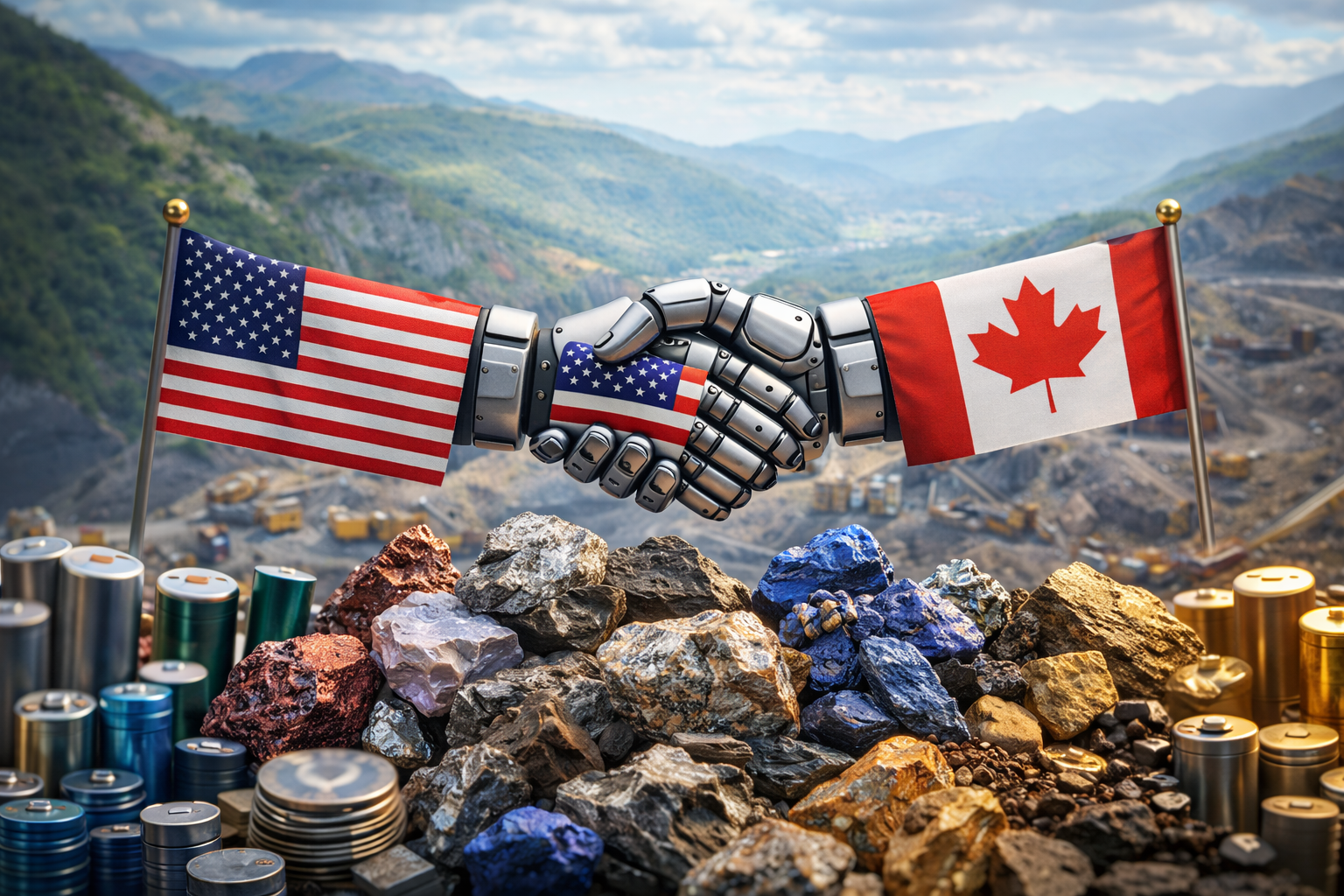
North American economic strategy is undergoing a seismic shift — and it’s being driven by minerals most investors have only recently begun to appreciate. Amid rising geopolitical tensions and supply chain disruptions, the United States and Canada are accelerating cooperation on critical minerals, the foundational elements powering clean energy, advanced manufacturing, defense technology and next‑generation electronics. This renewed partnership is emerging as one of the most consequential trends in the global resource economy, with broad implications for investors across sectors.
At a high‑level delegation event this week, leaders from both nations underscored their commitment to deepening economic ties and strengthening supply chain resilience for critical minerals and advanced materials. Strategic collaboration is no longer a policy ideal — it is actively shaping investment flows, industrial partnerships, and corporate strategies that could define competitiveness in the decades ahead.
Why This Matters Now
Critical minerals — elements like lithium, cobalt, nickel, rare earths, graphite and others — are essential inputs for technologies that underpin today’s most transformative industries, from electric vehicles and grid‑scale batteries to semiconductor manufacturing and aerospace systems. Unlike traditional commodities, their economic value is tied directly to industrial innovation and national security priorities.
China’s historical dominance in processing and refining many of these materials has left Western nations exposed to supply chain risks, prompting a strategic pivot toward domestic and allied production. A recent Financial Times report highlights the intensifying global competition for access to these “coveted elements,” reflecting both economic opportunity and geopolitical urgency.
For investors, this shift translates into new catalysts for growth in emerging sectors. Companies active in exploration, extraction, processing, and downstream manufacturing of critical minerals are at the forefront of a structural investment theme that intersects with electrification, decarbonization, defense modernization, and advanced manufacturing.
The U.S.–Canada Strategic Partnership
The latest delegation event brought together business and government leaders from the United States and Canada to reaffirm a shared commitment to building resilient supply chains for critical minerals and advanced materials. This initiative emphasizes economic collaboration, cross‑border investment, and integrated industrial planning — transcending traditional trade frameworks.
Officials outlined priorities that include:
- Coordinated investment policies that attract private capital into North American mineral projects
- Streamlined permitting and regulatory alignment to expedite mining and processing operations
- Joint research and development programs focused on next‑generation extraction and materials science
- Infrastructure partnerships to support robust logistics and value‑added manufacturing capacity in both nations
These strategic objectives are not merely aspirational. They reflect a broader industrial policy environment in which governments are increasingly partnering to secure supply chains for technologies that matter most for economic stability and defense readiness.
Competitive Dynamics: A Global Context
The backdrop for this partnership is global realignment in how critical minerals are sourced and processed.
China still controls a disproportionate share of refining capacity for many essential materials — a reality that has driven policy responses in the United States, Canada, the European Union, and allied nations. Efforts like the G7 Critical Minerals Action Plan and coordinated R&D initiatives point to a collective push toward diversifying supply chains, scaling domestic processing, and reducing strategic dependencies.
For investors, this dynamic underscores several important trends:
- Resource nationalism and strategic industrial policy are reshaping where and how capital flows into mining and processing sectors.
- Public‑private partnerships are increasingly underwriting high‑cost, high‑risk projects that may have struggled to attract financing under purely market conditions.
- Downstream manufacturing capacity — not just raw extraction — is emerging as a differentiator for long‑term competitiveness.
In this strategic contest, North America’s combined resource base and technological ecosystem place it in a unique position to challenge established players and capture a larger share of the critical minerals value chain.
Actionable Insights for Investors
1. Target Integrated Value Chains
Investors should look beyond pure exploration plays and consider companies involved in processing, refining, and downstream manufacturing of critical minerals. The shift toward value‑added supply chains — such as battery materials conversion and rare earth separation — is expected to attract sustained policy support and capital.
2. Monitor Policy Signals
Legislative developments and funding announcements in both the U.S. and Canada can serve as early indicators of where capital deployment and incentives may concentrate. For example, provincial initiatives like Ontario’s C$500 million Critical Minerals Processing Fund illustrate how local jurisdictions are positioning themselves as hubs of industry growth.
3. Assess Geopolitical Risk Premiums
With supply chain security taking on national‑security importance, investors should consider how geopolitical risk premiums might influence valuations in sectors ranging from EV battery materials to rare earth elements vital for defense technologies.
4. Evaluate Strategic Partnerships
Partnerships between North American firms and international technology partners — particularly in EV and battery alliances — are indicators of how industries are organizing around shared economic interests. Recent agreements, such as expanded Canadian cooperation with Germany on EV and battery supply chains, suggest that cross‑border integration is deepening beyond raw material extraction.
Future Trends to Watch
As this strategic collaboration evolves, several key developments merit close attention:
- Scaling processing infrastructure: Governments and corporations alike are investing in facilities that convert raw minerals into battery‑grade and semiconductor‑ready materials.
- Tech‑mining convergence: Industry participants are increasingly integrating advanced technologies like AI and automation into mining operations, improving efficiency and reducing costs.
- Energy transition priorities: Demand for clean energy infrastructure — from wind turbines to grid storage — will continue to drive demand for critical materials.
- Defense supply chain policies: National security considerations will influence defense procurement and domestic sourcing requirements, potentially boosting demand for strategic minerals.
Investment Insight
North America’s strengthening economic ties in critical minerals represent more than just a policy narrative — they are a powerful investment theme with long‑term structural implications. By creating coordinated industrial strategies, aligning regulatory frameworks, and promoting cross‑border capital flows, the U.S. and Canada are shaping a resource ecosystem that supports emerging industries central to the energy transition and technological leadership.
For investors, this context offers a multi‑layered opportunity: from early‑stage exploration companies to advanced processing firms and technology integrators that depend on reliable mineral inputs.
Stay attuned to evolving policies, corporate partnerships, and supply chain developments, and you’ll be well positioned to navigate and benefit from this pivotal shift in global economic strategy.